




15 Results for "

ripening

" in MedChemExpress (MCE) Product Catalog:
Products (15)

15 Results for "ripening" in MCE Product Catalog:

Cat. No.: HY-126386
CAS No.: 9032-75-1
Synonyms: EC 3.2.1.15
Research Areas:  

Others

Pectinase (EC 3.2.1.15) is a mixed enzymes that hydrolyze pectic substances, it mostly presents in microorganisms and higher plants. Pectinase is involved in the metabolism of the cell wall as well as in the growth of the cell, senescence, ripening of fruits, pathogenesis and abscission process .
loading...
    loading...
Cat. No.: HY-P3028
CAS No.: 9001-33-6
Synonyms: Ficin
Research Areas:  

Others Metabolic Disease

Ficain is an enzyme extract composed of several proteases that can be isolated from Ficus hispida L. and the latex of fig (Ficus carica). Ficain has different specificities in different proportions during fruit ripening. Ficain is widely used in protein hydrolysis, food, production of bioactive peptides and antibody fragments .
loading...
    loading...
Cat. No.: HY-137940
CAS No.: 554-91-6
Purity:  ≥98.0%
Synonyms: Gentiobiose
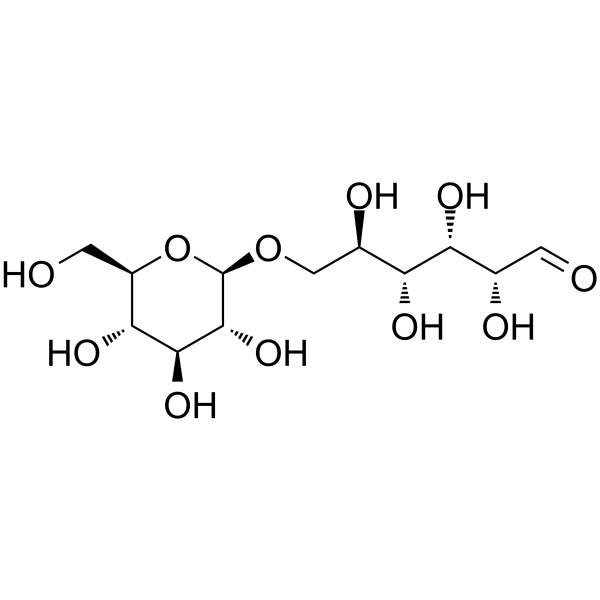
β-Gentiobiose (Gentiobiose) is a natural oligosaccharide. β-Gentiobiose can promote ripening of tomato fruit .
loading...
    loading...
Cat. No.: HY-126386B
CAS No.: 9032-75-1
Synonyms: Macerozyme R-10
Research Areas:  

Others

Pectinase, rhizobia is a mixed enzymes that hydrolyze pectic substances, it mostly presents in microorganisms and higher plants. Pectinase is involved in the metabolism of the cell wall as well as in the growth of the cell, senescence, ripening of fruits, pathogenesis and abscission process .
loading...
    loading...
Cat. No.: HY-N10374
CAS No.: 527-06-0
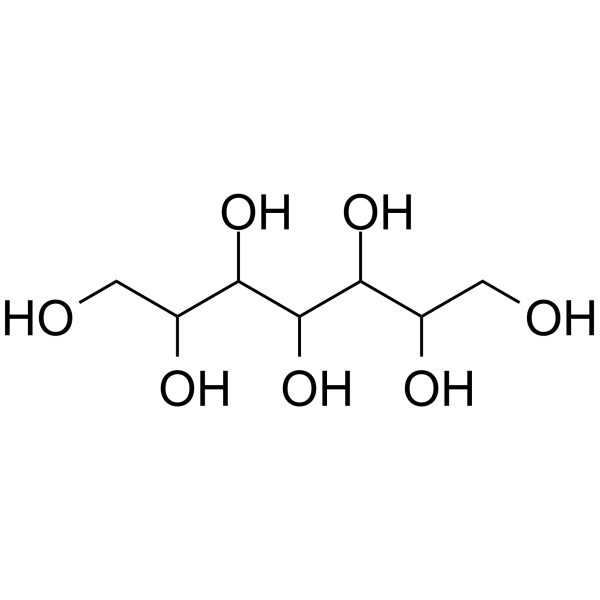
Perseitol is a seven-carbon sugar produced by mature avocado plants. Perseitol can be converted into D-mannoheptulose, serving as an energy-providing compound and a transport carbohydrate. Perseitol may act as a ripening inhibitor during fruit maturation. Perseitol can serve as a urinary biomarker for avocado intake and transaldolase deficiency. Perseitol can be used in studies related to transaldolase deficiency .
loading...
    loading...
Cat. No.: HY-W007140
CAS No.: 40222-77-3
2-Hydroxymethyl-5-hydroxypyridine is isolated from the the matured, ripened and dried seeds of S. lychnophora.
loading...
    loading...
Cat. No.: HY-W088425
CAS No.: 13532-18-8
Methyl 3-(methylthio)propanoate is a volatile compound that can be isolated from green and ripened pineapple .
loading...
    loading...
Cat. No.: HY-N10374R
CAS No.: 527-06-0
Perseitol (Standard) is the analytical standard of Perseitol (HY-N10374). This product is intended for research and analytical applications. Perseitol is a seven-carbon sugar produced by mature avocado plants. Perseitol can be converted into D-mannoheptulose, serving as an energy-providing compound and a transport carbohydrate. Perseitol may act as a ripening inhibitor during fruit maturation. Perseitol can serve as a urinary biomarker for avocado intake and transaldolase deficiency. Perseitol can be used in studies related to transaldolase deficiency .
loading...
    loading...
Cat. No.: HY-N7402
CAS No.: 6378-65-0
Category:  

Natural Products Animals

Target:  

Others

Hexyl hexanoate is a fruit aroma component with potential food and beverage additive activity. Hexyl hexanoate is found in alcoholic beverages and is used to blend fruit flavors. Hexyl hexanoate is present in many fruits, Parmesan cheese, alcoholic beverages, and black tea. Hexyl hexanoate is a volatile component produced as a result of fruit ripening. Toxicity assessments of hexyl hexanoate showed that it is not mutagenic and that exposure is below safety thresholds for repeated dose, reproduction, and local respiratory toxicity. Hexyl hexanoate is also below thresholds in skin sensitization assessments, and for phototoxicity and photosensitization, the results showed that it does not present a relevant risk. Hexyl hexanoate is considered non-persistent, non-bioaccumulative, and non-toxic according to the environmental criteria of the International Fragrance Association .
loading...
    loading...
Cat. No.: HY-155771
CAS No.: 2964462-17-5
Research Areas:  

Others

1-DCP is a potent ethylene antagonist. 1-DCP can inhibit the role of ethylene in fruit ripening and senescence .
loading...
    loading...
Cat. No.: HY-174290
CAS No.: 1226899-66-6
Target:  

Endogenous Metabolite

Research Areas:  

Others

Lactoyl-L-tyrosine is an endogenous N-lactoyl-amino acid formed from L-lactic acid and L-tyrosine. Lactoyl-L-tyrosine can be used to study flavor development during cheese ripening or as a natural flavor enhancer in the food industry .
loading...
    loading...
Cat. No.: HY-P3872
CAS No.: 87713-86-8
Target:  

Peptides

Research Areas:  

Inflammation/Immunology

Peptide B, bovine is an immunoregulatory peptide in bovine milk. Peptide B, bovine comes from αs1-casein B-8P (f1-13), is the major peptide produced during the ripening process with antihypertensive effects .
loading...
    loading...
Cat. No.: HY-E70911
Research Areas:  

Others

Chlorophyllase (EC 3.1.1.14) is part of the chlorophyll degradation pathway and is believed to be involved in various plant chlorosis processes, such as fruit ripening, leaf senescence, and flowering, as well as chlorophyll turnover and homeostasis. Chlorophyllase (EC 3.1.1.14) preferentially acts on chlorophyll a, but can also use chlorophyll b and pheophytin as substrates.
loading...
    loading...
Cat. No.: HY-W007140R
CAS No.: 40222-77-3
2-Hydroxymethyl-5-hydroxypyridine (Standard) is the analytical standard of 2-Hydroxymethyl-5-hydroxypyridine (HY-W007140). This product is intended for research and analytical applications. 2-Hydroxymethyl-5-hydroxypyridine is isolated from the the matured, ripened and dried seeds of S. lychnophora.
loading...
    loading...
Cat. No.: HY-N18264
CAS No.: 184424-55-3
3-O-trans-Feruloyl euscaphic acid is a triterpene ester. 3-O-trans-Feruloyl euscaphic acid can be isolated from Eriobotrya japonica and Docynia delavayi (Franch) .
loading...
    loading...
  • 1

