
1. Search Result
Search Result
Results for "

scaffolding

" in MedChemExpress (MCE) Product Catalog:

16

Inhibitors & Agonists

5

Biochemical Assay Reagents

2

Peptides

1

Recombinant Proteins

2

Antibodies

Cat. No. Product Name Target Research Areas Chemical Structure
  • HY-123972
    SEC inhibitor KL-2
    1 Publications Verification

    KL-2

    DNA/RNA Synthesis Cancer
    SEC inhibitor KL-2 (KL-2), a peptidomimetic lead compound, is a potent, selective super elongation complex (SEC) inhibitor and disrupts the interaction between the SEC scaffolding protein AFF4 and P-TEFb, resulting in impaired release of Pol II from promoter-proximal pause sites and a reduced average rate of processive transcription elongation. SEC inhibitor KL-2 exhibits an dose-dependent inhibitory effect on AFF4-CCNT1 interaction with a Ki of 1.50 μM .
    SEC inhibitor KL-2
  • HY-130644
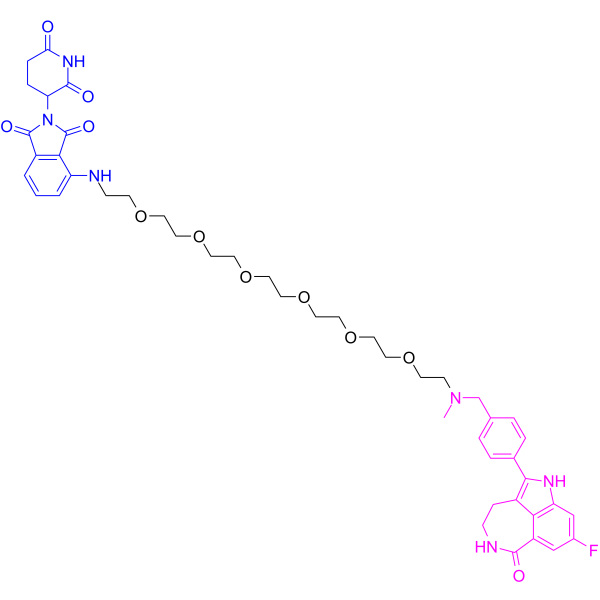
    iRucaparib-AP6
    2 Publications Verification

    PROTACs PARP Cancer
    iRucaparib-AP6 is a highly efficient and specific PROTAC PARP1 degrader. iRucaparib-AP6, a non-trapping PARP1 degrader, blocks both the catalytic activity and scaffolding effects of PARP1 .
    iRucaparib-AP6
  • HY-P2975

    Mouse laminin (Engelbreth-Holm-Swarm murine sarcoma basement membrane)

    Endogenous Metabolite Biochemical Assay Reagents Neurological Disease
    Laminin (Engelbreth-Holm-Swarm murine sarcoma basement membrane) is a crucial structural element in animal tissues, forming part of the scaffolding that supports tissue architecture. It interacts with type IV collagen through entactin and perlecan, connects to cell membranes via integrin receptors, dystroglycan complexes, and Lutheran blood group glycoproteins, and contains functional domains that facilitate collagen binding, cell adhesion, heparin interaction, and promote neurite outgrowth.
    Laminin (Engelbreth-Holm-Swarm murine sarcoma basement membrane)
  • HY-153598

    PROTACs RIP kinase Apoptosis Inflammation/Immunology Cancer
    LD4172 is a selective RIPK1 PROTAC degrader with a Ki of 4.8 nM. LD4172 induces RIPK1 protein degradation via ternary complex formation with RIPK1 and VHL E3 ligase, driving ubiquitination and proteasomal breakdown. LD4172 abrogates TNF-induced classical NF-κB signaling in TRAF2-deficient cells, impairing IκBα phosphorylation and degradation, and reducing IL-8 production. LD4172 induces apoptosis and immunogenic cell death in tumor cells, enhances tumor-infiltrating lymphocyte responses, and sensitizes tumors to anti-PD1 therapy. LD4172 acts as a chemical probe for investigating RIPK1 scaffolding functions. LD4172 can be used for the research of melanoma, colon cancer .
    LD4172
  • HY-P5904

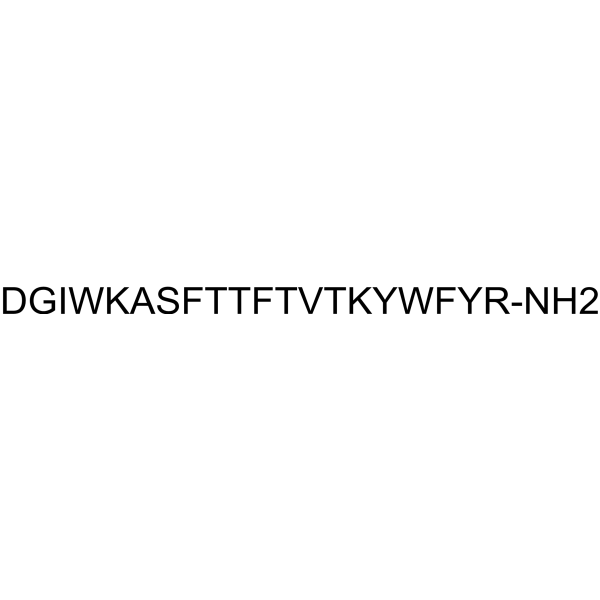
    Caveolin-1 scaffolding domain peptide

    c-Met/HGFR Others
    Caveolin-1 (82-101) amide (human, mouse, rat) (Caveolin-1 scaffolding domain peptide) is a peptide that reverses aging-associated deleterious changes in multiple organs. Caveolin-1 (82-101) amide (human, mouse, rat) inhibits tyrosine kinases .
    Caveolin-1 (82-101) amide (human, mouse, rat)
  • HY-120337

    Choline Kinase Apoptosis Cancer
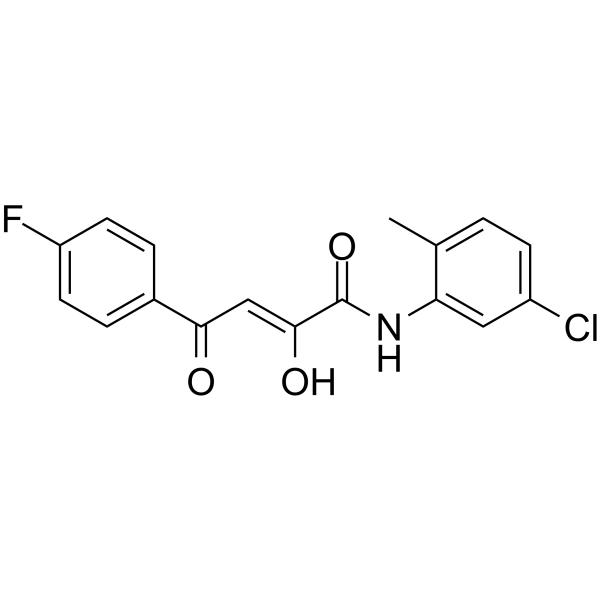
    V-11-0711 is a potent and selective Chk-α (IC50 = 20 nM) inhibitor. V-11-0711 can significantly reduce PCho levels. V-11-0711 causes a reversible growth arrest. V-11-0711 induces apoptosis at high concentrations. V-11-0711 can be used for the study of cervical cancer and triple-negative breast cancer .
    V-11-0711
  • HY-156675A
    Plecstatin-1 hydrochloride
    1 Publications Verification

    Microtubule/Tubulin Cancer
    Plecstatin-1 hydrochloride is an anticancer agent containing organoeuropium. Plecstatin-1 hydrochloride selectively targets plectin, a scaffolding protein and cellular connector, in tumor spheroids .
    Plecstatin-1 hydrochloride
  • HY-135382

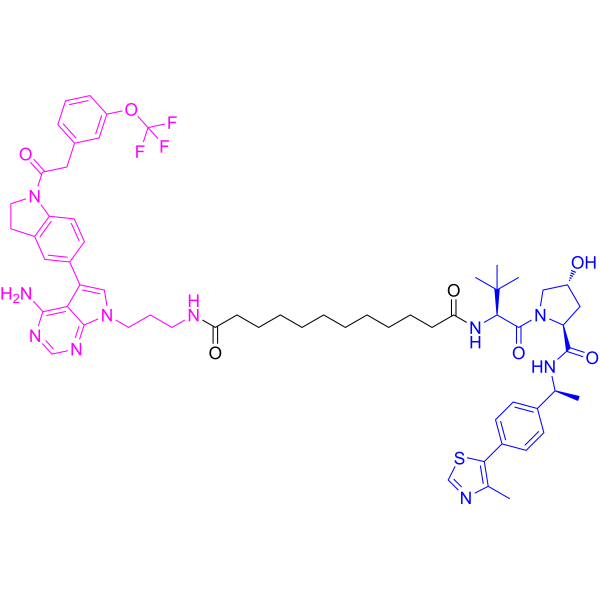
    PROTACs IRAK Inflammation/Immunology Cancer
    PROTAC IRAK4 degrader-2 (Compound 9) is a PROTAC-based IRAK4 degrader that affords potent IRAK4 degradation with a DC50 in peripheral blood mononuclear cells (PBMCs) cells of 151 nM. PROTAC IRAK4 degrader-2 induce a reduction of IRAK4 protein levels with a DC50 of 36 nM in PBMC cells. PROTAC IRAK4 degrader-2 also leads to the inhibition of multiple cytokines in PBMCs .
    PROTAC IRAK4 degrader-2
  • HY-157193

    CD1 Inflammation/Immunology
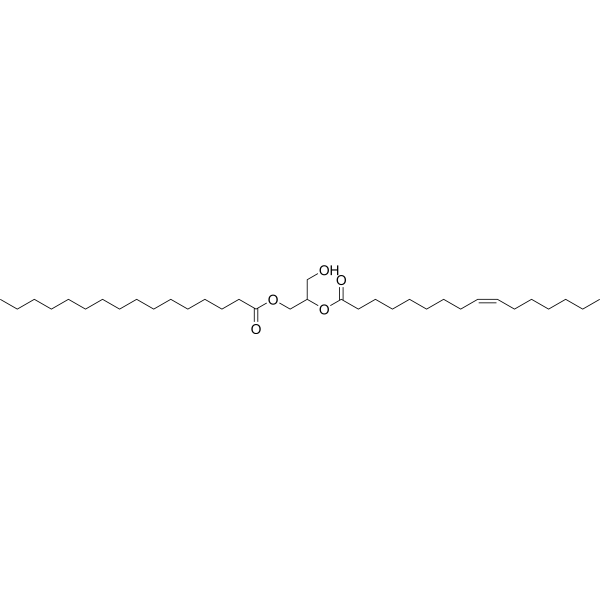
    Diacylglyceride, a natural scaffolding lipid, is a hapten that binds to CD1b. Diacylglyceride can be combined with carrier proteins and used in the design of antigens .
    Diacylglyceride
  • HY-170481

    Biochemical Assay Reagents Others
    Silk fibroin, suitable for cell culture is a commonly available natural biopolymer suitable for cell culture. Silk fibroin can be used as a scaffolding materials in the context of biocompatibility, biodegradability and tissue specific requirements .
    Silk fibroin, suitable for cell culture
  • HY-139095

    Phosphodiesterase (PDE) Inflammation/Immunology
    Cipamfylline is a PDE4 inhibitor that can cause PDE4A4 to accumulate in specific areas of the cell through interaction with the ubiquitin scaffolding protein p62. Cipamfylline can be used in the research of atopic dermatitis .
    Cipamfylline
  • HY-141543

    β-catenin Cancer
    YW2065 is an Axin-1 stabilizer. Axin-1 is a scaffolding protein that regulates proteasome degradation of β-catenin. YW2065 exhibits anti-colorectal cancer effects via dual activities of wnt/β-catenin signaling inhibition and AMPK activation .
    YW2065
  • HY-158219A

    GelMA, 60% methacrylation, blue fluorescent

    Biochemical Assay Reagents Others
    Gelatin Methacryloyl (GelMA), 60% methacrylation, blue fluorescent is methacrylated gelatin (GelMA) with blue fluorescence, which is obtained by "grafting" fluorescent molecules on GelMA. Gelatin Methacryloyl, 60% methacrylation, blue fluorescent has a scaffolding effect and can be used to design tissue analogs from vasculature to cartilage and bone, allowing cell proliferation and spreading. Gelatin Methacryloyl, 30% methacrylation, blue fluorescent needs to be self-assembled into fibrous hydrogels under the action of the photoinitiator LAP (HY-44076), and target bioactive adhesion sites, exert inherent support for tissue cells and biodegradation activity.
    Application direction: cell culture, biological 3D printing, tissue engineering, etc.
    Gelatin Methacryloyl, 60% methacrylation, blue fluorescent
  • HY-158219

    GelMA, 30% methacrylation, blue fluorescent

    Biochemical Assay Reagents Others
    Gelatin Methacryloyl (GelMA), 30% methacrylation, blue fluorescent is methacrylated gelatin (GelMA) with blue fluorescence, which is obtained by "grafting" fluorescent molecules on GelMA. Gelatin Methacryloyl, 30% methacrylation, blue fluorescent has a scaffolding effect and can be used to design tissue analogs from vasculature to cartilage and bone, allowing cell proliferation and spreading. Gelatin Methacryloyl, 30% methacrylation, blue fluorescent needs to be self-assembled into fibrous hydrogels under the action of the photoinitiator LAP (HY-44076), and target bioactive adhesion sites, exert inherent support for tissue cells and biodegradation activity.
    Application direction: cell culture, biological 3D printing, tissue engineering, etc.
    Gelatin Methacryloyl, 30% methacrylation, blue fluorescent
  • HY-158219B

    GelMA, 90% methacrylation, blue fluorescent

    Biochemical Assay Reagents Others
    Gelatin Methacryloyl (GelMA), 90% methacrylation, blue fluorescent is methacrylated gelatin (GelMA) with blue fluorescence, which is obtained by "grafting" fluorescent molecules on GelMA. Gelatin Methacryloyl, 90% methacrylation, blue fluorescent has a scaffolding effect and can be used to design tissue analogs from vasculature to cartilage and bone, allowing cell proliferation and spreading. Gelatin Methacryloyl, 30% methacrylation, blue fluorescent needs to be self-assembled into fibrous hydrogels under the action of the photoinitiator LAP (HY-44076), and target bioactive adhesion sites, exert inherent support for tissue cells and biodegradation activity.
    Application direction: cell culture, biological 3D printing, tissue engineering, etc.
    Gelatin Methacryloyl, 90% methacrylation, blue fluorescent
  • HY-120337A

    Choline Kinase Apoptosis Cancer
    V-11-0711 hydrochloride is a potent and selective Chk-α (IC50 = 20 nM) inhibitor. V-11-0711 hydrochloride can significantly reduce PCho levels. V-11-0711 hydrochloride causes a reversible growth arrest. V-11-0711 induces apoptosis at high concentrations. V-11-0711 hydrochloride can be used for the study of cervical cancer and triple-negative breast cancer .
    V-11-0711 hydrochloride

Inquiry Online

Your information is safe with us. * Required Fields.

Salutation


Country or Region *

Applicant Name *


Organization Name *

Department *


Email Address *


Product Name *

Cat. No.


Requested quantity *

Phone Number *


Remarks

Inquiry Online

Inquiry Information

Product Name:
Cat. No.:
Quantity:
MCE Japan Authorized Agent:

