



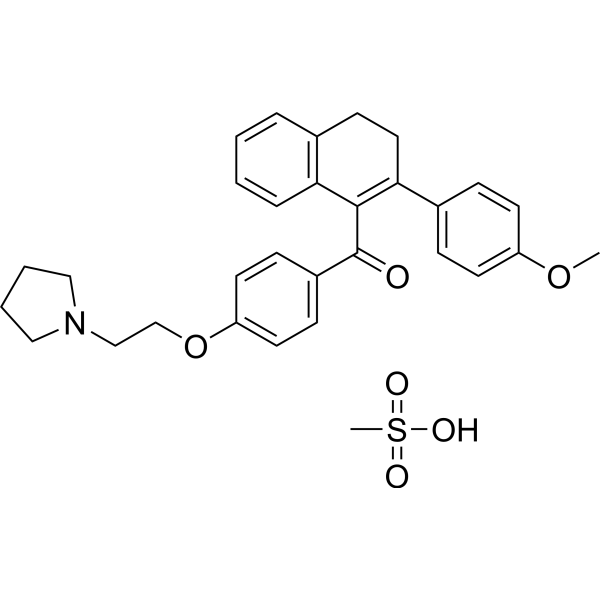
Trioxifene mesylate
Trioxifene mesylate (LY133314) is an orally active and selective estrogen receptor (ER) modulator with human ERα IC50 of 203.49 nM and Ki of 20.84 nM. Trioxifene mesylate binds estradiol receptors, inhibits ERα-mediated gene expression, reduces circulating gonadotrophin levels. Trioxifene mesylate can be used for the research of advanced breast cancer and androgen-independent, metastatic prostatic adenocarcinoma.
For research use only. We do not sell to patients.
- CAS No.: 68307-81-3
- Formula: C31H35NO6S
- Molecular Weight:549.68
-
Storage:
Please store the product under the recommended conditions in the Certificate of Analysis.

To place orders, for customer services and technical support, please contact: MedChemExpress USA
Tel: 609-228-6898 E-mail: [email protected] [email protected]


-
 Biological Activity
-
Chemical Information
- Protocols
- Purity & Documentation
- References
-
 Help & FAQs




Biological Activity
Description
IC50 & Target
|
hERα 203.49 nM (IC50) |
hERα 20.84 nM (Ki) |
hERβ 1506.04 nM (IC50) |
hERβ 144.85 nM (Ki) |
In Vitro
Trioxifene (0.3-10000 nM; 4 h) mesylate binds to purified human recombinant ERα with human ERα IC50 of 203.49 nM and Ki of 20.84 nM[2].
Trioxifene (0.1-10.0 μM; 24 h) mesylate weakly antagonizes ERα-mediated gene expression in PAIII rat prostatic adenocarcinoma cells but does not alter ERβ-mediated gene expression in these cells[2].
Trioxifene (7 days) mesylate inhibits the proliferation of PAIII rat prostatic adenocarcinoma cells in vitro with an IC50 of 4.6 μM[2].
MedChemExpress (MCE) has not independently confirmed the accuracy of these methods. They are for reference only. Further protocols information, click here.
In Vivo
Trioxifene (2.0-40.0 mg/kg; s.c.; daily; 28 days or continuously until death) mesylate significantly inhibits PAIII prostatic adenocarcinoma metastasis to lymph nodes and lungs, reduces male accessory sex organ weight, and extends mean survival to 64.44 days with continuous 40.0 mg/kg-day administration in male LW rats[2].
MedChemExpress (MCE) has not independently confirmed the accuracy of these methods. They are for reference only.
-
Animal Model:LW (male, 110-125 g, injected s.c. with 1×10⁶ PAIII prostatic adenocarcinoma cells in the dorsal tail)[2]
-
Dosage:2.0 mg/kg; 4.0 mg/kg; 20.0 mg/kg; 40.0 mg/kg
-
Administration:s.c.; daily; 28 days or continuously until death
-
Result:Produced significant (P < 0.05) inhibition of PAIII metastasis, with maximum 86% reduction in gluteal lymph node weight, 88% reduction in iliac lymph node weight, and 98% reduction in pulmonary foci count at 40.0 mg/kg-day for 28 days.
Did not reduce primary tail tumor weight at any dose.
Induced dose-related, significant (P < 0.05) regression of male accessory sex organs, with maximum 76% reduction in normalized ventral prostate weight and 64% reduction in normalized seminal vesicle weight at 40.0 mg/kg-day for 28 days.
Caused significant (P < 0.05) dose-related decreases in final-to-initial body weight ratios, with a maximum 31% reduction at 40.0 mg/kg-day for 28 days.
Increased normalized testicular weights significantly (P < 0.05), though absolute testicular weights did not differ from controls.
Extended mean survival to 50.11 days in rats treated with 40.0 mg/kg-day for 28 days followed by vehicle, significantly longer than vehicle controls (41.78 days).
Extended mean survival to 64.44 days in rats treated continuously with 40.0 mg/kg-day until death, significantly longer than both vehicle controls and the 28-day treatment group.


Chemical Information
-
CAS No. 68307-81-3
-
Molecular Weight 549.68
-
Formula C31H35NO6S
-
SMILES
O=C(C1=C(C2=CC=C(OC)C=C2)CCC3=C1C=CC=C3)C4=CC=C(OCCN5CCCC5)C=C4.CS(=O)(O)=O
-
Synonyms
LY133314
-
Shipping
Room temperature in continental US; may vary elsewhere.
-
Storage
Please store the product under the recommended conditions in the Certificate of Analysis.

Protocols
-
RT-PCR
Reverse transcription technology uses RNA as a template to synthesize DNA. RT-PCR is simple, specific and sensitive, and can be used to detect gene expression levels and expression differences in cells; detect RNA virus content; clone cDNA sequences of specific genes.
-
RNA extraction experimental
By lysing cells, releasing RNA, and removing impurities such as proteins and DNA, high-purity RNA products are finally obtained. The commonly used traditional method is the guanidine isothiocyanate/phenol/chloroform method (Trizol), which is suitable for a variety of animal materials including animal tissues, microorganisms, cultured cells, etc., and most plant materials.
-
Cell Cytotoxicity Assay
Cytotoxicity assays are usually based on the assessment of cell membrane damage, which can also be indirectly detected by measuring cell viability. Detection methods include MTT assay, CKK-8 assay, LDH assay and ATP assay, etc.
-
Research Protocol for Endocrine Diseases
Endocrine diseases often arise from disrupted hormone production, hormone signaling, or target-tissue responsiveness; for diabetes-focused endocrine disease models, insulin signaling regulates glucose uptake, hepatic glucose output, lipid metabolism, and β-cell compensation. Type 2 diabetes develops through interacting defects in insulin resistance, β-cell dysfunction, adipose inflammation, hepatic glucose overproduction, altered incretin signaling, and ectopic lipid metabolism. A major unresolved question is whether endocrine dysfunction is driven primarily by target-tissue insulin resistance, intrinsic β-cell failure, immune/inflammatory stress, or combined multi-organ failure that differs by disease stage.
-
Breast Cancer Modeling
Breast cancer is a heterogeneous cancer, and it has been distinguished into four subtypes: luminal A, luminal B, HER2-positive and basal-like. Molecular mutations, epigenetic alterations, hormone exposure and immune microenvironment are related to the progression of breast cancer.
-
Real Time qPCR (Q-PCR)
Real-time quantitative PCR (qPCR) quantifies an amplifiable nucleic-acid target by monitoring fluorescence during PCR cycling rather than measuring product only after amplification. The increase in fluorescence tracks accumulation of PCR product, and the quantification cycle (Cq; historically also Ct/CP) is related to the initial amount of target: samples containing more starting target generally reach the defined fluorescence threshold in fewer cycles.


Purity & Documentation
References
[1]. Lee RW, et al. Trioxifene mesylate in the treatment of advanced breast cancer. Cancer. 1986;57(1):40-43. [Content Brief]
[2]. Neubauer BL, et al. The selective estrogen receptor modulator trioxifene (LY133314) inhibits metastasis and extends survival in the PAIII rat prostatic carcinoma model. Cancer Res. 2003;63(18):6056-6062. [Content Brief]

Calculators
Concentration (start) × Volume (start) = Concentration (final) × Volume (final)


Trioxifene mesylate Related Classifications
HY-123664 Related Classifications
 Powered by Bioz
Keywords
- Trioxifene
- 68307-81-3
- LY133314
- LY 133314
- LY-133314
- Estrogen Receptor/ERR
- PAIII rat prostatic adenocarcinoma cells
- male accessory sex organs
- male LW rats
- DMBA-induced rat mammary carcinoma
- immature Holtzman rats
- immature Standard Cox mice
- ERα
- estrogen receptor modulator
- adult ovariectomized CD-1 mice
- ERβ
- Inhibitor
- inhibitor
- inhibit