



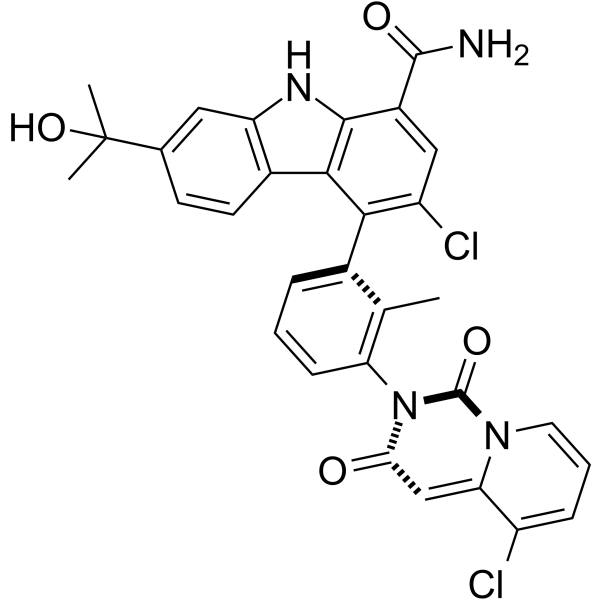
BMS-986143
BMS-986143 is an orally active, reversible BTK inhibitor with an IC50 of 0.26 nM. BMS-986143 also inhibits TEC, BLK, BMX, TXK FGR, YES1, ITK with IC50s of 3 nM, 5 nM, 7 nM, 10 nM, 15 nM,19 nM, 21 nM, respectively. BMS-986143 can be used for the research of autoimmune diseases.
For research use only. We do not sell to patients.
- CAS No.: 1643372-83-1
- Formula: C31H24Cl2N4O4
- Molecular Weight:587.45
-
Storage:
Please store the product under the recommended conditions in the Certificate of Analysis.

To place orders, for customer services and technical support, please contact: MedChemExpress USA
Tel: 609-228-6898 E-mail: [email protected] [email protected]


-
 Biological Activity
-
Chemical Information
- Purity & Documentation
- References
-
 Help & FAQs




Biological Activity
Description
Cellular Effect
|
Cell Line

|
Type | Value | Description | References |
|---|---|---|---|---|
| B cell | IC50 |
1 nM
Compound: 6d; BMS-986143
|
Antiproliferative activity against anti-IgM/IgG-induced human peripheral B cells
Antiproliferative activity against anti-IgM/IgG-induced human peripheral B cells
|
[PMID: 33214829] |
In Vitro
BMS-986143 inhibits BTK with IC50s of 6.9±3.4 and 25±19 nM in Ramos cellular assay and the human whole blood assay, respectively[1].
BMS-986143 provides potent inhibition of end points derived from IgG-containing immune complex low affinity activating Fcγ receptor signaling in peripheral blood mononuclear cells (PBMC) (IC50=2 nM)[1].
BMS-986143 inhibits the expression of CD63 on the surface of basophils in human whole blood, driven by FcεRI signaling (IC50 of 54 nM)[1].
BMS-986143 inhibits calcium flux in Ramos B Cells, proliferation of human peripheral B Cells, CD86 surface expression in peripheral B Cells, and TNFα from human PBMC Cells with IC50s of 7±3, 1±0.4, 1±0.5, and 2 nM, respectively[1].
MedChemExpress (MCE) has not independently confirmed the accuracy of these methods. They are for reference only.
In Vivo
BMS-986143 exhibits high oral bioavailability (mouse 100%, dog 82%) and moderate Cmax (mouse 4.3, dog 1.2 μM) following oral administration (mouse 6, dog 2 mg/kg)[1].
BMS-986143 exhibits long elimination half-lives (mouse 3.6, dog 7.9 h) due to moderate plasma clearance (8.6, 4.4 mL/min/kg respectively) combined with low volumes of distribution (1.8, 2.6 L/kg respectively) following intravenous administration (mouse 3.0, dog 1.0 mg/kg)[1].
MedChemExpress (MCE) has not independently confirmed the accuracy of these methods. They are for reference only.
-
Animal Model:DBA/1 male mice (8-10wk of age) bearing CIA model[1]
-
Dosage:15 and 45 mg/kg
-
Administration:Oral gavage; BID
-
Result:15 and 45 mg/kg provided dose-dependent inhibition of observed clinical disease progression (63% and 80%, respectively), representing 17 and 19 h coverage of the mouse whole blood IC50 (130 nM).


Chemical Information
-
CAS No. 1643372-83-1
-
Molecular Weight 587.45
-
Formula C31H24Cl2N4O4
-
SMILES
CC1=C(C=CC=[C@@]1[C@@]2=C(C=C(C3=C2C4=C(N3)C=C(C=C4)C(C)(O)C)C(N)=O)Cl)N5C(C=C6C(Cl)=CC=CN6C5=O)=O
-
Shipping
Room temperature in continental US; may vary elsewhere.
-
Storage
Please store the product under the recommended conditions in the Certificate of Analysis.


Purity & Documentation
References

Calculators
Concentration (start) × Volume (start) = Concentration (final) × Volume (final)


BMS-986143 Related Classifications
HY-145373 Related Classifications
 Powered by Bioz