



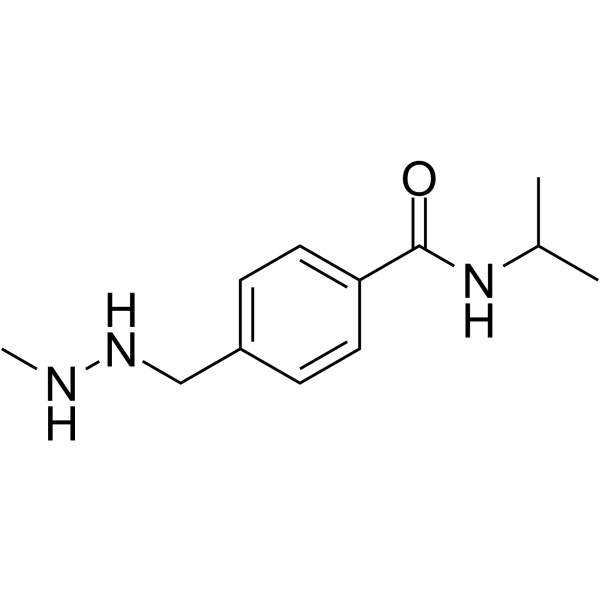
Procarbazine
Procarbazine is an orally active alkylating agent, with anticancer activity. Procarbazine can be used in Hodgkin's disease research.
For research use only. We do not sell to patients.
- CAS No.: 671-16-9
- Formula: C12H19N3O
- Molecular Weight:221.30
-
Storage:
Please store the product under the recommended conditions in the Certificate of Analysis.

To place orders, for customer services and technical support, please contact: MedChemExpress USA
Tel: 609-228-6898 E-mail: [email protected] [email protected]


-
 Biological Activity
-
Chemical Information
- Purity & Documentation
- References
-
 Help & FAQs




Biological Activity
Description
In Vitro
Procarbazine (5 and 20 nM; 1 h) treatment shows cell survival at various concentrarions[1].
MedChemExpress (MCE) has not independently confirmed the accuracy of these methods. They are for reference only. .
-
Cell Line:L1210 cells
-
Concentration:5 and 20 nM
-
Incubation Time:1 hour
-
Result:Showed 99.3% and 99.9% survival of cells at 5 mM and 20 mM, respectively.
In Vivo
MedChemExpress (MCE) has not independently confirmed the accuracy of these methods. They are for reference only.
-
Animal Model:Male muta mouse (7-8 weeks old) [2]
-
Dosage:50 and 150 mg/kg
-
Administration:Intraperitoneal injection; 50 and 150 mg/kg; once daily; 5 days
-
Result:Increased the MN frequency appreciably, and observed micronucleus induction in the peripheral blood at 50 mg/kg.
Clinical Trial
| NCT Number | Sponsor | Condition | Start Date |
Phase

|
|---|---|---|---|---|
| NCT01329991 | Plexxikon| | 2011-05 | PHASE1 |


Chemical Information
-
CAS No. 671-16-9
-
Molecular Weight 221.30
-
Formula C12H19N3O
-
SMILES
O=C(NC(C)C)C1=CC=C(CNNC)C=C1
-
Shipping
Room temperature in continental US; may vary elsewhere.
-
Storage
Please store the product under the recommended conditions in the Certificate of Analysis.


Purity & Documentation
References
[1]. J M Erikson, et al. Cytotoxicity and DNA damage caused by the azoxy metabolites of procarbazine in L1210 tumor cells. Cancer Res. 1989 Jan 1;49(1):127-33. [Content Brief]
[2]. T Suzuki, et al. Procarbazine genotoxicity in the MutaMouse; strong clastogenicity and organ-specific induction of lacZ mutations. Mutat Res. 1999 Aug 18;444(2):269-81. [Content Brief]

Calculators
Concentration (start) × Volume (start) = Concentration (final) × Volume (final)


Procarbazine Related Classifications
HY-13733A Related Classifications
 Powered by Bioz