



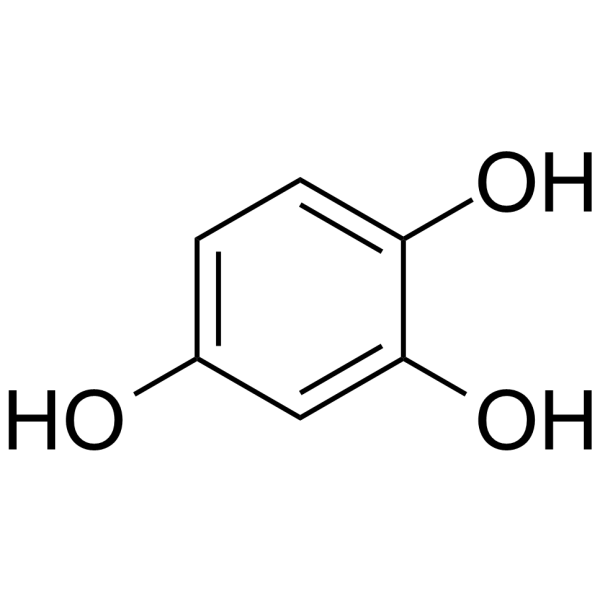
1,2,4-Trihydroxybenzene (Standard)
1,2,4-Trihydroxybenzene (Hydroxyhydroquinone) (Standard) is the analytical standard of 1,2,4-Trihydroxybenzene (HY-W010451). This product is intended for research and analytical applications. 1,2,4-Trihydroxybenzene (Hydroxyhydroquinone) is an ER stress inducer that targets proteins such as PKR-like ER kinase PERK to induce cytotoxicity. 1,2,4-Trihydroxybenzene selectively activates eIF2α phosphorylation, activates the PERK-eIF2α signaling pathway and induces stress granule formation. 1,2,4-Trihydroxybenzene subsequently exacerbates oxidative stress and causes DNA double-strand breaks, destroying organelles such as mitochondria and ER, and inducing cell death. 1,2,4-Trihydroxybenzene also has the potential to exhibit anti-tumor effect, increase blood pressure, and relieve spasm.
For research use only. We do not sell to patients.
- Purity : 98%
- CAS No.: 533-73-3
- Formula: C6H6O3
- Molecular Weight:126.11
-
Storage:
Please store the product under the recommended conditions in the Certificate of Analysis.


To place orders, for customer services and technical support, please contact: MedChemExpress USA
Tel: 609-228-6898 E-mail: [email protected] [email protected]


-
 Product Information
-
Chemical Information
- Purity & Documentation
-
 Help & FAQs




Product Information
Information
Application
The compound is the grade of analytical standard, which is the reference standard supplied assay. It is commonly used in qualitative, quantitative and methodological research experiments in HPLC, GC and MS.


Chemical Information
-
CAS No. 533-73-3
-
Molecular Weight 126.11
-
Formula C6H6O3
-
SMILES
OC1=CC=C(O)C=C1O
-
Synonyms
Hydroxyhydroquinone (Standard)
-
Structure Classification
-
Initial Source
-
Shipping
Room temperature in continental US; may vary elsewhere.
-
Storage
Please store the product under the recommended conditions in the Certificate of Analysis.


Purity & Documentation
References
[1]. Risa Kamae, et al. Hydroxyhydroquinone, a by-product of coffee bean roasting, increases intracellular Ca2+ concentration in rat thymic lymphocytes. Food Chem Toxicol. 2017 Apr;102:39-45. [Content Brief]
[2]. Jung DM, et al. 1,2,4-trihydroxybenzene induces stress granule formation and causes DNA damage in human keratinocytes. Toxicol In Vitro. 2023 Oct;92:105638. [Content Brief]
[3]. Park EJ, et al. 1,2,4-trihydroxybenzene induces non-apoptotic cell death via the structural damage of intracellular organelles. Toxicol Appl Pharmacol. 2024 Nov;492:117096. [Content Brief]
[4]. Inoue S. Effects of 1,3,5-trihydroxybenzene and 2,4,6-trihydroxy-1-propiophenone on the smooth muscle organs. Jpn J Pharmacol. 1969 Jun;19(2):224-33. [Content Brief]

Calculators
Concentration (start) × Volume (start) = Concentration (final) × Volume (final)


1,2,4-Trihydroxybenzene (Standard) Related Classifications
HY-W010451R Related Classifications
 Powered by Bioz