



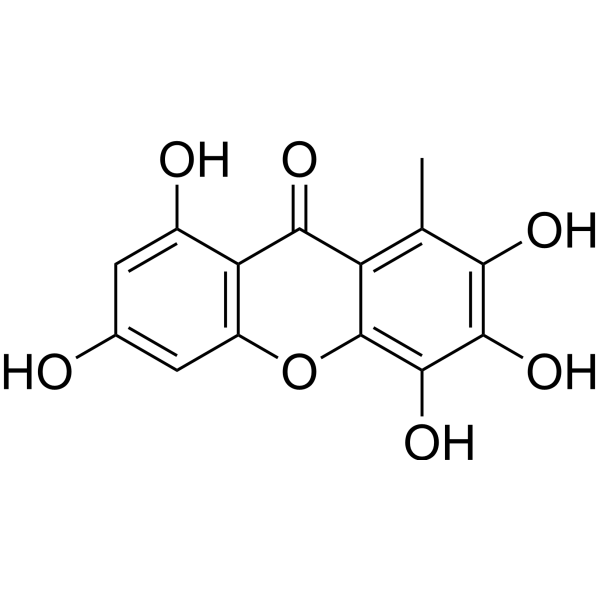
2,3,4,6,8-Pentahydroxy-1-methylxanthone
2,3,4,6,8-Pentahydroxy-1-methylxanthone is a xanthone derivative of Wardomyces anomalus. 2,3,4,6,8-Pentahydroxy-1-methylxanthone shows significant antioxidant activities. 2,3,4,6,8-Pentahydroxy-1-methylxanthone is inhibitors of p56lck tyrosine kinase. 2,3,4,6,8-Pentahydroxy-1-methylxanthone can be used to research cardiovascular disease.
For research use only. We do not sell to patients.
- CAS No.: 548740-87-0
- Formula: C14H10O7
- Molecular Weight:290.23
-
Storage:
Please store the product under the recommended conditions in the Certificate of Analysis.

To place orders, for customer services and technical support, please contact: MedChemExpress USA
Tel: 609-228-6898 E-mail: [email protected] [email protected]


-
 Biological Activity
-
Chemical Information
- Protocols
- Purity & Documentation
- References
-
 Help & FAQs




Biological Activity
Description
IC50 & Target
p56 lck[1]
In Vitro
2,3,4,6,8-Pentahydroxy-1-methylxanthone (1~50µM with 50 µg/mL ox-LDL, 6h) has protective effect on ox-LDL induced apoptosis in human umbilical vein endothelial cells[2].
2,3,4,6,8-Pentahydroxy-1-methylxanthone (1~50µM with 50 µg/mL ox-LDL, 6h) inhibits ox-LDL-induced adhesion molecules expression in human umbilical vein endothelial cells[2].
2,3,4,6,8-Pentahydroxy-1-methylxanthone (1~50µM with 50 µg/mL ox-LDL, 6h) has protective effect on ox-LDL-induced oxidative damage in human umbilical vein endothelial cells[2].
MedChemExpress (MCE) has not independently confirmed the accuracy of these methods. They are for reference only. Further protocols information, click here.
-
Cell Line:Human umbilical vein endothelial cells
-
Concentration:1µM, 5µM, 50µM (with 50 µg/mL ox-LDL)
-
Incubation Time:6h
-
Result:The percentage of apoptosis cells significantly decreased to around 20 ~ 40%.
-
Cell Line:Human umbilical vein endothelial cells
-
Concentration:1µM, 5µM, 50µM (with 50 µg/mL ox-LDL)
-
Incubation Time:6h
-
Result:The level of pro-apoptotic protein Bax decreased significantly, while that of anti-apoptotic protein Bcl-2 increased significantly.
-
Cell Line:Human umbilical vein endothelial cells
-
Concentration:1µM, 5µM, 50µM (with 50 µg/mL ox-LDL)
-
Incubation Time:6h
-
Result:The protein level of VCAM-1 and ICAM-1 decreased.
-
Cell Line:Human umbilical vein endothelial cells
-
Concentration:1µM, 5µM, 50µM (with 50 µg/mL ox-LDL)
-
Incubation Time:6h
-
Result:Activated Nrf2 nuclear translocations and the expression of HO-1 was significantly increased.


Chemical Information
-
CAS No. 548740-87-0
-
Molecular Weight 290.23
-
Formula C14H10O7
-
SMILES
O=C1C2=C(OC3=C(C(O)=C(C(C)=C13)O)O)C=C(O)C=C2O
-
Structure Classification
-
Initial Source
-
Shipping
Room temperature in continental US; may vary elsewhere.
-
Storage
Please store the product under the recommended conditions in the Certificate of Analysis.

Protocols
-
Research Protocol for Cardiovascular Diseases
Cardiovascular disease can be modeled as maladaptive cardiac remodeling, where ischemic injury or pressure overload activates inflammatory signaling, fibroblast activation, extracellular-matrix deposition, cardiomyocyte hypertrophy, vascular remodeling, and progressive ventricular dysfunction. The TGF-β/SMAD axis is a central profibrotic pathway after myocardial injury and pressure overload, while innate immune and cytokine pathways regulate leukocyte recruitment, scar formation, and adverse remodeling. Key unresolved questions include which inflammatory signals are reparative versus harmful, when fibrosis is protective versus maladaptive, and whether pathway inhibition improves function without weakening necessary infarct healing or compensatory remodeling.


Purity & Documentation
References
[1]. Abdel-Lateff A, et al. Two new xanthone derivatives from the algicolous marine fungus Wardomyces anomalus. J Nat Prod. 2003 May;66(5):706-8. [Content Brief]
[2]. Hou JR, et al. Protective Effect of Flavonoids from a Deep-Sea-Derived Arthrinium sp. against ox-LDL-Induced Oxidative Injury through Activating the AKT/Nrf2/HO-1 Pathway in Vascular Endothelial Cells. Mar Drugs. 2021 Dec 18;19(12):712. [Content Brief]

Calculators
Concentration (start) × Volume (start) = Concentration (final) × Volume (final)


2,3,4,6,8-Pentahydroxy-1-methylxanthone Related Classifications
HY-N12166 Related Classifications
 Powered by Bioz