



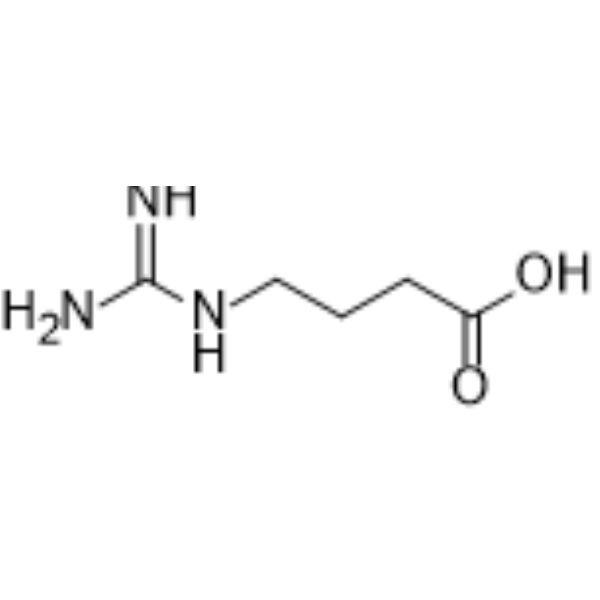
4-Guanidinobutanoic acid

Based on 1 Customer Validation
4-Guanidinobutanoic acid is a metabolite of arginine and an orally active SLC36A1/Hedgehog signaling pathway activator. 4-Guanidinobutanoic acid drives epithelial reprogramming, enhances intestinal stem cell function and goblet cell differentiation. 4-Guanidinobutanoic acid promotes the enrichment of Akkermansia muciniphila via mucus-dependent niche expansion, regulates intestinal homeostasis, and establishes a microbiota-host feedback loop. 4-Guanidinobutanoic acid exhibits anti-aging and healthspan-regulating properties. 4-Guanidinobutanoic acid can be used in research related to ulcerative colitis, amyotrophic lateral sclerosis, and Duchenne muscular dystrophy.
For research use only. We do not sell to patients.
- Purity : 98.0%
- CAS No.: 463-00-3
- Formula: C5H11N3O2
- Molecular Weight:145.16
-
Storage:Powder -20°C, 3 years , 4°C, 2 years ; In solvent -80°C, 2 years , -20°C, 1 year

To place orders, for customer services and technical support, please contact: MedChemExpress USA
Tel: 609-228-6898 E-mail: [email protected] [email protected]


-
 Biological Activity
-
Chemical Information
-
Solvent & Solubility
- Protocols
- Purity & Documentation
- References
-
 Help & FAQs


All Endogenous Metabolite Isoforms
More

Biological Activity
Description
IC50 & Target
[1]|
Human Endogenous Metabolite |
In Vitro
4-GBA (0.8 mM; 4 d) enhances MUC2 expression and goblet cell differentiation in murine colonic organoids[1].
4-GBA (0.8 mM; 4 d) enhances intestinal stem cell function and goblet cell differentiation in murine colonic organoids via activation of the Hedgehog signaling pathway[1].
4-GBA (0.8 mM; 4 d) enhances intestinal stem cell function and activates Hedgehog signaling in murine colonic organoids via a SLC36A1-dependent mechanism[1].
MedChemExpress (MCE) has not independently confirmed the accuracy of these methods. They are for reference only. Further protocols information, click here.
In Vivo
4-GBA (150 mg/kg; p.o.; daily; 14 days) ameliorates Citrobacter rodentium-induced colitis in C57BL/6J mice by reducing tissue damage and bacterial burden[1].
4-GBA (150 mg/kg; p.o.; daily; 7 days) enhances intestinal epithelial homeostasis in healthy C57BL/6J mice by increasing goblet cell density, MUC2 production, and ISC proliferation and function[1].
4-GBA (150 mg/kg; p.o.; daily; 7 days) enriches Akkermansia muciniphila in the gut microbiota of healthy C57BL/6J mice in a mucus-dependent manner[1].
4-Guanidinobutanoic acid (0.2-5 mM; supplemented in NGM; continuous from day 1 of adulthood) extends mean wild-type C. elegans lifespan by 12% at 0.2, 1, and 5 mM, and significantly improves locomotion in aged worms at 5 mM[2].
4-Guanidinobutanoic acid (5 mM; supplemented in NGM; continuous from day 1 of adulthood) slightly extends mean lifespan and improves late-stage locomotion in the C. elegans dys-1(eg33) Duchenne muscular dystrophy model[2].
4-Guanidinobutanoic acid (5 mM; supplemented in NGM; continuous from day 1 of adulthood) decreases mean lifespan but improves late-stage locomotion in the C. elegans dys-1(cx18) Duchenne muscular dystrophy model[2].
4-Guanidinobutanoic acid (5 mM; supplemented in NGM; continuous from day 1 of adulthood) slightly extends mean lifespan in the sod-1WTc ALS control strain but has no effect on the sod-1G85Rc ALS mutant strain[2].
4-Guanidinobutanoic acid (5 mM; supplemented in NGM; continuous from day 1 of adulthood) reduces lifespan and locomotion in ALS model worms exposed to Paraquat-induced oxidative stress[2].
MedChemExpress (MCE) has not independently confirmed the accuracy of these methods. They are for reference only.
-
Animal Model:C57BL/6J (6-8-week-old, wild-type; 2% dextran sulfate sodium-induced acute ulcerative colitis)[1]
-
Dosage:150 mg/kg
-
Administration:p.o.; daily; 7 days
-
Result:Reduced composite disease activity index scores.
Increased colon lengths.
Reduced histopathological severity scores.
Increased goblet cell counts per high-power field.
Increased relative MUC2 protein intensity.
Reduced colonic mRNA expression of proinflammatory cytokines Il-1β, iNOS, Tnfα, Ccl2, and Cxcl1.
Upregulated colonic mRNA expression of antimicrobial peptides Reg3b and Reg3g.
Increased regulatory T cell frequency in mesenteric lymph nodes.
-
Animal Model:C57BL/6J (6-8-week-old, wild-type; oral infection with 1 × 10⁹ CFU nalidixic acid-resistant Citrobacter rodentium-induced bacterial colitis)[1]
-
Dosage:150 mg/kg
-
Administration:p.o.; daily; 14 days
-
Result:Reduced intestinal histopathological damage compared to untreated infected controls.
Lowered Citrobacter rodentium colony-forming units in feces and colon tissue compared to untreated infected controls.
-
Animal Model:C57BL/6J (6-8-week-old, wild-type; healthy); Lgr5-CreERT2; H11-CAG-LSL-tdTomato (6-8-week-old, transgenic, C57BL/6J background; healthy)[1]
-
Dosage:150 mg/kg
-
Administration:p.o.; daily; 7 days
-
Result:Increased goblet cell counts per high-power field in wild-type mice.
Increased relative MUC2 protein intensity in wild-type mice.
Upregulated mRNA expression of goblet cell differentiation regulators Atoh1 and Spdef in wild-type mice.
Increased Ki67+ proliferating cell counts in wild-type mice.
Elevated OCCLUDIN expression in the colon of wild-type mice.
Increased the proportion of tdTomato+ intestinal stem cells per crypt in transgenic mice.
Increased the number of Ki67+ proliferating cells per crypt in transgenic mice.
-
Animal Model:C57BL/6J (6-8-week-old, wild-type; healthy); Muc2∆IEC (6-8-week-old, intestinal epithelium-specific Muc2 knockout, C57BL/6J background; healthy)[1]
-
Dosage:150 mg/kg
-
Administration:p.o.; daily; 7 days
-
Result:Induced distinct fecal microbial composition in wild-type mice.
Significantly enriched the Akkermansia genus, with Akkermansia muciniphila identified as the most differentially abundant species via LEfSe analysis in wild-type mice.
Did not alter fecal Akkermansia muciniphila abundance in Muc2∆IEC mice.
-
Animal Model:wild-type N2[2]
-
Dosage:0.2 mM; 1 mM; 5 mM
-
Administration:supplemented in NGM; continuous from day 1 of adulthood
-
Result:Extended mean lifespan by 12%.
Significantly improved locomotion parameters (peristaltic track length, peristaltic speed, straight-line distance) at day 12 of adulthood.
Showed myosin mean intensity, bleb count, and straightness similar to vehicle controls at day 12.
Showed no significant differences in mitochondrial volume, elongation, or intensity compared to vehicle controls at day 12.
-
Animal Model:dys-1(eg33) (Duchenne muscular dystrophy model)[2]
-
Dosage:5 mM
-
Administration:supplemented in NGM; continuous from day 1 of adulthood
-
Result:Slightly increased mean lifespan of dys-1(eg33) worms.
Significantly improved straight-line distance locomotion at day 12 of adulthood.
-
Animal Model:dys-1(cx18) (Duchenne muscular dystrophy model)[2]
-
Dosage:5 mM
-
Administration:supplemented in NGM; continuous from day 1 of adulthood
-
Result:Decreased mean lifespan of dys-1(cx18) worms.
Significantly improved straight-line distance locomotion at day 12 of adulthood.
-
Animal Model:sod-1WTc; sod-1G85Rc (amyotrophic lateral sclerosis models)[2]
-
Dosage:5 mM
-
Administration:supplemented in NGM; continuous from day 1 of adulthood
-
Result:Slightly increased mean lifespan of sod-1WTc worms.
Had no effect on mean lifespan of sod-1G85Rc worms.
-
Animal Model:sod-1WTc; sod-1G85Rc (amyotrophic lateral sclerosis models, exposed to 16 mM paraquat)[2]
-
Dosage:5 mM
-
Administration:supplemented in NGM; continuous from day 1 of adulthood
-
Result:Decreased mean lifespan of both sod-1WTc and sod-1G85Rc worms exposed to paraquat-induced oxidative stress.
Decreased locomotion of both sod-1WTc and sod-1G85Rc worms exposed to paraquat-induced oxidative stress.


Chemical Information
-
CAS No. 463-00-3
-
Appearance Solid
-
Molecular Weight 145.16
-
Formula C5H11N3O2
-
Color White to off-white
-
SMILES
O=C(O)CCCNC(N)=N
-
Structure Classification
-
Initial Source
-
Shipping
Room temperature in continental US; may vary elsewhere.
-
Storage
Powder -20°C 3 years 4°C 2 years In solvent -80°C 2 years -20°C 1 year


Solvent & Solubility
In Vitro:
H2O : 25 mg/mL (172.22 mM; Need ultrasonic)
Please refer to the solubility information to select the appropriate solvent. Once prepared, please aliquot and store the solution to prevent product inactivation from repeated freeze-thaw cycles.
Storage method and period of stock solution: -80°C, 2 years; -20°C, 1 year. When stored at -80°C, please use it within 2 years. When stored at -20°C, please use it within 1 year.
* Note: If you choose water as the stock solution, please dilute it to the working solution, then filter and sterilize it with a 0.22 μm filter before use.
Please refer to the solubility information to select the appropriate solvent. Once prepared, please aliquot and store the solution to prevent product inactivation from repeated freeze-thaw cycles.
Storage method and period of stock solution: -80°C, 2 years; -20°C, 1 year. When stored at -80°C, please use it within 2 years. When stored at -20°C, please use it within 1 year.
* Note: If you choose water as the stock solution, please dilute it to the working solution, then filter and sterilize it with a 0.22 μm filter before use.
Concentration (start) × Volume (start) = Concentration (final) × Volume (final)
In Vivo:
For the following dissolution methods, please prepare the working solution directly:
It is recommended to prepare fresh solutions and use them promptly within a short period of time.
The percentages shown for the solvents indicate their volumetric ratio in the final prepared solution. If precipitation or phase separation occurs during preparation, heat and/or sonication can be used to aid dissolution.
Add each solvent one by one: PBS
Solubility: 16.67 mg/mL (114.84 mM); Clear solution; Need ultrasonic and warming and heat to 60°C

Protocols
-
DSS-Induced Colitis
Dextran sulfate sodium (DSS)-induced colitis is generated by administering DSS in mouse drinking water, producing epithelial injury, barrier disruption, weight loss, diarrhea, fecal blood, colon shortening, histologic mucosal damage, and inflammatory mediator changes; the model is mainly used to study acute or chronic intestinal inflammation resembling selected features of ulcerative colitis. DSS injury is interpreted through clinical and tissue readouts rather than a single molecular endpoint: daily body weight, stool consistency, and bleeding are combined into a disease activity index, while colon length, histology, cytokines, myeloperoxidase activity, intestinal permeability, and tight-junction markers provide complementary measures of inflammation and barrier damage.
-
TNBS-Induced Colitis
TNBS-induced colitis is produced by intrarectal delivery of 2,4,6-trinitrobenzene sulfonic acid in ethanol, where ethanol disrupts the mucosal barrier and TNBS haptenates colonic proteins, generating immune-mediated colonic inflammation with weight loss, diarrhea, ulceration, transmural injury, inflammatory-cell infiltration, and cytokine responses. The model is used as an experimental intestinal inflammation model with Crohn’s disease–like features, especially when Th1-type responses, IL-12–dependent inflammation, chronic relapsing inflammation, or fibrosis-related endpoints are studied.
-
Research Protocol for Microbiome Analysis
Microbiome analysis characterizes microbial communities in biological or environmental samples by measuring community composition, diversity, taxonomic structure, functional potential, and associations with host or environmental phenotypes. 16S rRNA gene amplicon sequencing is commonly used for bacterial and archaeal taxonomic profiling, while shotgun metagenomics provides higher taxonomic resolution and direct functional information, including microbial genes, pathways, viruses, fungi, and antimicrobial-resistance genes when sequencing depth and host-DNA contamination are adequately controlled. Microbiome results are strongly affected by sample collection, storage, DNA extraction, contamination, sequencing method, reference database, and bioinformatic pipeline; therefore, standardized protocols, negative controls, mock communities, and transparent analysis workflows are required. Unresolved issues include low-biomass contamination, compositional-data bias, inconsistent species-level c
-
iPSC cell differentiation
Induced pluripotent stem cells (iPSCs) are a type of cell that has similar properties to embryonic stem cells through somatic cell reprogramming.


Purity & Documentation
-
Data Sheet (285 KB)
-
SDS (394 KB)
- English - EN (394 KB)
- Français - FR (394 KB)
- Deutsch - DE (394 KB)
- Norwegian - NO (394 KB)
- Español - ES (394 KB)
- Swedish - SV (394 KB)
- Italian - IT (394 KB)
- Korean - KR (394 KB)
- Portuguese - PT (394 KB)
-
Handling Instructions (2659 KB)
References
[1]. Yang J, et al. A 4-guanidinobutanoic acid-SLC36A1 axis drives a microbiota‒host feedback loop to regulate intestinal homeostasis. Gut microbes. 2026 Dec 31;18(1):2639216. [Content Brief]
[2]. Jonk SM, et al. Metabolic analysis of sarcopenic muscle identifies positive modulators of longevity and healthspan in C. elegans. Redox biology. 2025 Sep;85:103732. [Content Brief]


Complete Stock Solution Preparation Table
Please refer to the solubility information to select the appropriate solvent. Once prepared, please aliquot and store the solution to prevent product inactivation from repeated freeze-thaw cycles.
Storage method and period of stock solution: -80°C, 2 years; -20°C, 1 year. When stored at -80°C, please use it within 2 years. When stored at -20°C, please use it within 1 year.
| Optional Solvent | Concentration Solvent Mass | 1 mg | 5 mg | 10 mg | 25 mg |
|---|---|---|---|---|---|
| H2O | 1 mM | 6.8889 mL | 34.4447 mL | 68.8895 mL | 172.2237 mL |
| 5 mM | 1.3778 mL | 6.8889 mL | 13.7779 mL | 34.4447 mL | |
| 10 mM | 0.6889 mL | 3.4445 mL | 6.8889 mL | 17.2224 mL | |
| 15 mM | 0.4593 mL | 2.2963 mL | 4.5926 mL | 11.4816 mL | |
| 20 mM | 0.3444 mL | 1.7222 mL | 3.4445 mL | 8.6112 mL | |
| 25 mM | 0.2756 mL | 1.3778 mL | 2.7556 mL | 6.8889 mL | |
| 30 mM | 0.2296 mL | 1.1482 mL | 2.2963 mL | 5.7408 mL | |
| 40 mM | 0.1722 mL | 0.8611 mL | 1.7222 mL | 4.3056 mL | |
| 50 mM | 0.1378 mL | 0.6889 mL | 1.3778 mL | 3.4445 mL | |
| 60 mM | 0.1148 mL | 0.5741 mL | 1.1482 mL | 2.8704 mL | |
| 80 mM | 0.0861 mL | 0.4306 mL | 0.8611 mL | 2.1528 mL | |
| 100 mM | 0.0689 mL | 0.3444 mL | 0.6889 mL | 1.7222 mL |
* Note: If you choose water as the stock solution, please dilute it to the working solution, then filter and sterilize it with a 0.22 μm filter before use.


4-Guanidinobutanoic acid Related Classifications
HY-113286 Related Classifications
 Powered by Bioz