



4-Bromo A23187

Based on 1 Customer Validation
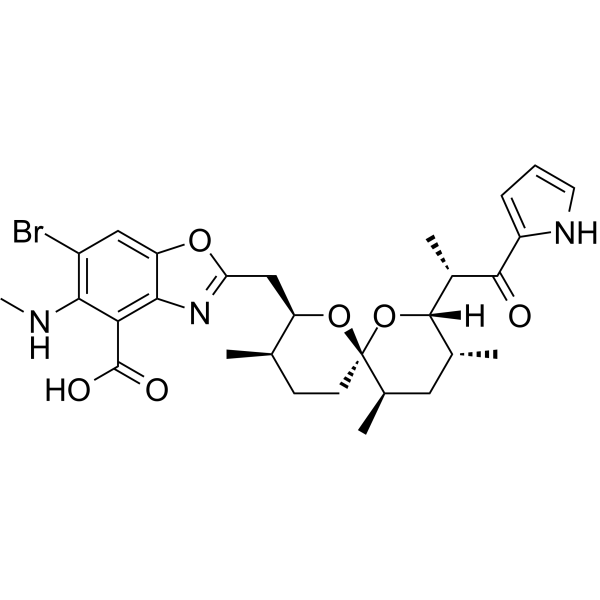
4-Bromo A23187 is a halogenated analog of the highly selective calcium ionophore A-23187. 4-Bromo A23187, a calcium modulator, induces apoptosis in different cells, including HL-60 cells.
For research use only. We do not sell to patients.
- Purity : 95.46%
- CAS No.: 76455-48-6
- Formula: C29H36BrN3O6
- Molecular Weight:602.52
-
Storage:Powder -20°C, 3 years , 4°C, 2 years ; In solvent -80°C, 6 months , -20°C, 1 month

To place orders, for customer services and technical support, please contact: MedChemExpress USA
Tel: 609-228-6898 E-mail: [email protected] [email protected]


-
 Biological Activity
-
Chemical Information
-
Solvent & Solubility
- Protocols
- Purity & Documentation
- References
-
 Help & FAQs




Biological Activity
Description


Chemical Information
-
CAS No. 76455-48-6
-
Appearance Solid
-
Molecular Weight 602.52
-
Formula C29H36BrN3O6
-
Color White to yellow
-
SMILES
C[C@H]1[C@@]2(O[C@@H]([C@@H](CC2)C)CC3=NC4=C(C(O)=O)C(NC)=C(Br)C=C4O3)O[C@]([C@@H](C1)C)([H])[C@H](C)C(C5=CC=CN5)=O
-
Shipping
Room temperature in continental US; may vary elsewhere.
-
Storage
Powder -20°C 3 years 4°C 2 years In solvent -80°C 6 months -20°C 1 month


Solvent & Solubility
In Vitro:
DMSO : ≥ 100 mg/mL (165.97 mM; Hygroscopic DMSO has a significant impact on the solubility of product, please use newly opened DMSO)
* "≥" means soluble, but saturation unknown.
Please refer to the solubility information to select the appropriate solvent. Once prepared, please aliquot and store the solution to prevent product inactivation from repeated freeze-thaw cycles.
Storage method and period of stock solution: -80°C, 6 months; -20°C, 1 month. When stored at -80°C, please use it within 6 months. When stored at -20°C, please use it within 1 month.
Please refer to the solubility information to select the appropriate solvent. Once prepared, please aliquot and store the solution to prevent product inactivation from repeated freeze-thaw cycles.
Storage method and period of stock solution: -80°C, 6 months; -20°C, 1 month. When stored at -80°C, please use it within 6 months. When stored at -20°C, please use it within 1 month.
Concentration (start) × Volume (start) = Concentration (final) × Volume (final)


Purity & Documentation
-
Data Sheet (270 KB)
-
SDS (394 KB)
- English - EN (394 KB)
- Français - FR (394 KB)
- Deutsch - DE (394 KB)
- Norwegian - NO (394 KB)
- Español - ES (394 KB)
- Swedish - SV (394 KB)
- Italian - IT (394 KB)
- Korean - KR (394 KB)
- Portuguese - PT (394 KB)
-
Handling Instructions (2659 KB)
References


Complete Stock Solution Preparation Table
Please refer to the solubility information to select the appropriate solvent. Once prepared, please aliquot and store the solution to prevent product inactivation from repeated freeze-thaw cycles.
Storage method and period of stock solution: -80°C, 6 months; -20°C, 1 month. When stored at -80°C, please use it within 6 months. When stored at -20°C, please use it within 1 month.
| Optional Solvent | Concentration Solvent Mass | 1 mg | 5 mg | 10 mg | 25 mg |
|---|---|---|---|---|---|
| DMSO | 1 mM | 1.6597 mL | 8.2985 mL | 16.5970 mL | 41.4924 mL |
| 5 mM | 0.3319 mL | 1.6597 mL | 3.3194 mL | 8.2985 mL | |
| 10 mM | 0.1660 mL | 0.8298 mL | 1.6597 mL | 4.1492 mL | |
| 15 mM | 0.1106 mL | 0.5532 mL | 1.1065 mL | 2.7662 mL | |
| 20 mM | 0.0830 mL | 0.4149 mL | 0.8298 mL | 2.0746 mL | |
| 25 mM | 0.0664 mL | 0.3319 mL | 0.6639 mL | 1.6597 mL | |
| 30 mM | 0.0553 mL | 0.2766 mL | 0.5532 mL | 1.3831 mL | |
| 40 mM | 0.0415 mL | 0.2075 mL | 0.4149 mL | 1.0373 mL | |
| 50 mM | 0.0332 mL | 0.1660 mL | 0.3319 mL | 0.8298 mL | |
| 60 mM | 0.0277 mL | 0.1383 mL | 0.2766 mL | 0.6915 mL | |
| 80 mM | 0.0207 mL | 0.1037 mL | 0.2075 mL | 0.5187 mL | |
| 100 mM | 0.0166 mL | 0.0830 mL | 0.1660 mL | 0.4149 mL |


4-Bromo A23187 Related Classifications
HY-N6694 Related Classifications
 Powered by Bioz