



6-Hydroxymelatonin

Based on 1 Customer Validation
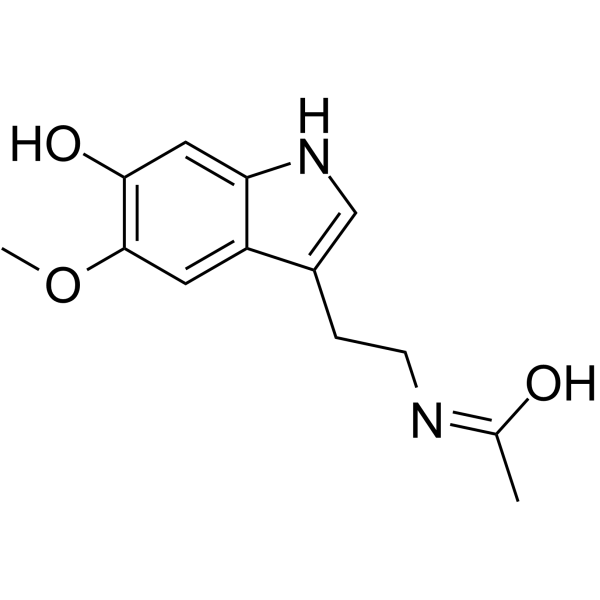
6-Hydroxymelatonin is the main metabolite of melatonin (HY-B0075) after being metabolized by CYP1A2 and can cross the blood-brain barrier. 6-Hydroxymelatonin has strong free radical scavenging ability and antioxidant activity, and can alleviate oxidative damage caused by various neurotoxins. 6-Hydroxymelatonin can cause oxidative DNA damage in the presence of copper ions through a "non-quinone" type redox cycling mechanism.
Nos produits utilisent uniquement pour la recherche. Nous ne vendons pas aux patients.
- Pureté : 99.92%
- CAS No.: 2208-41-5
- Formule: C13H16N2O3
- Masse moléculaire:248.28
-
Stockage:Powder -20°C, 3 years , 4°C, 2 years ; In solvent -80°C, 6 months , -20°C, 1 month

To place orders, for customer services and technical support, please contact: MedChemExpress USA
Tel: 609-228-6898 E-mail: [email protected] [email protected]


-
 Activité biologique
-
Chemical Information
-
Solvant et solubilité
- Protocole
- Pureté et documentation
- Références
-
 Help & FAQs



Voir tous les produits spécifiques à Isoform Endogenous Metabolite
More

Activité biologique
Description
IC50 & Target
|
Human Endogenous Metabolite |
In Vitro
6-Hydroxymelatonin (0-20 μM, 4 h) can cause dose-dependent DNA damage in the presence of Cu(II), significantly increasing the formation of 8-oxodG in HL-60 cells, but being ineffective on HP 100 cells[4].
MedChemExpress (MCE) has not independently confirmed the accuracy of these methods. They are for reference only. Further protocols information, click here.
In Vivo
MedChemExpress (MCE) has not independently confirmed the accuracy of these methods. They are for reference only.
-
Animal Model:QUIN induced dopamine system neurotoxicity model established by three-week-old adult male Wistar rats, 250-300 g[3]
-
Dosage:10 mg/kg
-
Administration:Subcutaneous injection (s.c.), once daily for 7 days
-
Result:Significantly reduced the lipid peroxidation level (MDA content) by approximately 50%.
Not only completely reversed the effect of QUIN, but also reduced the level of superoxide anions to a significantly lower level than that of the sham operation group.
-
Animal Model:Fe²⁺ induced dopamine system neurotoxicity model established by male Wistar rats, 250-300 g[2]
-
Dosage:10 mg/kg
-
Administration:Intraperitoneal injection (i.p.), once daily for 7 days
-
Result:Significantly reduced the lipid peroxidation level (MDA content) by approximately 40%.
Significantly reversed the neuronal damage caused by Fe²⁺.


Chemical Information
-
CAS No. 2208-41-5
-
Appearance Solid
-
Masse moléculaire 248.28
-
Formule C13H16N2O3
-
Color White to yellow
-
SMILES
CC(NCCC1=CNC2=C1C=C(OC)C(O)=C2)=O
-
Structure Classification
-
Initial Source
-
Livraison
Room temperature in continental US; may vary elsewhere.
-
Stockage
Powder -20°C 3 years 4°C 2 years In solvent -80°C 6 months -20°C 1 month


Solvant et solubilité
In Vitro:
DMSO : 50 mg/mL (201.39 mM; Need ultrasonic; Hygroscopic DMSO has a significant impact on the solubility of product, please use newly opened DMSO)
Please refer to the solubility information to select the appropriate solvent. Once prepared, please aliquot and store the solution to prevent product inactivation from repeated freeze-thaw cycles.
Storage method and period of stock solution: -80°C, 6 months; -20°C, 1 month. When stored at -80°C, please use it within 6 months. When stored at -20°C, please use it within 1 month.
Please refer to the solubility information to select the appropriate solvent. Once prepared, please aliquot and store the solution to prevent product inactivation from repeated freeze-thaw cycles.
Storage method and period of stock solution: -80°C, 6 months; -20°C, 1 month. When stored at -80°C, please use it within 6 months. When stored at -20°C, please use it within 1 month.
Concentration (start) × Volume (start) = Concentration (final) × Volume (final)
In Vivo:
Select the appropriate dissolution method based on your experimental animal and administration route.
- For the following dissolution methods, please ensure to first prepare a clear stock solution using an In Vitro approach and then sequentially add co-solvents:
- To ensure reliable experimental results, the clarified stock solution can be appropriately stored based on storage conditions. As for the working solution for In Vivo experiments, it is recommended to prepare freshly and use it on the same day.
- The percentages shown for the solvents indicate their volumetric ratio in the final prepared solution. If precipitation or phase separation occurs during preparation, heat and/or sonication can be used to aid dissolution.
Add each solvent one by one: 10% DMSO 40% PEG300 5% Tween-80 45% Saline
Solubility: ≥ 2.5 mg/mL (10.07 mM); Clear solution
This protocol yields a clear solution of ≥ 2.5 mg/mL (saturation unknown).
Taking 1 mL working solution as an example, add 100 μL DMSO stock solution (25.0 mg/mL) to 400 μL PEG300, and mix evenly; then add 50 μL Tween-80 and mix evenly; then add 450 μL Saline to adjust the volume to 1 mL.
Preparation of Saline: Dissolve 0.9 g sodium chloride in ddH₂O and dilute to 100 mL to obtain a clear Saline solution.
Add each solvent one by one: 10% DMSO 90% (20% SBE-β-CD in Saline)
Solubility: ≥ 2.5 mg/mL (10.07 mM); Clear solution
This protocol yields a clear solution of ≥ 2.5 mg/mL (saturation unknown).
Taking 1 mL working solution as an example, add 100 μL DMSO stock solution (25.0 mg/mL) to 900 μL 20% SBE-β-CD in Saline, and mix evenly.
Preparation of 20% SBE-β-CD in Saline (4°C, storage for one week): 2 g SBE-β-CD powder is dissolved in 10 mL Saline, completely dissolve until clear.
In Vivo Dissolution Calculator
Please enter the basic information of animal experiments:
-
-
-
-
Recommended: Prepare an additional quantity of animals to account for potential losses during experiments.
Please enter your animal formula composition:
-
%DMSO +
Recommended: Keep the proportion of DMSO in working solution below 2% if your animal is weak.
-
%+
-
+%Tween-80 + +
-
%Saline +
The co-solvents required include: DMSO, . All of co-solvents are available by MedChemExpress (MCE). , Tween 80. All of co-solvents are available by MedChemExpress (MCE).
Working solution concentration: 0.22 mg/mL
Method for preparing stock solution: mg drug dissolved in μL DMSO. Stock solution concentration: mg/mL.
1. Take μL DMSO stock solution;
2. Add μL .
μL , mix evenly;
3. Then add μL Tween 80, mix evenly;
4. Then add μL
Please ensure that the stock solution in the first step is dissolved to a clear state, and add co-solvents in sequence. You can use ultrasonic heating (ultrasonic cleaner, recommended frequency 20-40 kHz), vortexing, etc. to assist dissolution.

Protocole
-
ROS/oxidative-stress fluorescent staining
ROS/oxidative-stress fluorescent staining uses cell-permeant fluorogenic probes that become fluorescent after oxidation inside cells or tissues; commonly used examples include DCFH-DA/DCFDA for broad cellular oxidant detection, DHE for superoxide-related signal detection, MitoSOX for mitochondrial superoxide-related signal detection, and CellROX probes for oxidative-stress-associated fluorescence readouts. The assay detects probe oxidation rather than a single ROS species unless the probe and analysis method have been chemically validated for that species. DCFH-DA enters cells, is deacetylated by intracellular esterases to DCFH, and produces fluorescent DCF after oxidation, so the readout is used as an operational measure of total cellular oxidative stress rather than a species-specific ROS measurement. DHE and MitoSOX can report superoxide-related oxidation, but red fluorescence alone can include non-specific ethidium-like oxidation products; HPLC or optimized spectral approaches are
-
Genotoxicity/Mutagenicity Study
The bacterial reverse mutation assay detects point mutations that restore amino-acid prototrophy in auxotrophic Salmonella typhimurium or Escherichia coli tester strains; after exposure to a test article, mutagenic activity is read out as an increased number of revertant colonies on minimal agar compared with the vehicle control. The assay uses tester strains with different mutation targets so that base-substitution and frameshift mutagens can be detected, and testing is performed with and without exogenous mammalian metabolic activation because some chemicals require biotransformation to become mutagenic.


Pureté et documentation
-
Fiche technique (271 KB)
-
SDS (419 KB)
- English - EN (419 KB)
- Français - FR (419 KB)
- Deutsch - DE (419 KB)
- Norwegian - NO (419 KB)
- Español - ES (419 KB)
- Swedish - SV (419 KB)
- Italian - IT (419 KB)
- Korean - KR (419 KB)
- Portuguese - PT (419 KB)
-
Instruction de manipulation (2659 KB)
Références
[1]. Härtter S, et al. Orally given melatonin may serve as a probe drug for cytochrome P450 1A2 activity in vivo: a pilot study. Clin Pharmacol Ther. 2001 Jul;70(1):10-6. [Content Brief]
[2]. Maharaj DS, et al. 6-Hydroxymelatonin protects against quinolinic-acid-induced oxidative neurotoxicity in the rat hippocampus. J Pharm Pharmacol. 2005 Jul;57(7):877-81. [Content Brief]
[3]. Maharaj DS, et al. Melatonin and 6-hydroxymelatonin protect against iron-induced neurotoxicity. J Neurochem. 2006 Jan;96(1):78-81. [Content Brief]
[4]. Sakano K, et al. Oxidative DNA damage induced by a melatonin metabolite, 6-hydroxymelatonin, via a unique non-o-quinone type of redox cycle. Biochem Pharmacol. 2004 Nov 1;68(9):1869-78. [Content Brief]


Complete Stock Solution Preparation Table
Please refer to the solubility information to select the appropriate solvent. Once prepared, please aliquot and store the solution to prevent product inactivation from repeated freeze-thaw cycles.
Storage method and period of stock solution: -80°C, 6 months; -20°C, 1 month. When stored at -80°C, please use it within 6 months. When stored at -20°C, please use it within 1 month.
| Optional Solvent | Concentration Solvent Mass | 1 mg | 5 mg | 10 mg | 25 mg |
|---|---|---|---|---|---|
| DMSO | 1 mM | 4.0277 mL | 20.1386 mL | 40.2771 mL | 100.6928 mL |
| 5 mM | 0.8055 mL | 4.0277 mL | 8.0554 mL | 20.1386 mL | |
| 10 mM | 0.4028 mL | 2.0139 mL | 4.0277 mL | 10.0693 mL | |
| 15 mM | 0.2685 mL | 1.3426 mL | 2.6851 mL | 6.7129 mL | |
| 20 mM | 0.2014 mL | 1.0069 mL | 2.0139 mL | 5.0346 mL | |
| 25 mM | 0.1611 mL | 0.8055 mL | 1.6111 mL | 4.0277 mL | |
| 30 mM | 0.1343 mL | 0.6713 mL | 1.3426 mL | 3.3564 mL | |
| 40 mM | 0.1007 mL | 0.5035 mL | 1.0069 mL | 2.5173 mL | |
| 50 mM | 0.0806 mL | 0.4028 mL | 0.8055 mL | 2.0139 mL | |
| 60 mM | 0.0671 mL | 0.3356 mL | 0.6713 mL | 1.6782 mL | |
| 80 mM | 0.0503 mL | 0.2517 mL | 0.5035 mL | 1.2587 mL | |
| 100 mM | 0.0403 mL | 0.2014 mL | 0.4028 mL | 1.0069 mL |


6-Hydroxymelatonin Related Classifications
HY-W011956 Related Classifications
 Powered by Bioz