



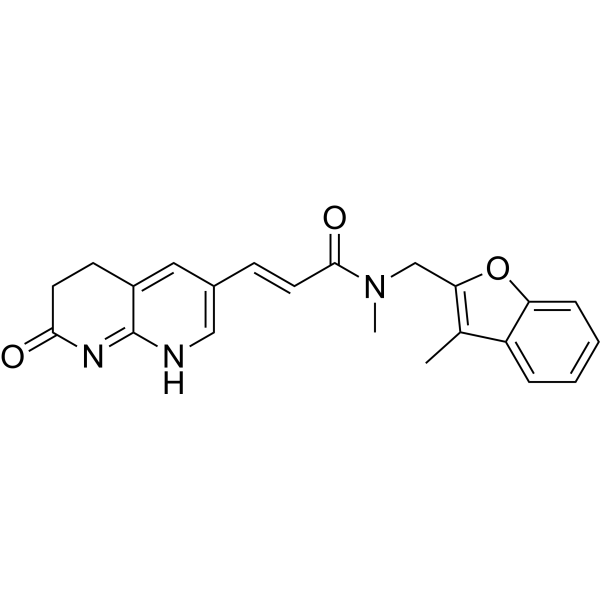
AFN-1252
Based on 12 publication(s) in Google Scholar
AFN-1252 is an orally active and selective inhibitor of FabI, an essential enzyme in fatty acid biosynthesis in Staphylococcus spp. AFN-1252 exhibits exquisite and highly selective activity against Staphylococcus spp. AFN-1252 exhibits typical MIC90 values of ⩽0.015 μg/ml against diverse clinical isolates of S. aureus. AFN-1252 is efficacious in a mouse model of septicemia providing 100% protection from an otherwise lethal peritoneal infection of S. aureus Smith.
For research use only. We do not sell to patients.
- Purity : 99.49%
- CAS No.: 620175-39-5
- Formula: C22H21N3O3
- Molecular Weight:375.42
-
Storage:Powder -20°C, 3 years , 4°C, 2 years ; In solvent -80°C, 2 years , -20°C, 1 year

To place orders, for customer services and technical support, please contact: MedChemExpress USA
Tel: 609-228-6898 E-mail: [email protected] [email protected]


-
 Biological Activity
-
Chemical Information
-
Solvent & Solubility
- Protocols
- Purity & Documentation
- References
-
 Help & FAQs



Publications Citing Use of MedChemExpress (MCE) AFN-1252
More- Nat Commun. 2016 Oct 5:7:12944. [Abstract]
- Phytomedicine. 2024 Jul 25:130:155732. [Abstract]
- Cell Rep. 2019 Dec 17;29(12):3974-3982.e4. [Abstract]
- Sci Data. 2024 Sep 19;11(1):1024. [Abstract]
- J Lipid Res. 2024 Dec;65(12):100693. [Abstract]
- PLoS Pathog. 2020 Oct 30;16(10):e1008529. [Abstract]
- Antimicrob Agents Chemother. 2019 Mar 27;63(4):e02105-18. [Abstract]
- PLoS Genet. 2026 May 27;22(5):e1012165. [Abstract]
- Patent. US20250270197A1.
- University of Washington. 2024.
- bioRxiv. 2023 Jun 30:2023.06.29.547085. [Abstract]
- Patent. US20210017165A1.
All Antibiotic Isoforms
More

Biological Activity
Description
In Vitro
AFN-1252 is extremely potent against clinical isolates of S. aureus (MIC90, 0.015 μg/ml) and coagulase-negative staphylococci (MIC90, 0.12 μg/ml)[2]
MedChemExpress (MCE) has not independently confirmed the accuracy of these methods. They are for reference only. Further protocols information, click here.
In Vivo
MedChemExpress (MCE) has not independently confirmed the accuracy of these methods. They are for reference only.
-
Animal Model:Female 5- to 6-week-old CD-1 mice (18 to 22 g) with S. aureus Smith bacterial inoculum[2]
-
Dosage:0.03, 0.1, 0.3, 1, 3 mg/kg
-
Administration:Oral gavage; single dose
-
Result:Was efficacious in a mouse model of septicemia, with 100% survival obtained with a single oral dose of 1 mg/kg.
The calculated ED50s (95% confidence limits) were 0.15 (0.11 to 0.21) mg/kg.


Chemical Information
-
CAS No. 620175-39-5
-
Appearance Solid
-
Molecular Weight 375.42
-
Formula C22H21N3O3
-
Color White to off-white
-
SMILES
O=C(N(C)CC1=C(C)C2=CC=CC=C2O1)/C=C/C(C=C3CC4)=CNC3=NC4=O
-
Synonyms
API-1252; Debio 1452
-
Shipping
Room temperature in continental US; may vary elsewhere.
-
Storage
Powder -20°C 3 years 4°C 2 years In solvent -80°C 2 years -20°C 1 year


Publications (12)
-
Journal Impact Factor
-
Most Recent
-
Nat Commun
Environmental fatty acids enable emergence of infectious Staphylococcus aureus resistant to FASII-targeted antimicrobials. [Abstract]2016 Oct 5:7:12944. PMID: 27703138 -
Phytomedicine
In vitro and in vivo enhancement effect of glabridin on the antibacterial activity of colistin, against multidrug resistant Escherichia coli strains. [Abstract]2024 Jul 25:130:155732. PMID: 38776738 -
Cell Rep
Permissive Fatty Acid Incorporation Promotes Staphylococcal Adaptation to FASII Antibiotics in Host Environments. [Abstract]2019 Dec 17;29(12):3974-3982.e4. PMID: 31851927 -
Sci Data
High-throughput drug screening identifies novel therapeutics for Low Grade Serous Ovarian Carcinoma. [Abstract]2024 Sep 19;11(1):1024. PMID: 39300112 -
J Lipid Res
2024 Dec;65(12):100693. PMID: 39505263 -
PLoS Pathog
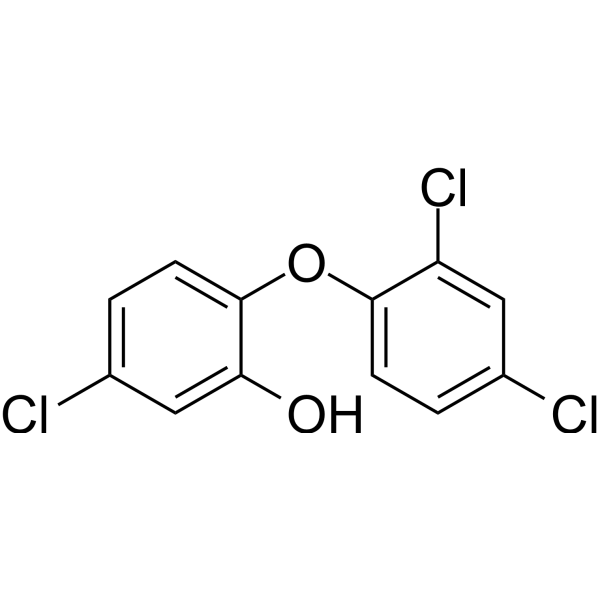
Triclosan depletes the membrane potential in Pseudomonas aeruginosa biofilms inhibiting aminoglycoside induced adaptive resistance. [Abstract]2020 Oct 30;16(10):e1008529. PMID: 33125434 -
Antimicrob Agents Chemother
A FASII Inhibitor Prevents Staphylococcal Evasion of Daptomycin by Inhibiting Phospholipid Decoy Production. [Abstract]2019 Mar 27;63(4):e02105-18. PMID: 30718253 -
PLoS Genet
FabF and FadM cooperate to recycle fatty acids and rescue ∆plsX lethality in Staphylococcus aureus. [Abstract]2026 May 27;22(5):e1012165. PMID: 42201948 -
-
-
bioRxiv
Elucidating the Impact of Bacterial Lipases, Human Serum Albumin, and FASII Inhibition on the Utilization of Exogenous Fatty Acids by Staphylococcus aureus. [Abstract]2023 Jun 30:2023.06.29.547085. PMID: 37425828 -


Solvent & Solubility
In Vitro:
DMSO : 5.8 mg/mL (15.45 mM; Need ultrasonic; Hygroscopic DMSO has a significant impact on the solubility of product, please use newly opened DMSO)
Please refer to the solubility information to select the appropriate solvent. Once prepared, please aliquot and store the solution to prevent product inactivation from repeated freeze-thaw cycles.
Storage method and period of stock solution: -80°C, 2 years; -20°C, 1 year. When stored at -80°C, please use it within 2 years. When stored at -20°C, please use it within 1 year.
Please refer to the solubility information to select the appropriate solvent. Once prepared, please aliquot and store the solution to prevent product inactivation from repeated freeze-thaw cycles.
Storage method and period of stock solution: -80°C, 2 years; -20°C, 1 year. When stored at -80°C, please use it within 2 years. When stored at -20°C, please use it within 1 year.
Concentration (start) × Volume (start) = Concentration (final) × Volume (final)

Protocols
-
Research Protocol for Infectious Diseases
Infectious-disease experiments test how pathogens interact with host barriers, innate immune receptors, inflammatory signaling, pathogen replication, and tissue injury; pattern-recognition receptors such as TLRs, RIG-I-like receptors, NOD-like receptors, and inflammasomes detect microbial molecules and activate NF-κB, interferon, and cytokine responses. The central hypothesis is that infection severity reflects the balance between pathogen burden and host response: protective inflammation restricts pathogen growth, whereas excessive or mislocalized inflammation contributes to tissue damage and disease phenotype. Unresolved questions include which host pathways are protective versus pathogenic, why some infection models fail to translate to human disease, and which combined readouts best predict clinically relevant infection outcomes.
-
How to Choose the Right Model Animal
Choosing the right model animal is a validity-driven decision in which the species, strain, sex, age, genetic background, disease-induction method, outcome measures, and welfare burden must match the scientific question rather than laboratory tradition or convenience. A model should be selected by judging face validity, construct validity, and predictive validity: whether it resembles the human phenotype, whether it reproduces relevant mechanisms, and whether results are likely to predict human biology or treatment response. Animal studies often fail to translate because of species differences, weak disease resemblance, poor experimental design, inadequate reporting, publication bias, and underuse of randomization, blinding, and sample-size justification. Unresolved questions include how to rank competing models objectively, how much human-disease complexity must be reproduced for a given objective, and when non-animal systems such as organoids, ex vivo tissue, or computational models


Purity & Documentation
-
Data Sheet (272 KB)
-
SDS (393 KB)
- English - EN (393 KB)
- Français - FR (393 KB)
- Deutsch - DE (393 KB)
- Norwegian - NO (393 KB)
- Español - ES (393 KB)
- Swedish - SV (393 KB)
- Italian - IT (393 KB)
- Korean - KR (393 KB)
- Portuguese - PT (393 KB)
-
Handling Instructions (2659 KB)
References
[1]. Nachum Kaplan, et al. In vitro activity (MICs and rate of kill) of AFN-1252, a novel FabI inhibitor, in the presence of serum and in combination with other antibiotics. J Chemother. 2013 Feb;25(1):18-25. [Content Brief]
[2]. Nachum Kaplan,et al. Mode of action, in vitro activity, and in vivo efficacy of AFN-1252, a selective antistaphylococcal FabI inhibitor. Antimicrob Agents Chemother. 2012 Nov;56(11):5865-74. [Content Brief]


Complete Stock Solution Preparation Table
Please refer to the solubility information to select the appropriate solvent. Once prepared, please aliquot and store the solution to prevent product inactivation from repeated freeze-thaw cycles.
Storage method and period of stock solution: -80°C, 2 years; -20°C, 1 year. When stored at -80°C, please use it within 2 years. When stored at -20°C, please use it within 1 year.
| Optional Solvent | Concentration Solvent Mass | 1 mg | 5 mg | 10 mg | 25 mg |
|---|---|---|---|---|---|
| DMSO | 1 mM | 2.6637 mL | 13.3184 mL | 26.6368 mL | 66.5921 mL |
| 5 mM | 0.5327 mL | 2.6637 mL | 5.3274 mL | 13.3184 mL | |
| 10 mM | 0.2664 mL | 1.3318 mL | 2.6637 mL | 6.6592 mL | |
| 15 mM | 0.1776 mL | 0.8879 mL | 1.7758 mL | 4.4395 mL |


AFN-1252 Related Classifications
HY-16911 Related Classifications
 Powered by Bioz