



Acetohydroxamic acid
Based on 1 publication(s) in Google Scholar
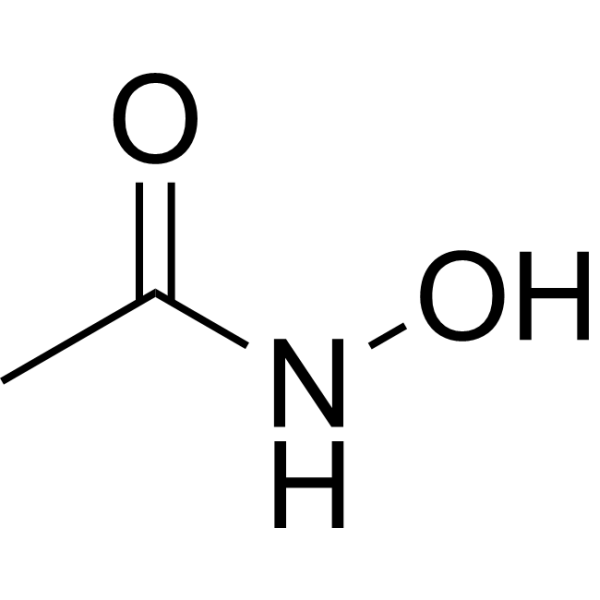
Acetohydroxamic acid is the inhibitor for bacterial and plant urease that can be used for chronic urinary tract infections. Acetohydroxamic acid selectively inhibits arachidonic acid 5-lipoxygenase that is useful in the research of asthma. Acetohydroxamic acid inhibits the formation of advanced glycation end products, and reduces oxidative stress and inflammatory responses. Acetohydroxamic acid exhibits antiviral activity against HIV.
For research use only. We do not sell to patients.
- Purity : 99.91%
- CAS No.: 546-88-3
- Formula: C2H5NO2
- Molecular Weight:75.07
-
Storage:Powder -20°C, 3 years , 4°C, 2 years ; In solvent -80°C, 2 years , -20°C, 1 year

To place orders, for customer services and technical support, please contact: MedChemExpress USA
Tel: 609-228-6898 E-mail: [email protected] [email protected]


-
 Biological Activity
-
Chemical Information
-
Solvent & Solubility
- Protocols
- Purity & Documentation
- References
-
 Help & FAQs



Publications Citing Use of MedChemExpress (MCE) Acetohydroxamic acid
More

Biological Activity
Description
In Vitro
Acetohydroxamic acid (7 mM, 24 h) penetrates bacterial cells, inhibits urease in Helicobacter pylori, reduces the adhesion of H. pylori to gastric tissue, and exhibits antibacterial activity[2].
Acetohydroxamic acid reduces the formation of advanced glycation end products (AGEs)(2.5-5 mM, 10-14 days), scavenges DPPH free radicals and hydroxyl free radicals (6 μM-50 mM, 30 min), and non-competitive inhibits semicarbazide-sensitive amine oxidase (SSAO) (0-50 μM, 1 min)[3].
MedChemExpress (MCE) has not independently confirmed the accuracy of these methods. They are for reference only.


Chemical Information
-
CAS No. 546-88-3
-
Appearance Solid
-
Molecular Weight 75.07
-
Formula C2H5NO2
-
Color White to off-white
-
SMILES
CC(NO)=O
-
Synonyms
N-Hydroxyacetamide
-
Shipping
Room temperature in continental US; may vary elsewhere.
-
Storage
Powder -20°C 3 years 4°C 2 years In solvent -80°C 2 years -20°C 1 year


Publications (1)
-
Journal Impact Factor
-
Most Recent


Solvent & Solubility
In Vitro:
DMSO : 133.33 mg/mL (1776.08 mM; Need ultrasonic; Hygroscopic DMSO has a significant impact on the solubility of product, please use newly opened DMSO)
H2O : 100 mg/mL (1332.09 mM; Need ultrasonic)
Please refer to the solubility information to select the appropriate solvent. Once prepared, please aliquot and store the solution to prevent product inactivation from repeated freeze-thaw cycles.
Storage method and period of stock solution: -80°C, 2 years; -20°C, 1 year. When stored at -80°C, please use it within 2 years. When stored at -20°C, please use it within 1 year.
* Note: If you choose water as the stock solution, please dilute it to the working solution, then filter and sterilize it with a 0.22 μm filter before use.
Please refer to the solubility information to select the appropriate solvent. Once prepared, please aliquot and store the solution to prevent product inactivation from repeated freeze-thaw cycles.
Storage method and period of stock solution: -80°C, 2 years; -20°C, 1 year. When stored at -80°C, please use it within 2 years. When stored at -20°C, please use it within 1 year.
* Note: If you choose water as the stock solution, please dilute it to the working solution, then filter and sterilize it with a 0.22 μm filter before use.
Concentration (start) × Volume (start) = Concentration (final) × Volume (final)
In Vivo:
Select the appropriate dissolution method based on your experimental animal and administration route.
- For the following dissolution methods, please ensure to first prepare a clear stock solution using an In Vitro approach and then sequentially add co-solvents:
- To ensure reliable experimental results, the clarified stock solution can be appropriately stored based on storage conditions. As for the working solution for In Vivo experiments, it is recommended to prepare freshly and use it on the same day.
- The percentages shown for the solvents indicate their volumetric ratio in the final prepared solution. If precipitation or phase separation occurs during preparation, heat and/or sonication can be used to aid dissolution.
Add each solvent one by one: 10% DMSO 40% PEG300 5% Tween-80 45% Saline
Solubility: ≥ 2.08 mg/mL (27.71 mM); Clear solution
This protocol yields a clear solution of ≥ 2.08 mg/mL (saturation unknown).
Taking 1 mL working solution as an example, add 100 μL DMSO stock solution (20.8 mg/mL) to 400 μL PEG300, and mix evenly; then add 50 μL Tween-80 and mix evenly; then add 450 μL Saline to adjust the volume to 1 mL.
Preparation of Saline: Dissolve 0.9 g sodium chloride in ddH₂O and dilute to 100 mL to obtain a clear Saline solution.
Add each solvent one by one: 10% DMSO 90% (20% SBE-β-CD in Saline)
Solubility: ≥ 2.08 mg/mL (27.71 mM); Clear solution
This protocol yields a clear solution of ≥ 2.08 mg/mL (saturation unknown).
Taking 1 mL working solution as an example, add 100 μL DMSO stock solution (20.8 mg/mL) to 900 μL 20% SBE-β-CD in Saline, and mix evenly.
Preparation of 20% SBE-β-CD in Saline (4°C, storage for one week): 2 g SBE-β-CD powder is dissolved in 10 mL Saline, completely dissolve until clear.
For the following dissolution methods, please prepare the working solution directly:
It is recommended to prepare fresh solutions and use them promptly within a short period of time.
The percentages shown for the solvents indicate their volumetric ratio in the final prepared solution. If precipitation or phase separation occurs during preparation, heat and/or sonication can be used to aid dissolution.
Add each solvent one by one: PBS
Solubility: 100 mg/mL (1332.09 mM); Clear solution; Need ultrasonic
In Vivo Dissolution Calculator
Please enter the basic information of animal experiments:
-
-
-
-
Recommended: Prepare an additional quantity of animals to account for potential losses during experiments.
Working solution concentration: 0.22 mg/mL
This product has good water solubility, please refer to the measured solubility data in water/PBS/Saline for details.


Purity & Documentation
-
Data Sheet (273 KB)
-
SDS (418 KB)
- English - EN (418 KB)
- Français - FR (418 KB)
- Deutsch - DE (418 KB)
- Norwegian - NO (418 KB)
- Español - ES (418 KB)
- Swedish - SV (418 KB)
- Italian - IT (418 KB)
- Korean - KR (418 KB)
- Portuguese - PT (418 KB)
-
Handling Instructions (2659 KB)
References
[1]. Sharma M, et al. Biotransformation of Acetamide to Acetohydroxamic Acid at Bench Scale Using Acyl Transferase Activity of Amidase of Geobacillus pallidus BTP-5x MTCC 9225. Indian J Microbiol. 2012 Mar;52(1):76-82. [Content Brief]
[2]. Umamaheshwari RB, et al., Receptor-mediated targeting of lipobeads bearing acetohydroxamic acid for eradication of Helicobacter pylori. J Control Release. 2004 Sep 14;99(1):27-40. [Content Brief]
[3]. Liu YH, et al., Antiglycation, radical scavenging, and semicarbazide-sensitive amine oxidase inhibitory activities of acetohydroxamic acid in vitro. Drug Des Devel Ther. 2017 Jul 13;11:2139-2147. [Content Brief]


Complete Stock Solution Preparation Table
Please refer to the solubility information to select the appropriate solvent. Once prepared, please aliquot and store the solution to prevent product inactivation from repeated freeze-thaw cycles.
Storage method and period of stock solution: -80°C, 2 years; -20°C, 1 year. When stored at -80°C, please use it within 2 years. When stored at -20°C, please use it within 1 year.
| Optional Solvent | Concentration Solvent Mass | 1 mg | 5 mg | 10 mg | 25 mg |
|---|---|---|---|---|---|
| H2O / DMSO | 1 mM | 13.3209 mL | 66.6045 mL | 133.2090 mL | 333.0225 mL |
| 5 mM | 2.6642 mL | 13.3209 mL | 26.6418 mL | 66.6045 mL | |
| 10 mM | 1.3321 mL | 6.6605 mL | 13.3209 mL | 33.3023 mL | |
| 15 mM | 0.8881 mL | 4.4403 mL | 8.8806 mL | 22.2015 mL | |
| 20 mM | 0.6660 mL | 3.3302 mL | 6.6605 mL | 16.6511 mL | |
| 25 mM | 0.5328 mL | 2.6642 mL | 5.3284 mL | 13.3209 mL | |
| 30 mM | 0.4440 mL | 2.2202 mL | 4.4403 mL | 11.1008 mL | |
| 40 mM | 0.3330 mL | 1.6651 mL | 3.3302 mL | 8.3256 mL | |
| 50 mM | 0.2664 mL | 1.3321 mL | 2.6642 mL | 6.6605 mL | |
| 60 mM | 0.2220 mL | 1.1101 mL | 2.2202 mL | 5.5504 mL | |
| 80 mM | 0.1665 mL | 0.8326 mL | 1.6651 mL | 4.1628 mL | |
| 100 mM | 0.1332 mL | 0.6660 mL | 1.3321 mL | 3.3302 mL |
* Note: If you choose water as the stock solution, please dilute it to the working solution, then filter and sterilize it with a 0.22 μm filter before use.


Acetohydroxamic acid Related Classifications
HY-B1235 Related Classifications
 Powered by Bioz