



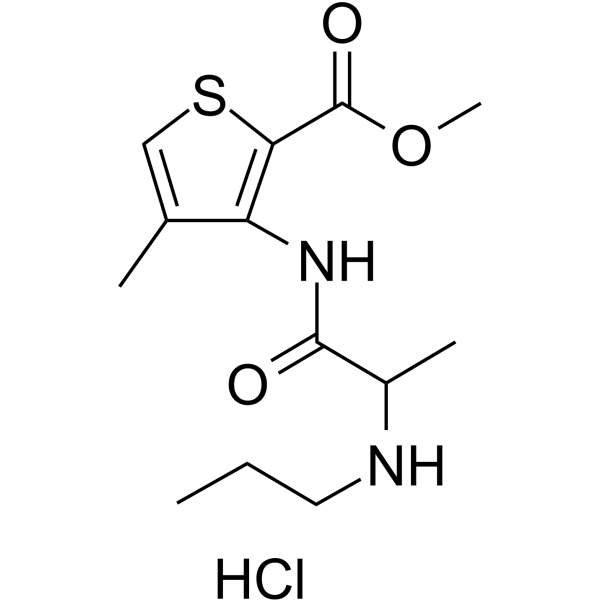
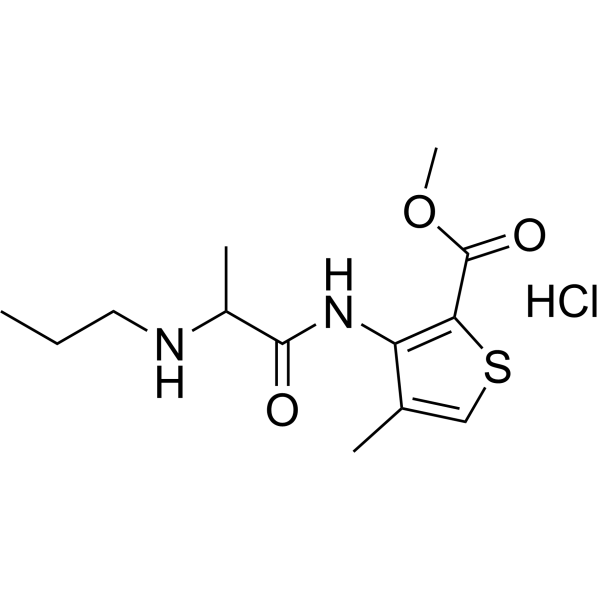
Articaine hydrochloride

Based on 1 Customer Validation
Articaine (Hoe-045) hydrochloride is a selective inhibitor of voltage-gated sodium channels (such as rNav1.4, hNav1.7, and rNav1.8), with an IC50 of 15.8 μM for open-state Na+ channels, and IC50 of 40.6 μM and 378 μM for inactivated and resting-state Na+ channels, respectively. Articaine hydrochloride exerts local anesthetic activity by inhibiting Na+ influx to block nerve impulse conduction, and can also inhibit NF-κB activation and NLRP3 inflammasome pathways, exhibiting anti-inflammatory function. Articaine hydrochloride can be used in the study of dental local anesthesia and inflammatory-related diseases (such as acute kidney injury).
For research use only. We do not sell to patients.
- Purity : 99.38%
- CAS No.: 23964-57-0
- Formula: C13H21ClN2O3S
- Molecular Weight:320.84
-
Storage:
4°C, sealed storage, away from moisture and light
* In solvent : -80°C, 6 months; -20°C, 1 month (sealed storage, away from moisture and light)

To place orders, for customer services and technical support, please contact: MedChemExpress USA
Tel: 609-228-6898 E-mail: [email protected] [email protected]


-
 Biological Activity
-
Chemical Information
-
Solvent & Solubility
- Purity & Documentation
- References
-
 Help & FAQs




Biological Activity
Description
IC50 & Target
|
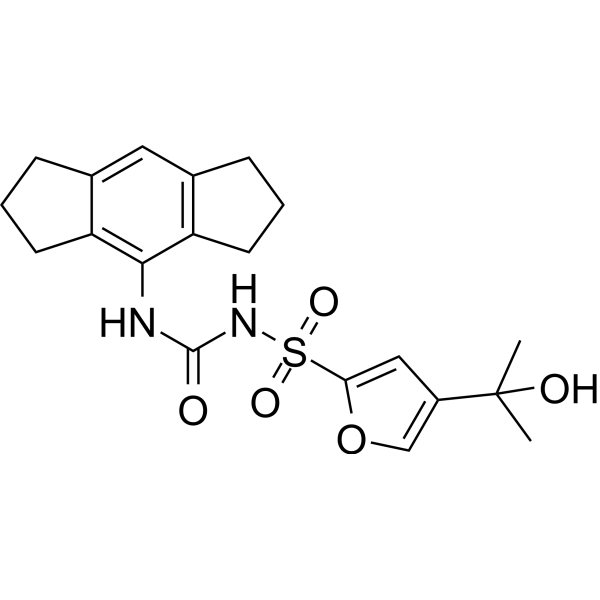
NLRP3 |
In Vivo
Articaine hydrochloride (0.5 mM, 1 mM; immersion for 1 h) can enhance the anesthetic effect in the zebrafish model, inhibiting the tactile response rate by 100% and reducing the heart rate by 60%. In combination with nanolipid carriers (NLCs), it can prolong the duration of anesthesia[3].
MedChemExpress (MCE) has not independently confirmed the accuracy of these methods. They are for reference only.
-
Animal Model:Swiss albino mice with LPS-induced acute kidney injury model[2]
-
Dosage:20 mg/kg, 40 mg/kg Articaine
-
Administration:Intraperitoneal injection; single dose
-
Result:Reduced serum BUN, creatinine, and cystatin C levels, alleviated renal histopathological damage, inhibited production of TNF-α, IL-6, IL-1β, and reduced MDA levels while increasing SOD and GSH activities.
Suppressed NF-κB activation, TLR4 expression, and NLRP3 inflammasome pathway, and restored Bcl-2/Bax ratio.
Clinical Trial
| NCT Number | Sponsor | Condition | Start Date |
Phase

|
|---|---|---|---|---|
| NCT01329991 | Plexxikon| | 2011-05 | PHASE1 |


Chemical Information
-
CAS No. 23964-57-0
-
Appearance Solid
-
Molecular Weight 320.84
-
Formula C13H21ClN2O3S
-
Color White to off-white
-
SMILES
O=C(C(C)NCCC)NC(C(C)=CS1)=C1C(OC)=O.Cl
-
Synonyms
Hoe-045
-
Shipping
Room temperature in continental US; may vary elsewhere.
-
Storage
4°C, sealed storage, away from moisture and light
* In solvent : -80°C, 6 months; -20°C, 1 month (sealed storage, away from moisture and light)


Solvent & Solubility
In Vitro:
H2O : 100 mg/mL (311.68 mM; Need ultrasonic)
DMSO : 100 mg/mL (311.68 mM; Need ultrasonic; Hygroscopic DMSO has a significant impact on the solubility of product, please use newly opened DMSO)
Please refer to the solubility information to select the appropriate solvent. Once prepared, please aliquot and store the solution to prevent product inactivation from repeated freeze-thaw cycles.
Storage method and period of stock solution: -80°C, 6 months; -20°C, 1 month (sealed storage, away from moisture and light). When stored at -80°C, please use it within 6 months. When stored at -20°C, please use it within 1 month.
* Note: If you choose water as the stock solution, please dilute it to the working solution, then filter and sterilize it with a 0.22 μm filter before use.
Please refer to the solubility information to select the appropriate solvent. Once prepared, please aliquot and store the solution to prevent product inactivation from repeated freeze-thaw cycles.
Storage method and period of stock solution: -80°C, 6 months; -20°C, 1 month (sealed storage, away from moisture and light). When stored at -80°C, please use it within 6 months. When stored at -20°C, please use it within 1 month.
* Note: If you choose water as the stock solution, please dilute it to the working solution, then filter and sterilize it with a 0.22 μm filter before use.
Concentration (start) × Volume (start) = Concentration (final) × Volume (final)
In Vivo:
Select the appropriate dissolution method based on your experimental animal and administration route.
- For the following dissolution methods, please ensure to first prepare a clear stock solution using an In Vitro approach and then sequentially add co-solvents:
- To ensure reliable experimental results, the clarified stock solution can be appropriately stored based on storage conditions. As for the working solution for In Vivo experiments, it is recommended to prepare freshly and use it on the same day.
- The percentages shown for the solvents indicate their volumetric ratio in the final prepared solution. If precipitation or phase separation occurs during preparation, heat and/or sonication can be used to aid dissolution.
Add each solvent one by one: 10% DMSO 40% PEG300 5% Tween-80 45% Saline
Solubility: ≥ 2.5 mg/mL (7.79 mM); Clear solution
This protocol yields a clear solution of ≥ 2.5 mg/mL (saturation unknown).
Taking 1 mL working solution as an example, add 100 μL DMSO stock solution (25.0 mg/mL) to 400 μL PEG300, and mix evenly; then add 50 μL Tween-80 and mix evenly; then add 450 μL Saline to adjust the volume to 1 mL.
Preparation of Saline: Dissolve 0.9 g sodium chloride in ddH₂O and dilute to 100 mL to obtain a clear Saline solution.
Add each solvent one by one: 10% DMSO 90% (20% SBE-β-CD in Saline)
Solubility: ≥ 2.5 mg/mL (7.79 mM); Clear solution
This protocol yields a clear solution of ≥ 2.5 mg/mL (saturation unknown).
Taking 1 mL working solution as an example, add 100 μL DMSO stock solution (25.0 mg/mL) to 900 μL 20% SBE-β-CD in Saline, and mix evenly.
Preparation of 20% SBE-β-CD in Saline (4°C, storage for one week): 2 g SBE-β-CD powder is dissolved in 10 mL Saline, completely dissolve until clear.
For the following dissolution methods, please prepare the working solution directly:
It is recommended to prepare fresh solutions and use them promptly within a short period of time.
The percentages shown for the solvents indicate their volumetric ratio in the final prepared solution. If precipitation or phase separation occurs during preparation, heat and/or sonication can be used to aid dissolution.
Add each solvent one by one: PBS
Solubility: 100 mg/mL (311.68 mM); Clear solution; Need ultrasonic
In Vivo Dissolution Calculator
Please enter the basic information of animal experiments:
-
-
-
-
Recommended: Prepare an additional quantity of animals to account for potential losses during experiments.
Working solution concentration: 0.22 mg/mL
This product has good water solubility, please refer to the measured solubility data in water/PBS/Saline for details.


Purity & Documentation
-
Data Sheet (278 KB)
-
SDS (393 KB)
- English - EN (393 KB)
- Français - FR (393 KB)
- Deutsch - DE (393 KB)
- Norwegian - NO (393 KB)
- Español - ES (393 KB)
- Swedish - SV (393 KB)
- Italian - IT (393 KB)
- Korean - KR (393 KB)
- Portuguese - PT (393 KB)
-
Handling Instructions (2659 KB)
References
[1]. Wang GK, et al. State-dependent block of Na+ channels by articaine via the local anesthetic receptor. J Membr Biol. 2009 May;229(1):1-9. [Content Brief]
[2]. Zhao G, et al. Local anesthetic articaine ameliorates LPS-induced acute kidney injury via inhibition of NF-ĸB activation and the NLRP3 inflammasome pathway. J Biochem Mol Toxicol. 2020 Oct;34(10):e22554. [Content Brief]
[3]. Rodrigues da Silva GH, et al. Articaine in functional NLC show improved anesthesia and anti-inflammatory activity in zebrafish. Sci Rep. 2020 Nov 12;10(1):19733. [Content Brief]


Complete Stock Solution Preparation Table
Please refer to the solubility information to select the appropriate solvent. Once prepared, please aliquot and store the solution to prevent product inactivation from repeated freeze-thaw cycles.
Storage method and period of stock solution: -80°C, 6 months; -20°C, 1 month (sealed storage, away from moisture and light). When stored at -80°C, please use it within 6 months. When stored at -20°C, please use it within 1 month.
| Optional Solvent | Concentration Solvent Mass | 1 mg | 5 mg | 10 mg | 25 mg |
|---|---|---|---|---|---|
| H2O / DMSO | 1 mM | 3.1168 mL | 15.5841 mL | 31.1682 mL | 77.9205 mL |
| 5 mM | 0.6234 mL | 3.1168 mL | 6.2336 mL | 15.5841 mL | |
| 10 mM | 0.3117 mL | 1.5584 mL | 3.1168 mL | 7.7920 mL | |
| 15 mM | 0.2078 mL | 1.0389 mL | 2.0779 mL | 5.1947 mL | |
| 20 mM | 0.1558 mL | 0.7792 mL | 1.5584 mL | 3.8960 mL | |
| 25 mM | 0.1247 mL | 0.6234 mL | 1.2467 mL | 3.1168 mL | |
| 30 mM | 0.1039 mL | 0.5195 mL | 1.0389 mL | 2.5973 mL | |
| 40 mM | 0.0779 mL | 0.3896 mL | 0.7792 mL | 1.9480 mL | |
| 50 mM | 0.0623 mL | 0.3117 mL | 0.6234 mL | 1.5584 mL | |
| 60 mM | 0.0519 mL | 0.2597 mL | 0.5195 mL | 1.2987 mL | |
| 80 mM | 0.0390 mL | 0.1948 mL | 0.3896 mL | 0.9740 mL | |
| 100 mM | 0.0312 mL | 0.1558 mL | 0.3117 mL | 0.7792 mL |
* Note: If you choose water as the stock solution, please dilute it to the working solution, then filter and sterilize it with a 0.22 μm filter before use.


Articaine hydrochloride Related Classifications
HY-B0516 Related Classifications
 Powered by Bioz