



Phthalylsulfathiazole
Based on 2 publication(s) in Google Scholar
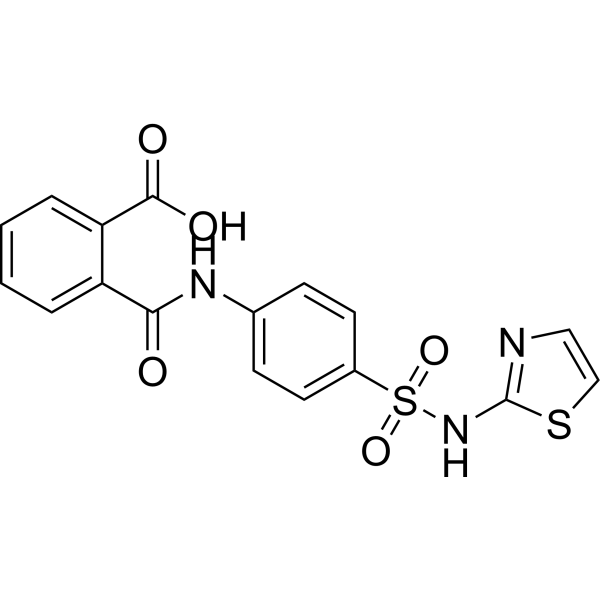
Phthalylsulfathiazole (N4-Phthalylsulfathiazole) is an orally active sulfonamide intestinal antibacterial agent. Phthalylsulfathiazole has low toxicity and excellent bacteriostatic efficacy. Phthalylsulfathiazole inhibits E. coli, streptococci, staphylococci, and total fecal bacteria. Phthalylsulfathiazole can be used in research related to intestinal infections such as colon infection, bacillary dysentery, and ulcerative colitis.
For research use only. We do not sell to patients.
- Purity : 95.0%
- CAS No.: 85-73-4
- Formula: C17H13N3O5S2
- Molecular Weight:403.43
-
Storage:Powder -20°C, 3 years , 4°C, 2 years ; In solvent -80°C, 2 years , -20°C, 1 year

To place orders, for customer services and technical support, please contact: MedChemExpress USA
Tel: 609-228-6898 E-mail: [email protected] [email protected]


-
 Biological Activity
-
Chemical Information
-
Solvent & Solubility
- Protocols
- Purity & Documentation
- References
-
 Help & FAQs


-

HY-B1407R
Phthalylsulfathiazole (Standard)Standard of Phthalylsulfathiazole -
HY-N7102
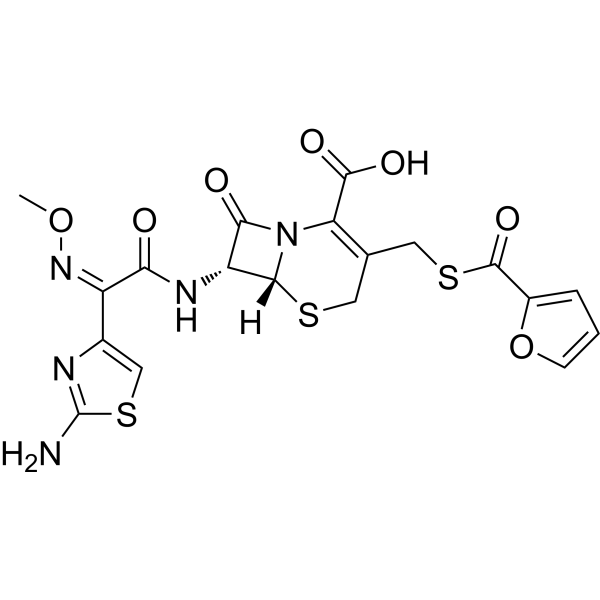
CeftiofurBacterial Inhibitor -
HY-B1282
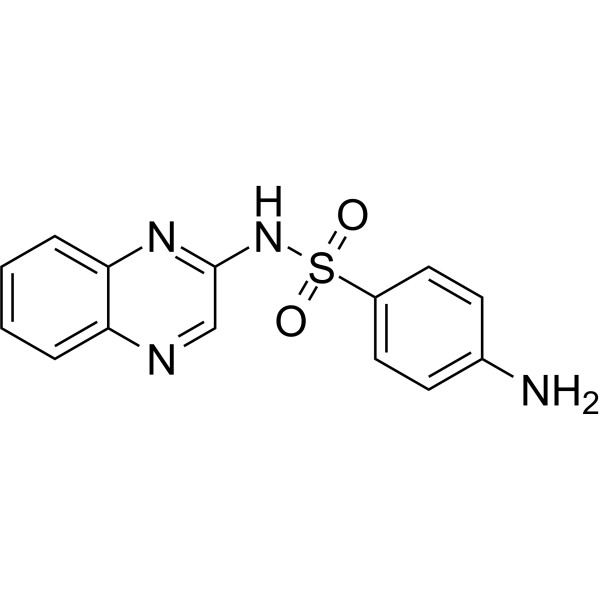
SulfaquinoxalineAntimicrobial -
HY-B0960
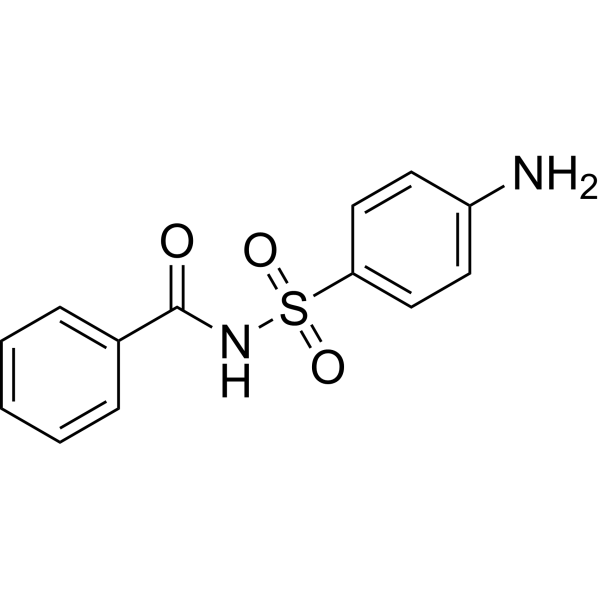
SulfabenzamideAntibacterial Agent -

HY-N7102R
Ceftiofur (Standard)Bacterial Inhibitor -

HY-B1282R
Sulfaquinoxaline (Standard)Antimicrobial -

HY-B0960R
Sulfabenzamide (Standard)Antimicrobial Agent
Publications Citing Use of MedChemExpress (MCE) Phthalylsulfathiazole
MoreAll Antibiotic Isoforms
More

Biological Activity
Description
In Vivo
MedChemExpress (MCE) has not independently confirmed the accuracy of these methods. They are for reference only.
-
Animal Model:Rockland strain rats (38-day-old, young)[1]
-
Dosage:0.5%; 1%; 2%
-
Administration:p.o.; mixed in feed; 77 days
-
Result:Caused a marked and sustained reduction in fecal coliform counts.
Significantly decreased fecal excretion of biotin and folic acid, and rats exhibited impaired weight gain, poor physical condition, and nutritional deficiency signs, and supplementation with biotin and folic acid improved physical appearance and weight gain without altering fecal bacterial counts.


Chemical Information
-
CAS No. 85-73-4
-
Appearance Solid
-
Molecular Weight 403.43
-
Formula C17H13N3O5S2
-
Color White to off-white
-
SMILES
O=C(O)C1=CC=CC=C1C(NC2=CC=C(S(=O)(NC3=NC=CS3)=O)C=C2)=O
-
Synonyms
N4-Phthalylsulfathiazole
-
Shipping
Room temperature in continental US; may vary elsewhere.
-
Storage
Powder -20°C 3 years 4°C 2 years In solvent -80°C 2 years -20°C 1 year


Publications (2)
-
Journal Impact Factor
-
Most Recent
-
ACS Environ Au
Machine Learning-Assisted Recognition of Environmental Sulfur-Containing Chemicals in Nontargeted Mass Spectrometry Analysis of Inadequate Mass Resolution. [Abstract]2025 Aug 5;5(6):573-582. PMID: 41277996 -
Anal Chem
Exposome-Scale Investigation of Cl-/Br-Containing Chemicals Using High-Resolution Mass Spectrometry, Multistage Machine Learning, and Cloud Computing. [Abstract]2025 Jun 3;97(21):11099-11109. PMID: 40401576


Solvent & Solubility
In Vitro:
DMSO : ≥ 40 mg/mL (99.15 mM; Hygroscopic DMSO has a significant impact on the solubility of product, please use newly opened DMSO)
* "≥" means soluble, but saturation unknown.
Please refer to the solubility information to select the appropriate solvent. Once prepared, please aliquot and store the solution to prevent product inactivation from repeated freeze-thaw cycles.
Storage method and period of stock solution: -80°C, 2 years; -20°C, 1 year. When stored at -80°C, please use it within 2 years. When stored at -20°C, please use it within 1 year.
Please refer to the solubility information to select the appropriate solvent. Once prepared, please aliquot and store the solution to prevent product inactivation from repeated freeze-thaw cycles.
Storage method and period of stock solution: -80°C, 2 years; -20°C, 1 year. When stored at -80°C, please use it within 2 years. When stored at -20°C, please use it within 1 year.
Concentration (start) × Volume (start) = Concentration (final) × Volume (final)

Protocols
-
Research Protocol for Infectious Diseases
Infectious-disease experiments test how pathogens interact with host barriers, innate immune receptors, inflammatory signaling, pathogen replication, and tissue injury; pattern-recognition receptors such as TLRs, RIG-I-like receptors, NOD-like receptors, and inflammasomes detect microbial molecules and activate NF-κB, interferon, and cytokine responses. The central hypothesis is that infection severity reflects the balance between pathogen burden and host response: protective inflammation restricts pathogen growth, whereas excessive or mislocalized inflammation contributes to tissue damage and disease phenotype. Unresolved questions include which host pathways are protective versus pathogenic, why some infection models fail to translate to human disease, and which combined readouts best predict clinically relevant infection outcomes.
-
DSS-Induced Colitis
Dextran sulfate sodium (DSS)-induced colitis is generated by administering DSS in mouse drinking water, producing epithelial injury, barrier disruption, weight loss, diarrhea, fecal blood, colon shortening, histologic mucosal damage, and inflammatory mediator changes; the model is mainly used to study acute or chronic intestinal inflammation resembling selected features of ulcerative colitis. DSS injury is interpreted through clinical and tissue readouts rather than a single molecular endpoint: daily body weight, stool consistency, and bleeding are combined into a disease activity index, while colon length, histology, cytokines, myeloperoxidase activity, intestinal permeability, and tight-junction markers provide complementary measures of inflammation and barrier damage.
-
TNBS-Induced Colitis
TNBS-induced colitis is produced by intrarectal delivery of 2,4,6-trinitrobenzene sulfonic acid in ethanol, where ethanol disrupts the mucosal barrier and TNBS haptenates colonic proteins, generating immune-mediated colonic inflammation with weight loss, diarrhea, ulceration, transmural injury, inflammatory-cell infiltration, and cytokine responses. The model is used as an experimental intestinal inflammation model with Crohn’s disease–like features, especially when Th1-type responses, IL-12–dependent inflammation, chronic relapsing inflammation, or fibrosis-related endpoints are studied.


Purity & Documentation
-
Data Sheet (276 KB)
-
SDS (459 KB)
- English - EN (459 KB)
- Français - FR (459 KB)
- Deutsch - DE (459 KB)
- Norwegian - NO (459 KB)
- Español - ES (459 KB)
- Swedish - SV (459 KB)
- Italian - IT (459 KB)
- Korean - KR (459 KB)
- Portuguese - PT (459 KB)
-
Handling Instructions (2659 KB)
References


Complete Stock Solution Preparation Table
Please refer to the solubility information to select the appropriate solvent. Once prepared, please aliquot and store the solution to prevent product inactivation from repeated freeze-thaw cycles.
Storage method and period of stock solution: -80°C, 2 years; -20°C, 1 year. When stored at -80°C, please use it within 2 years. When stored at -20°C, please use it within 1 year.
| Optional Solvent | Concentration Solvent Mass | 1 mg | 5 mg | 10 mg | 25 mg |
|---|---|---|---|---|---|
| DMSO | 1 mM | 2.4787 mL | 12.3937 mL | 24.7874 mL | 61.9686 mL |
| 5 mM | 0.4957 mL | 2.4787 mL | 4.9575 mL | 12.3937 mL | |
| 10 mM | 0.2479 mL | 1.2394 mL | 2.4787 mL | 6.1969 mL | |
| 15 mM | 0.1652 mL | 0.8262 mL | 1.6525 mL | 4.1312 mL | |
| 20 mM | 0.1239 mL | 0.6197 mL | 1.2394 mL | 3.0984 mL | |
| 25 mM | 0.0991 mL | 0.4957 mL | 0.9915 mL | 2.4787 mL | |
| 30 mM | 0.0826 mL | 0.4131 mL | 0.8262 mL | 2.0656 mL | |
| 40 mM | 0.0620 mL | 0.3098 mL | 0.6197 mL | 1.5492 mL | |
| 50 mM | 0.0496 mL | 0.2479 mL | 0.4957 mL | 1.2394 mL | |
| 60 mM | 0.0413 mL | 0.2066 mL | 0.4131 mL | 1.0328 mL | |
| 80 mM | 0.0310 mL | 0.1549 mL | 0.3098 mL | 0.7746 mL |


Phthalylsulfathiazole Related Classifications
HY-B1407 Related Classifications
 Powered by Bioz