Others
-
Others Related Products (76625)
Related Products (76625)

-
Sulfentrazone (Standard)
 0 Images
Sulfentrazone (Standard) is the analytical standard of Sulfentrazone. This product is intended for research and analytical applications. Sulfentrazone is a phenyl triazolinone herbicide used for control of certain broadleaf and grass weed species. Sulfentrazone inhibits protoporphyrinogen oxidase, resulting in the disruption of lipid cell membranes.
-
Mg(II) protoporphyrin IX
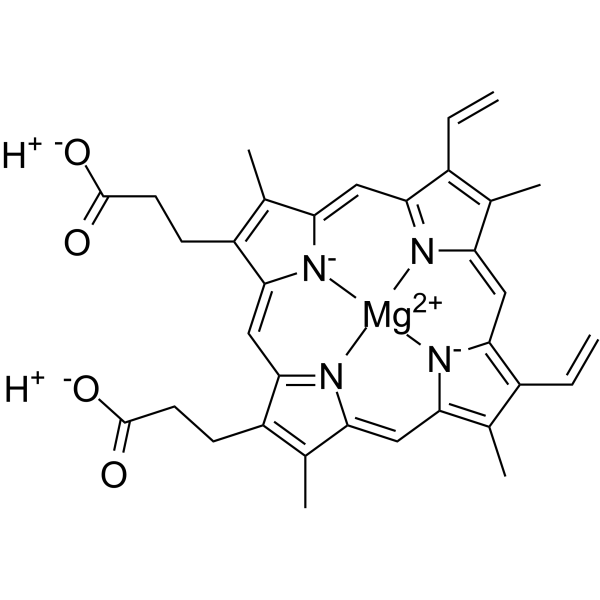 0 ImagesCat. No.: HY-136476CAS No.: 14947-11-6
Mg (II) protoporphyrin IX is a precursor of chlorophyll in Chlorella. Mg (II) protoporphyrin IX acts as a negative effector of nuclear photosynthetic gene expression. Mg (II) protoporphyrin IX can be used to study signal molecules involved in plastid-nucleus communication.
-
Pt(II) protoporphyrin IX
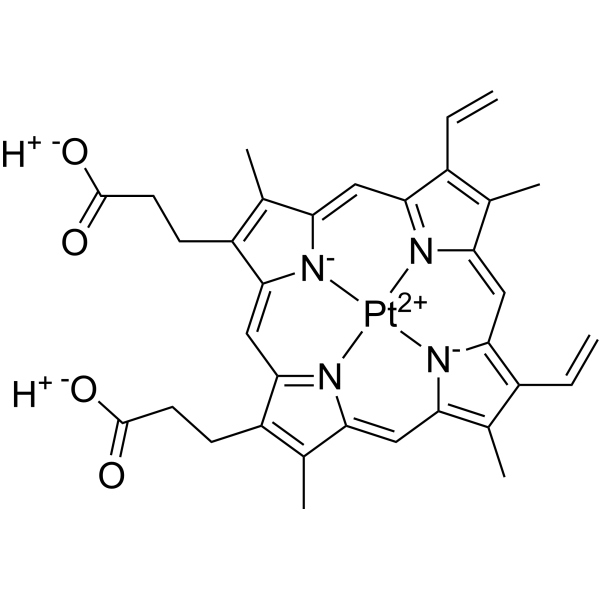 0 ImagesCat. No.: HY-136476GCAS No.: 98303-94-7
Pt(II) protoporphyrin IX is a protoporphyrin IX. Protoporphyrin IX is a heterocyclic organic compound, which consists of four pyrrole rings, and is the final intermediate in the heme biosynthetic pathway.
-
Boc-D-Phe-Pro-OH
 0 ImagesSynonyms: tert-Butoxycarbonyl-D-phenylalanyl-L-proline
Boc-D-Phe-Pro-OH (tert-Butoxycarbonyl-D-phenylalanyl-L-proline) is a synthetic intermediate useful for pharmaceutical synthesis.
-
MTT Formazan
 0 Images
MTT Formazan is a purple water-insoluble product formed by the reduction of yellow soluble MTT by succinate dehydrogenase in the mitochondria of viable cells. The amount of MTT Formazan produced is proportional to cellular metabolic activity, and it can serve as an indicator for evaluating cell viability and proliferation. MTT Formazan exhibits solvent-dependent solubility properties, and its absorbance value can be measured by spectrophotometry to reflect cellular status. MTT Formazan also supports the assessment of cell viability in bacterial MTT assays. MTT Formazan can be used in photoacoustic microscopy to enhance the imaging effect of viable cells, especially in applications in the fields of three-dimensional cell culture and tissue engineering.
-
(±)5-iPF2α-VI
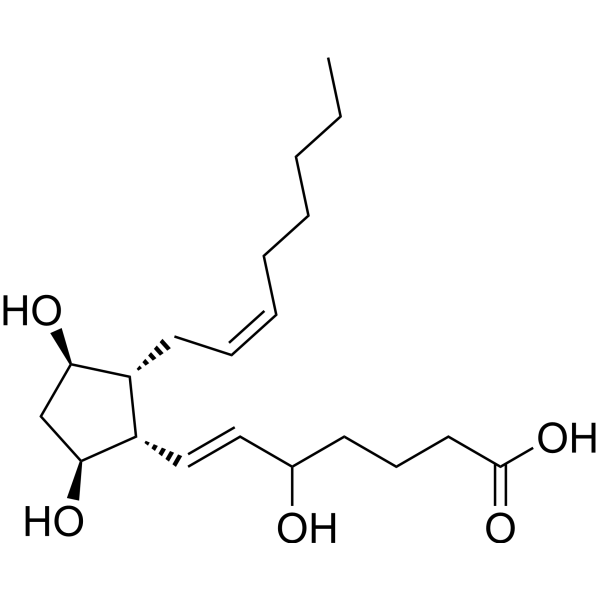 0 ImagesSynonyms: 5-iso Prostaglandin F2α-VI
(±)5-iPF2α-VI (5-iso Prostaglandin F2α-VI) is the racemate of 5-iPF2α-VI. 5-iPF2α-VI is a regioisomeric isoprostane formed from arachidonic acid (AA) and is a biomarker of oxidative stress.
-
Sp-ATPαS tetrasodium solution (100mM)
 0 ImagesCat. No.: HY-137626APurity: 98.60%
Sp-ATPαS tetrasodium is a thiophosphonate analogue of ATP. Sp-ATPαS tetrasodium is a competitive antagonist of the human P2Y1 receptor and can inhibit the calcium signal induced by ADP. Sp-ATPαS tetrasodium has higher metabolic stability than ATP. Sp-ATPαS tetrasodium can be used to study the binding mode of metal-nucleotide in enzymatic reactions.
-
Tenofovir isoproxil monoester
 0 ImagesCat. No.: HY-138138CAS No.: 211364-69-1
Tenofovir isoproxil monoester is a drug impurity.
-
N-(p-Tosyl)-GPR-pNA acetate
 0 ImagesSynonyms: Chromozym-TH
N-(p-Tosyl)-GPR-pNA acetate (Chromozym-TH) is a chromogenic substrate targeting the synthetic peptides Hirunorm IV and Hirunorm V and can be used to detect the dissociation constants (KI) of both peptides. Hirunorm IV and Hirunorm V are reversible inhibitors of amidolytic thrombin activity. By varying the peptide concentration at a fixed concentration of the chromogenic substrate N-(p-Tosyl)-GPR-pNA acetate, the dissociation constants determined were 0.134 nM (Hirunorm IV) and 0.245 nM (Hirunorm V).
-
Allyl 2-acetamido-2-deoxy-β-D-glucopyranoside
 0 Images
Allyl 2-acetamido-2-deoxy-β-D-glucopyranoside is a NodC substrate and chitooligosaccharide chain initiator. Allyl 2-acetamido-2-deoxy-β-D-glucopyranoside acts as an initial acceptor to enable the extension of chitooligosaccharide chains and the synthesis of allyl penta-N-acetylchitopentaose.
-
4-Hydroxy-6-methylcoumarin
 0 ImagesCat. No.: HY-138545CAS No.: 13252-83-0
4-Hydroxy-6-methylcoumarin is a Coumarin product.
-
(2R,3R)-GSK973
 0 ImagesCat. No.: HY-138563A
(2R,3R)-GSK973 is an isomer of GSK973. GSK973 is a highly selective, orally bioavailable inhibitor of the BD2s (second bromodomains) of the BET family.
-
24:0 Lyso PC-13C6
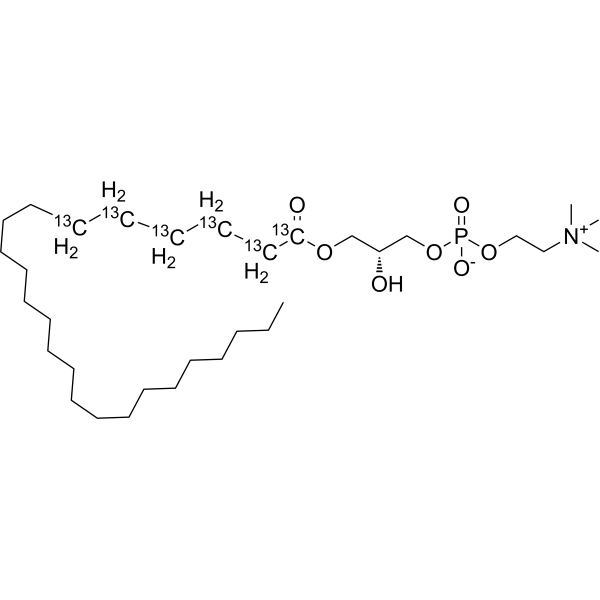 0 ImagesCat. No.: HY-138622SCAS No.: 2483735-01-7
24:0 Lyso PC-13C6 is the 13C labeled 24:0 Lyso PC. 24:0 Lyso PC is a lysophospholipid (LyP). 24:0 Lyso PC could be used for mRNA drug delivery.
-
Nirmatrelvir-d9
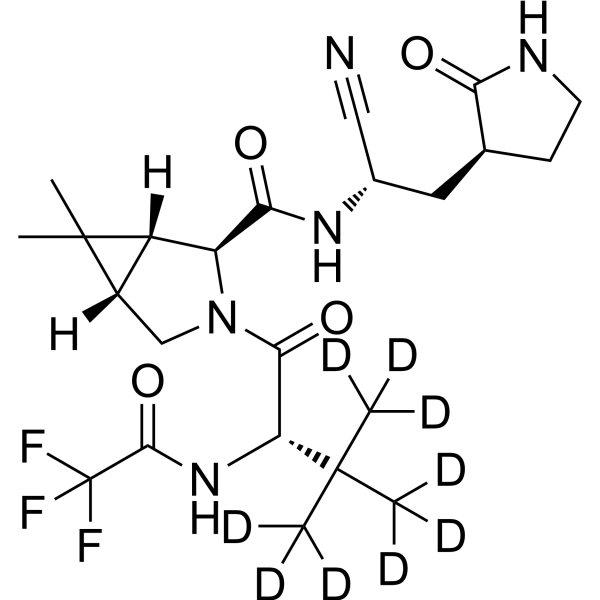 0 ImagesSynonyms: PF-07321332-d9
Nirmatrelvir-d9 (PF-07321332-d9) is the deuterium labeled Nirmatrelvir (HY-138687).
-
(±)17(18)-EpETE-ethanolamide
 0 ImagesCat. No.: HY-138971CAS No.: 2123491-23-4Synonyms: 17,18-EEQ-EA; (±)17,18-EEQ-ethanolamide; (±)17(18)-EpETE-EA
(±)17(18)-EpETE-ethanolamide (17,18-EEQ-EA) (compound 17) is an ω-3 endocannabinoid epoxide with cytokine modulation in neuroinflammation studies, antiangiogenic effects in vascular endothelial cells, and vasodilatory effects on coronary arteries.
-
4'-Hydroxywarfarin-d4
 0 ImagesCat. No.: HY-139003SCAS No.: 94820-63-0
4'-Hydroxywarfarin-d4 is the deuterated-labeled 4'-Hydroxywarfarin (HY-139003). 4'-Hydroxywarfarin is a regioisomeric phenolic derivative of Warfarin (HY-B0687). 4'-Hydroxywarfarin is a major metabolite of Warfarin in mammals and serves as a metabolic probe for the diversity of cytochrome P-450 isoenzymes.
-
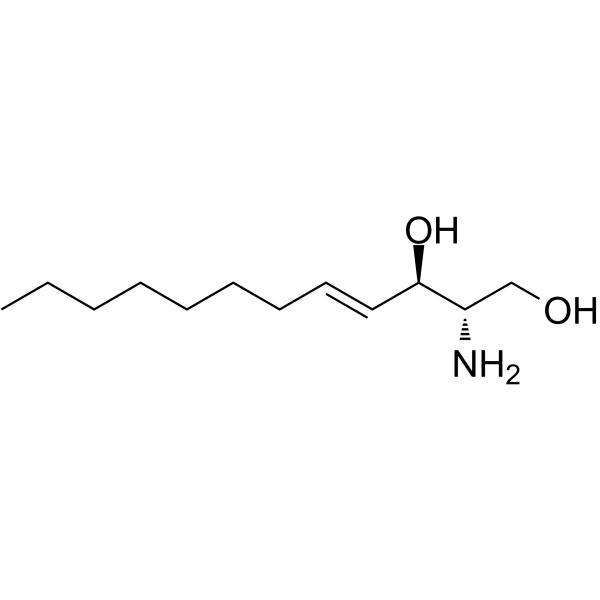
C12-Sphingosine
 0 Images
C12-Sphingosine is a short-chain Sphingosine homologue. C12-Sphingosine inhibits serine palmitoyltransferase activity in primary cultured cerebellar cells.
-
7-Methyl-diguanosine triphosphate ammonium solution (100 mM)
 0 ImagesSynonyms: m7Gp3G ammonium
7-Methyl-diguanosine triphosphate (m7Gp3G) ammonium is an mRNA cap structure analog that inhibits in vitro protein synthesis by binding to the translation initiation complex. 7-Methyl-diguanosine triphosphate ammonium binds to eIF4E, promotes cap-dependent translation initiation, stabilizes mRNA, and acts as a translation enhancer. 7-Methyl-diguanosine triphosphate ammonium can be used to prepare synthetic capped RNA transcripts for studies related to mRNA translation, splicing, turnover, and intracellular transport.
-
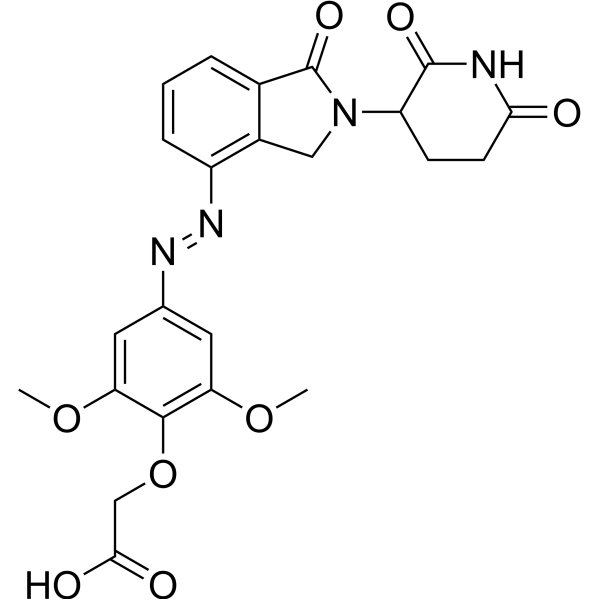
Photo-lenalidomide-acid
 0 ImagesCat. No.: HY-139340CAS No.: 2363154-39-4
Photo-lenalidomide-acid (compound 3) is a photacts consist of a ligand for an E3 ligase, a photoswitch, and a ligand for a protein of interest and enable optical control of protein degradation.