



Glycosidase
Glycosidase
Glycosidase are a class of enzymes which catalyze the hydrolysis of glycosidic bonds. In living organisms, Glycosidase are involved in carbohydrate metabolism. They can degrade polysaccharides such as starch and glycogen into monosaccharides, providing energy for cells. Glycosidase also participate in the synthesis and modification of biological macromolecules such as glycoproteins and glycolipids, playing a crucial role in cell recognition and signal transduction. Additionally, in plants and microorganisms, Glycosidase are involved in the metabolism of cell wall polysaccharide components, affecting cell growth, differentiation, and morphogenesis. Gene mutations of Glycosidase can trigger genetic diseases, leading to abnormal metabolism in the body and damage to organ functions. Changes in their activity are associated with various diseases such as diabetes, infectious diseases, and tumors, and can influence the occurrence and development of diseases[1][2].
References:
- [1]. Wang X, et al. Metabolites extracted from microorganisms as potential inhibitors of glycosidases (α-glucosidase and α-amylase): A review. Front Microbiol. 2022 Nov 17;13:1050869.
- [2]. Ohtsubo K, et al. Glycosylation in cellular mechanisms of health and disease. Cell. 2006 Sep 8;126(5):855-67. [Content Brief]
All Product Categories
-
Glycosidase Inhibitors
(456)
View all products
-
Glycosidase Antagonist
(1)
View all products
-
Glycosidase Activators
(20)
View all products
-
Glycosidase Modulators
(8)
View all products
-
Glycosidase Chemical
(1)
View all products
-
Glycosidase Inducers
(2)
View all products
-
Glycosidase Degrader
(1)
View all products
-
Glycosidase Controls
(6)
View all products
-
Glycosidase Substrates
(25)
View all products
-
Glycosidase Ligands
(3)
View all products
-
Glycosidase Related Products (697)
Related Products (697)

-
Antibodies (3)
-
α-Glucosidase-IN-103
 0 ImagesCat. No.: HY-179508α-Glucosidase-IN-103 (compound 5u) is a potent and competitive α-Glucosidase inhibitor with an IC50 of 5.38 µM and a Ki of 3.57 µM. α-Glucosidase-IN-103 can be used for type 2 diabetes (T2DM) research.
-
α-Glucosidase-IN-106
 0 ImagesCat. No.: HY-179729α-Glucosidase-IN-106 (Compound 17F) is an inhibitor of α-glucosidase with an IC50 of 14.9 μM. α-Glucosidase-IN-106 can effectively inhibit the peak of blood glucose after sucrose loading in normal mice, and shows a more significant anti-hyperglycemic effect in diabetic mice. α-Glucosidase-IN-106 can be used for research on diabetes.
-
α-Glucosidase-IN-108
 0 ImagesCat. No.: HY-180577α-Glucosidase-IN-108 (Compound 2h) is a potent competitive α-glucosidase inhibitor with an IC50 of 9.64 μM and a Ki of 7.39 μM. α-Glucosidase-IN-108 can be used for the research of type 2 diabetes.
-
Polypectate sodium
 0 ImagesCat. No.: HY-W250315CAS No.: 9049-37-0Synonyms: pectate sodiumPolypectate sodium is a major component of cell wall polysaccharides (pectins) and is used as a carbon source and inducer of polygalacturonase. Polypectate sodium can also be used to evaluate alkaline active and alkaline stable pectate lyases from Streptomyces spp. and to study the optimization of polygalacturonase production from Xanthophyllum spp. and reaction conditions.
-
Mortatarin G
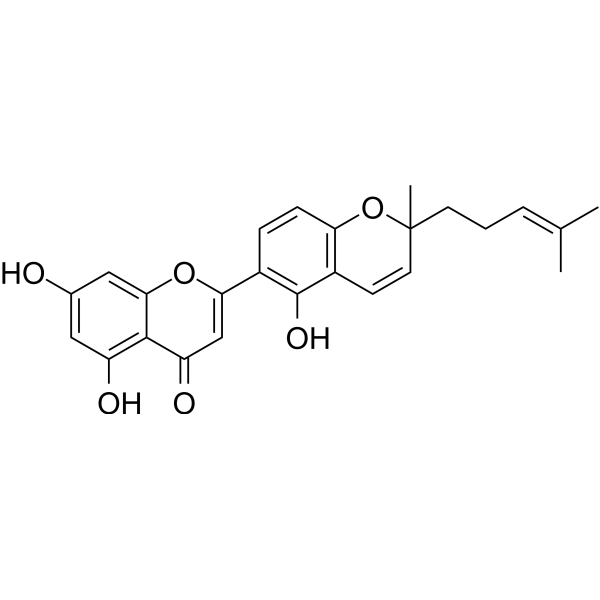 0 ImagesCat. No.: HY-N11841CAS No.: 2477746-26-0Mortatarin G (compound 3) is a prenylated flavonoid, that can be isolated from mulberry leaves. Mortatarin G exhibits good α-glucosidase inhibitory activity, with an IC50 of 20.4±1.4 μM.
-
α-Glucosidase-IN-3
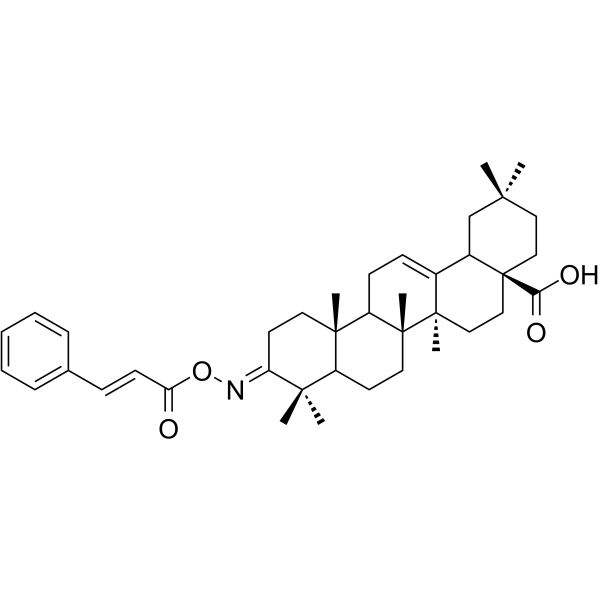 0 ImagesCat. No.: HY-146981CAS No.: 2758286-48-3α-Glucosidase-IN-3 is an oleanolic acid (OA) oxime ester derivativ eagainst α-glucosidase(IC50=0.35 µM) and α-amylase.
-
Trehalose-6-phosphate hydrolase, Escherichia coli
 0 ImagesCat. No.: HY-E70898Trehalose-6-phosphate hydrolase, Escherichia coli (EC 3.2.1.93), belongs to the hydrolase family and is a glycosidase that hydrolyzes O- and S-glycoside compounds. Trehalose-6-phosphate hydrolase participates in the metabolism of starch and sucrose. Its substrates are α,α'-trehalose-6-phosphate and water, and its products are D-glucose and D-glucose-6-phosphate.
-
α-Glucosidase-IN-28
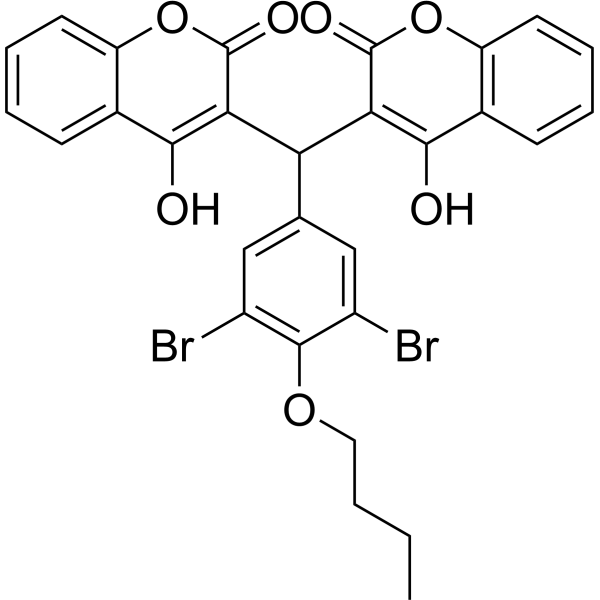 0 ImagesCat. No.: HY-149341CAS No.: 2949513-10-2α-Glucosidase-IN-28 (Compound 18) is a α-Glucosidase inhibitor (IC50: 0.62 μM, Ki: 3.93 μM). α-Glucosidase-IN-28 binds to α-glucosidase at the original binding site (OBS), and forms multiple hydrophobic interactions with nearby amino acids. α-Glucosidase-IN-28 can be used for research of diabetes and related diseases.
-
β-Galactosidase 42A, Caldicellulosiruptor saccharolyticus
 0 ImagesCat. No.: HY-E71299Aβ-Galactosidase 42A, Caldicellulosiruptor saccharolyticus (EC 3.2.1.23) is a hydrolase enzyme that catalyzes the hydrolysis of β-galactosides into monosaccharides. Substrates of different β-galactosidases include ganglioside GM1, lactosylceramides, lactose, and various glycoproteins.
-
α-Glucosidase-IN-122
 0 ImagesCat. No.: HY-187713α-Glucosidase-IN-122 is an inhibitor of α-glucosidase (α-Glucosidase). α-Glucosidase-IN-122 regulates glucose and lipid metabolism through multiple pathways, including inhibition of α-glucosidase and lipase, and exertion of antioxidant activity, and enhances glucose consumption in insulin-resistant HepG2 cells. α-Glucosidase-IN-122 can be used in the research of type 2 diabetes.
-
Plantagoside (Standard)
 0 ImagesCat. No.: HY-N1470RCAS No.: 78708-33-5Plantagoside (Standard) is the analytical standard of Plantagoside (HY-N1470). This product is intended for research and analytical applications. Plantagoside is a flavanone glucoside found in Plantago asiatica seeds, acting as a specific non-competitive α-mannosidase inhibitor with IC50 values of 5 μM and a Ki of 2.7 μM (jack bean). Plantagoside suppresses antibody response and Concanavalin A (HY-P2149)-induced lymphocyte proliferation in mouse spleen cells. Plantagoside inhibits the Maillard reaction, advanced glycation end product formation, and glycation-dependent protein-protein cross-link formation. Plantagoside can be used for the research of diabetes.
-
α-Glucosidase-IN-15
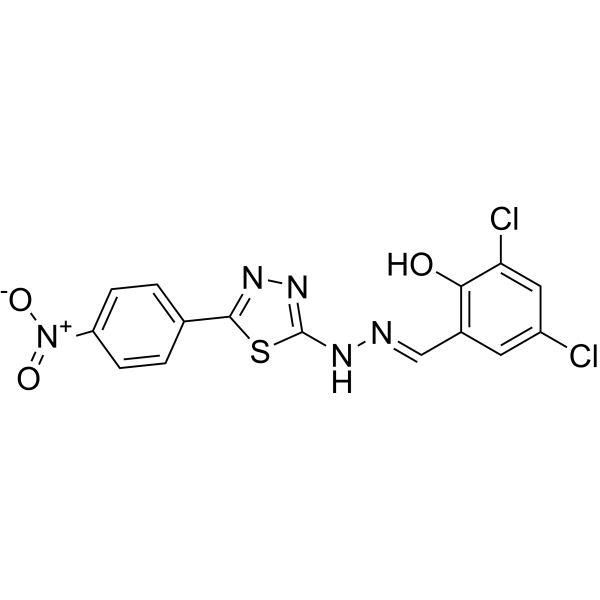
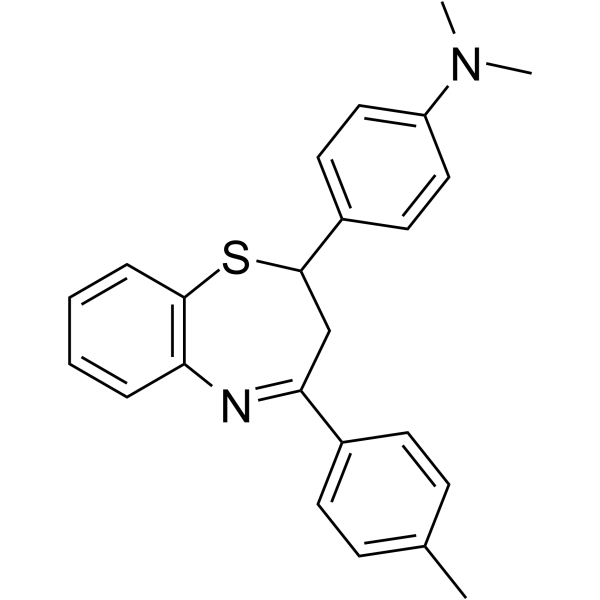 0 ImagesCat. No.: HY-151135CAS No.: 2820424-85-7α-Glucosidase-IN-15 (Compound 14B) is a potent, orally active α-glucosidase inhibitor with an IC50 of 3.34 μM. α-Glucosidase-IN-15 shows antidiabetic activity.


-
PROTAC RTA Degrader-1
 0 ImagesCat. No.: HY-181705PROTAC RTA Degrader-1 (Compound 3A) is a ricin toxin A chain (RTA) PROTAC degrader. PROTAC RTA Degrader-1 forms stable ternary complexes, maintains sustained hydrogen bonding interactions, and exhibits distinct interaction energy. PROTAC RTA Degrader-1 is applicable to research related to ricin toxin poisoning.

-
β-Galactosidase 2B, Bacteroides thetaiotaomicron
 0 ImagesCat. No.: HY-E71298β-Galactosidase 2B, Bacteroides thetaiotaomicron (EC 3.2.1.23) is a hydrolase enzyme that catalyzes the hydrolysis of β-galactosides into monosaccharides. Substrates of different β-galactosidases include ganglioside GM1, lactosylceramides, lactose, and various glycoproteins.
-
Ferruginoside C
 0 ImagesCat. No.: HY-N16523CAS No.: 213991-03-8Ferruginoside C is a phenylethanoid. Ferruginoside C can be isolated from V. leiocarpum. Ferruginoside C shows potent alpha-glucosidase inhibitory activity with an IC50 of 19.93 μM. Ferruginoside C shows antioxidant activities. Ferruginoside C can be used in the research of cervical cancer, ovarian cancer, and colon cancer.
-
3,4,6-Tri-O-galloyl-D-glucose
 0 ImagesCat. No.: HY-N17215CAS No.: 99523-99-6Synonyms: 3,4,6-Trigalloylglucose3,4,6-Tri-O-galloyl-D-glucose (3,4,6-Trigalloylglucose) is an α-amylase (porcine α-amylase IC50 = 334.6 μM; Ki = 307.5 μM) and α-glucosidase (yeast α-glucosidase IC50 = 46.5 μM; Ki = 39.9 μM) mixed type inhibitor. 3,4,6-Tri-O-galloyl-D-glucose exhibits free radical scavenging ability, ferric-reducing power, and antioxidant activity. 3,4,6-Tri-O-galloyl-D-glucose can be used for the research of diabetes.




