



Fluorescent Dye
Fluorescence is a phenomenon of photoluminescence in luminescence. When an atom is irradiated by light, some electrons around the nucleus jump from their original orbitals to higher energy orbitals under the influence of light energy, i.e., from the ground state to the first or second excited single-line state, etc. Due to the instability of the first or second excited singlet state, the electron returns from the excited singlet state to the ground state accompanied by released energy, resulting in fluorescence.
Fluorescent dyes can be covalently bound or physically adsorbed in the structure of the substance. The fluorescence properties allow for the characterization, localization and quantitative analysis of the labeled object. Fluorescent dyes have shown great potential for the detection of proteins, nucleic acids, cells, and immunoassays, attributed to the advantages in non-radioactive contamination, simple experimental operation and easy observation.
Fluorescent dyes have penetrated many fields such as pharmacology, physiology, environmental science, and information science, as well as functional studies of proteins and drug screening.
All Product Categories
-
Fluorescent Dye Related Products (4914)
Related Products (4914)

-
Antibodies (4)
-
FAM labled Evazarsen sodium
 0 ImagesCat. No.: HY-147267DFAM labled Evazarsen sodiumis a FAM labled Evazarsen sodium.

-
Pyranine hydrate
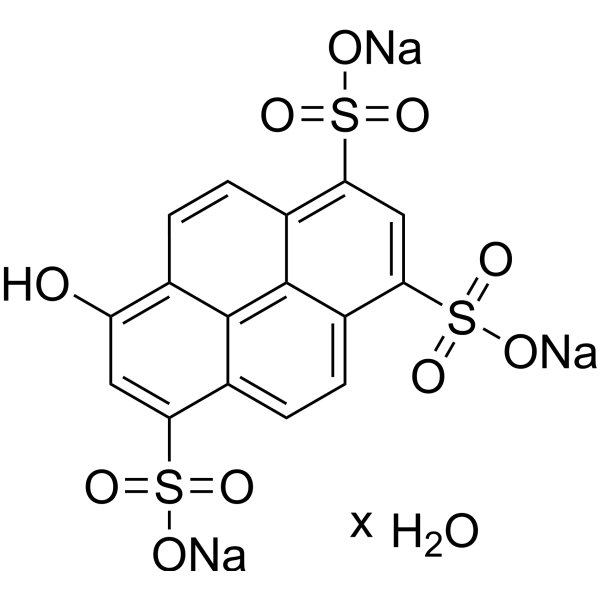 0 ImagesCat. No.: HY-D0023ASynonyms: HPTS hydrate; Solvent Green 7 hydratePyranine (HPTS; Solvent Green 7) hydrate is a cell-impermeant pH-sensitive fluorescent indicator. Pyranine hydrate acts as a class of fluorescent chemosensor for the Cu+ ion. Pyranine hydrate is used as a coloring agent, biological stain, optical detecting reagent, and pH indicator (Ex/Em = 450/510 nm).
-
Dansyl-D-Ala-Gly-Phe(pNO2)-Gly
 0 ImagesDansyl-D-Ala-Gly-Phe(pNO2)-Gly is a synthetic peptide substrate. As a substrate of NEP, Dansyl-D-Ala-Gly-Phe(pNO2)-Gly can be specifically recognized and cleaved by the enzyme, thereby releasing the fluorophore dansyl, which can be quantitatively detected. Therefore, it is often used to determine the activity of NEP.
-
ATTO 550 maleimide
 0 ImagesCat. No.: HY-D2021CAS No.: 870534-97-7ATTO 550 maleimide is a new fluorescent marker based on the Rhodamine structure. It has strong absorption, high fluorescence quantum yield, high thermal stability and photochemical stability, and is suitable for single molecule detection and high-resolution microscopy. ATTO 550 maleimide is a maleimide derivative of ATTO 550, which can be used to label proteins or antibodies.
-
TPE-SQ5
 0 ImagesCat. No.: HY-D3094CAS No.: 2687198-42-9TPE-SQ5 is a ratiometric Fluorescent probe for hypochlorite (ClO-) detection with a limit of detection of 5.6 nM. TPE-SQ5 exhibits high selectivity and high sensitivity towards ClO-. TPE-SQ5 can be oxidized by ClO- to form an epoxide, which quenches its deep red fluorescence; subsequently, the epoxide decomposes into a hemicyanine and a sulfonic acid-substituted oxindole, producing blue-green fluorescence to achieve a ratiometric response. TPE-SQ5 can form nanoparticles with Pluronic F-127 via the nanoprecipitation method, and these nanoparticles possess cell permeability. TPE-SQ5 has unique Ex/Em spectra in different solvents and nanoparticle forms, with emission peaks at 643 nm (380 nm excitation, 95% H2O/THF), 631 nm (564 nm excitation, DMSO), 652 nm (536 nm excitation, THF) and 630 nm (524 nm excitation, nanoparticles); the Ex/Em settings used for cell imaging are 488/550-650 nm (red channel) and 405/450-550 nm (green channel).
-
PE-VF647 Maleimide
 0 ImagesCat. No.: HY-D2091PE-VF647 Maleimide is a double-dye dye that can undergo thiol reaction. It contains maleimide groups that can react with thiol groups to form covalent bonds. PE-VF647 Maleimide contains two dyes, PE and VF, with excitation wavelengths (Ex) of 495 nm and 566 nm, respectively. PE-VF594 Maleimide has an emission wavelength (Em) of 665 nm.
-
Rhodamine B-Heparin
 0 ImagesCat. No.: HY-D3038Rhodamine B-Heparin is a Rhodamine B (HY-Y0016)-labeled heparin. Rhodamine B-Heparin is widely used in fluorescent labeling, molecular tracking, and visualization studies (Ex/Em = 546/610 nm).
-
Bis[3,4,6-trichloro-2-(pentyloxycarbonyl)phenyl] oxalate
![Bis[3,4,6-trichloro-2-(pentyloxycarbonyl)phenyl] oxalate](https://file.medchemexpress.com/product_pic/hy-w099490.gif "Click to View Bis[3,4,6-trichloro-2-(pentyloxycarbonyl)phenyl] oxalate Product Detail") 0 ImagesCat. No.: HY-W099490CAS No.: 30431-54-0Bis[3,4,6-trichloro-2-(pentyloxycarbonyl)phenyl] oxalate is a fluorescent dye that can be used for generation of chemiluminescence.
0 ImagesCat. No.: HY-W099490CAS No.: 30431-54-0Bis[3,4,6-trichloro-2-(pentyloxycarbonyl)phenyl] oxalate is a fluorescent dye that can be used for generation of chemiluminescence.
-
RB-PEG5000-N3
 0 ImagesCat. No.: HY-D2886ESynonyms: Rhodamine B-PEG5000-N3RB-PEG5000-N3 (Rhodamine B-PEG5000-N3) is a fluorescent dye composed of Rhodamine B (HY-Y0016), PEG and azide group (N3). RB-PEG5000-N3 is a click chemistry reagent, it contains an Azide group and can undergo copper-catalyzed azide-alkyne cycloaddition reaction (CuAAc) with molecules containing Alkyne groups. It can also undergo strain-promoted alkyne-azide cycloaddition (SPAAC) reactions with molecules containing DBCO or BCN groups (Ex/Em=546/610 nm).
-
TRITC-Polysucrose 40
 0 ImagesCat. No.: HY-179073ATRITC-Polysucrose 40 is TRITC-labeled Polysucrose 40 (HY-131960C). Polysucrose 40 is a copolymer of sucrose and epichlorohydrin. Polysucrose 40 can be used to prepare cross-linked polysucrose microspheres. TRITC-Polysucrose 40 is mainly used for permeability and microcirculation studies (Ex/Em = 544/570 nm).
-
C.I. Solvent red 197
 0 ImagesCat. No.: HY-D0573CAS No.: 52372-39-1Synonyms: Solvent red 197; Fluorescent Red GKC.I. Solvent Red 197 (Solvent Red 197; Fluorescent Red GK) is a high-temperature-resistant fluorescent bluish-red dye that is widely used for coloring polymers, plastics, fibers, printing inks, and hydrocarbon products (such as lubricants and candles). C.I. Solvent Red 197 does not induce allergic contact dermatitis.
-
AF 430 amine
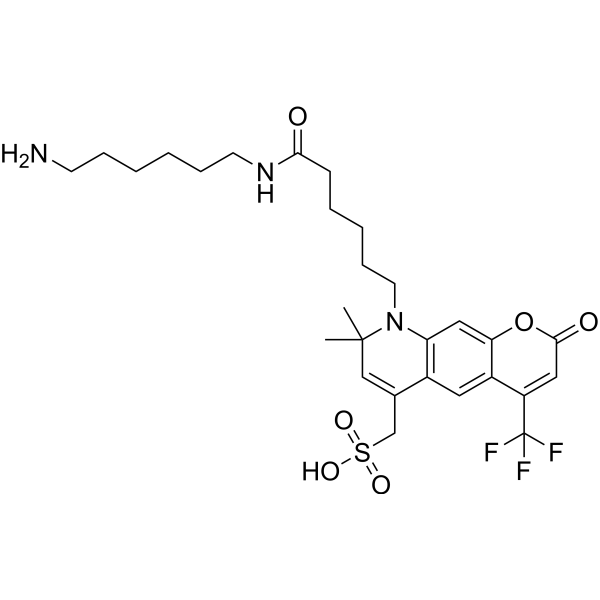 0 ImagesCat. No.: HY-D2163AF 430 amine is a derivative of the yellow fluorescent dye AF 430. AF430 has an excitation wavelength of 425 nm and an emission wavelength of 542 nm. AF 430 amine can form covalent bonds through a condensation reaction between amino groups and molecules containing carboxyl groups. To achieve specific coupling of dye labels and biomolecules.
-
PB succiniMidyl ester
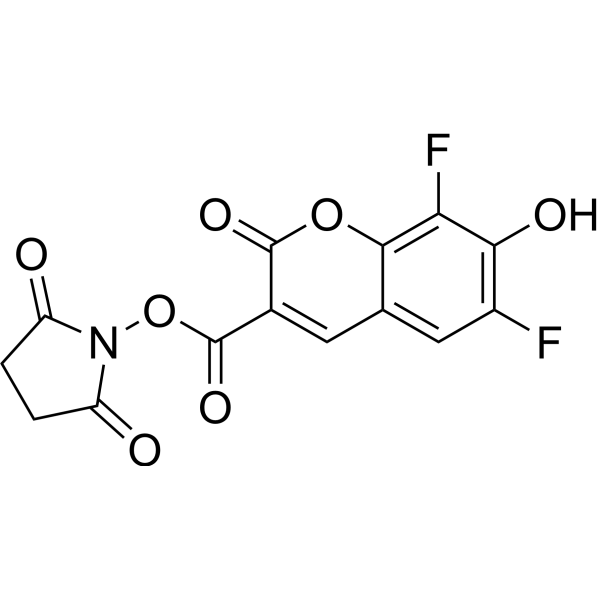 0 ImagesCat. No.: HY-133532CAS No.: 215868-33-0Synonyms: Ocean Blue, SEPB succiniMidyl ester (Ocean Blue, SE) is a fluorophore with the λexcitation/emission of ~405/455 nm.

-
Neutral Red Staining Solution (for Live Cells)
 0 ImagesCat. No.: HY-DY2020Neutral Red Staining Solution (for Live Cells) is a vital stain used for vital staining of peripheral blood cells, and it can also be used for staining other living cells or tissues. Neutral Red Staining Solution (for Live Cells) accumulates in cytoplasmic vacuoles, lysosomes of living cells, as well as plant/fungal vacuoles. It binds to anionic sites, suberin, lignin, cell walls, DNA and phenolic substances, and can intercalate into DNA. Neutral Red Staining Solution (for Live Cells) stains the cytoplasm of specific phytoplankton and estuarine zooplankton, while dead cells are not stained, enabling viability determination of such organisms.




