



Reference Standards
Material, sufficiently homogeneous and stable with respect to one or more specified properties, and the uses include the calibration of a measurement system, assessment of a measurement procedure, assigning values to other materials, and quality control and so on.
-
Reference Standards Related Products (11771)
Related Products (11771)

-
D-Glucose (Standard)
 0 ImagesSynonyms: Glucose (Standard); D-(+)-Glucose (Standard); Dextrose (Standard)D-Glucose (Standard) is the analytical standard of D-Glucose. This product is intended for research and analytical applications. D-Glucose is the naturally occurring form of glucose and the most abundant monosaccharide. D-Glucose is a critical components of the general metabolism, and serve as critical signaling molecules in relation to both cellular metabolic status and biotic or abiotic stress response.
-
Ampicillin (Standard)
 0 ImagesSynonyms: D-(-)-α-Aminobenzylpenicillin (Standard)Ampicillin (Standard) is the analytical standard of Ampicillin. This product is intended for research and analytical applications. Ampicillin is a broad-spectrum beta-lactam antibiotic against a variety of gram-positive and gram-negative bacteria.
-
Glutathione oxidized (Standard)
 0 ImagesSynonyms: L-Glutathione oxidized (Standard); GSSG (Standard); Oxiglutatione (Standard)Glutathione oxidized (Standard) is the analytical standard of Glutathione oxidized. This product is intended for research and analytical applications. Glutathione oxidized (L-Glutathione oxidized) is produced by the oxidation of glutathione. Detoxification of reactive oxygen species is accompanied by production of glutathione oxidized. Glutathione oxidized can be used for the research of sickle cells and erythrocytes.
-
Dimethyl sulfoxide (Standard)
 0 ImagesSynonyms: DMSO, meets analytical specification of Ch.P. (Standard)Dimethyl sulfoxide (Standard) is the analytical standard of Dimethyl sulfoxide. This product is intended for research and analytical applications. Dimethyl sulfoxide (DMSO) is an aprotic solvent that dissolves both polar and nonpolar compounds. Dimethyl sulfoxide has anti-freezing and bacteriostatic properties.
-
L-Isoleucine (Standard)
 0 ImagesL-Isoleucine (Standard) is the analytical standard of L-Isoleucine. This product is intended for research and analytical applications. L-Isoleucine is an orally active branched chain amino acid, which is the L-enantiomer of isoleucine. L-Isoleucine has a role as a Saccharomyces cerevisiae metabolite, an Escherichia coli metabolite, a plant metabolite, a human metabolite, an algal metabolite and a mouse metabolite. L-Isoleucine regulates the inflammatory response to protect against pathogens in vivo and in vitro.
-
Ursolic acid (Standard)
 0 ImagesSynonyms: Prunol (Standard); Urson (Standard); Malol (Standard)Ursolic acid (Standard) is the analytical standard of Ursolic acid. This product is intended for research and analytical applications. Ursolic acid (Prunol) is a natural pentacyclic triterpenoid carboxylic acid, exerts anti-tumor effects and is an effective compound for cancer prevention and therapy.
-
Xanthurenic acid (Standard)
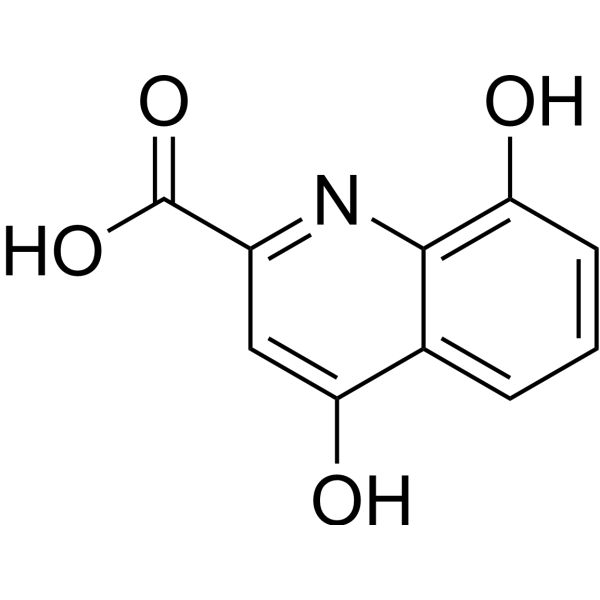 0 ImagesXanthurenic acid (Standard) is the analytical standard of Xanthurenic acid. This product is intended for research and analytical applications. Xanthurenic acid is a putative endogenous Group II metabotropic glutamate receptor agonist, on sensory transmission in the thalamus.
-
Spermine (Standard)
 0 ImagesSynonyms: NSC 268508 (Standard); Neuridine (Standard)Spermine (Standard) is the analytical standard of Spermine. This product is intended for research and analytical applications. Spermine (NSC 268508) functions directly as a free radical scabenger to protect DNA from free radical attack. Spermine has antiviral effects.
-
Acetazolamide (Standard)
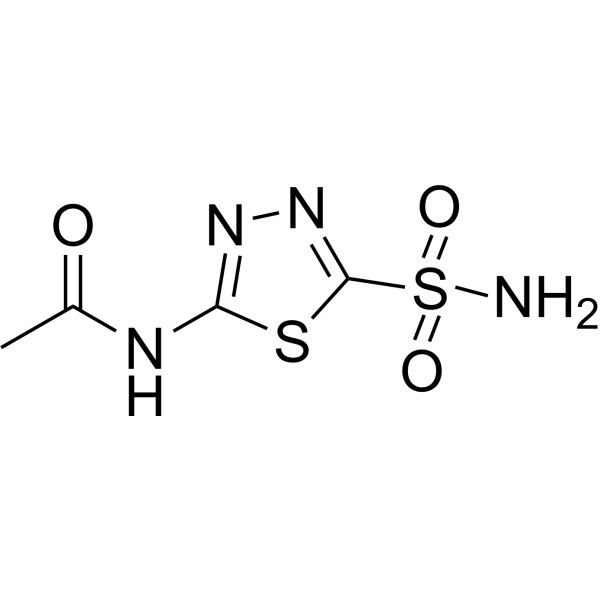 0 ImagesAcetazolamide (Standard) is the analytical standard of Acetazolamide. This product is intended for research and analytical applications. Acetazolamide is a carbonic anhydrase (CA) IX inhibitor with an IC50 of 30 nM for hCA IX. Acetazolamide has diuretic, antihypertensive and anti-gonococcal activities.
-
Gallic acid (Standard)
 0 ImagesSynonyms: 3,4,5-Trihydroxybenzoic acid (Standard)Gallic acid (Standard) is the analytical standard of Gallic acid. This product is intended for research and analytical applications. Gallic acid (3,4,5-Trihydroxybenzoic acid) is a natural polyhydroxyphenolic compound and an free radical scavenger to inhibit cyclooxygenase-2 (COX-2). Gallic acid has various activities, such as antimicrobial, antioxidant, antimicrobial, anti-inflammatory, and anticance activities.
-
Protoporphyrin IX (Standard)
 0 ImagesProtoporphyrin IX (Standard) is the analytical standard of Protoporphyrin IX. This product is intended for research and analytical applications. Protoporphyrin IX is a final intermediate in the heme biosynthetic pathway, which acts as a radiation sensitizer enhancing ROS generation even in a hypoxic state and inducing DNA damage. Protoporphyrin IX also acts as a photo sensitizer undergoing photobleaching that occurs through direct degradation by light irradiation. Protoporphyrin IX is formed and accumulated following 5-aminolevulinic acid (5-ALA) (HY-W000450) administration in the tumor cells of rats. Protoporphyrin IX causes selective improvement of basal cell carcinoma when activated red fluorescence of a peak wavelength at 405 nm. Protoporphyrin IX is promising for research of sonodynamic and photodynamic agents for a wide range of cancers, such as bladder cancer and nodular basal cell carcinoma.
-
Glycine (Standard)
 0 ImagesGlycine (Standard) is the analytical standard of Glycine. This product is intended for research and analytical applications. Glycine is an inhibitory neurotransmitter in the CNS and also acts as a co-agonist along with glutamate, facilitating an excitatory potential at the glutaminergic N-methyl-D-aspartic acid (NMDA) receptors. Glycine is orally active. Glycine can be used to study cell protection, cancer, neurological diseases, and angiogenesis.
-
L-Phenylalanine (Standard)
 0 ImagesSynonyms: (S)-2-Amino-3-phenylpropionic acid (Standard)L-Phenylalanine (Standard) is the analytical standard of L-Phenylalanine. This product is intended for research and analytical applications. L-Phenylalanine ((S)-2-Amino-3-phenylpropionic acid) is an essential amino acid isolated from Escherichia coli. L-Phenylalanine is a α2δ subunit of voltage-dependent Ca+ channels antagonist with a Ki of 980 nM. L-phenylalanine is a competitive antagonist for the glycine- and glutamate-binding sites of N-methyl-D-aspartate receptors (NMDARs) (KB of 573 μM ) and non-NMDARs, respectively. L-Phenylalanine is widely used in the production of food flavors and pharmaceuticals.
-
Methylcobalamin (Standard)
 0 ImagesCat. No.: HY-B0586RCAS No.: 13422-55-4Synonyms: Mecobalamin (Standard); CH3-B12 (Standard)Methylcobalamin (Standard) is the analytical standard of Methylcobalamin. This product is intended for research and analytical applications. Methylcobalamin (CH3-B12), a cobalamin, is a form of vitamin B12.
-
Acyclovir (Standard)
 0 ImagesSynonyms: Aciclovir (Standard); Acycloguanosine (Standard)Acyclovir (Standard) is the analytical standard of Acyclovir. This product is intended for research and analytical applications. Acyclovir (Aciclovir) is a potent, orally active antiviral agent. Acyclovir has antiherpetic activity with IC50 values of 0.85 μM and 0.86 μM for HSV-1 and HSV-2, respectively. Acyclovir induces cell cycle perturbation and apoptosis. Acyclovir prevents bacterial infections during induction therapy for acute leukaemia.
-
Prednisolone (Standard)
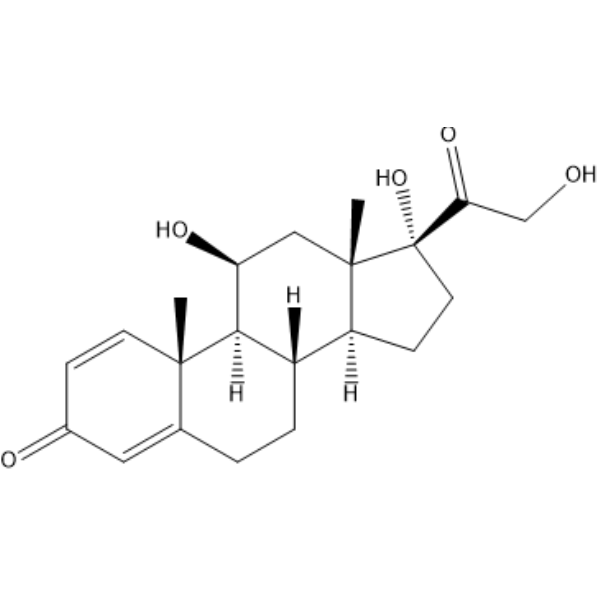 0 ImagesPrednisolone (Standard) is the analytical standard of Prednisolone. This product is intended for research and analytical applications. Prednisolone is a potent, orally active corticosteroid and a glucocorticoid. Prednisolone possesses about four times the anti-inflammatory activity of hydrocortisone while causing less salt and water retention. Prednisolone can be used for ocular, anti-inflammatory research.
-
Taurine (Standard)
 0 ImagesSynonyms: 2-Aminoethanesulfonic acid (Standard)Taurine (Standard) is the analytical standard of Taurine. This product is intended for research and analytical applications. Taurine, a sulphur-containing amino acid and an organic osmolyte involved in cell volume regulation, provides a substrate for the formation of bile salts, and plays a role in the modulation of intracellular free calcium concentration. Taurine has the ability to activate autophagy in adipocytes.
-
Pravastatin sodium (Standard)
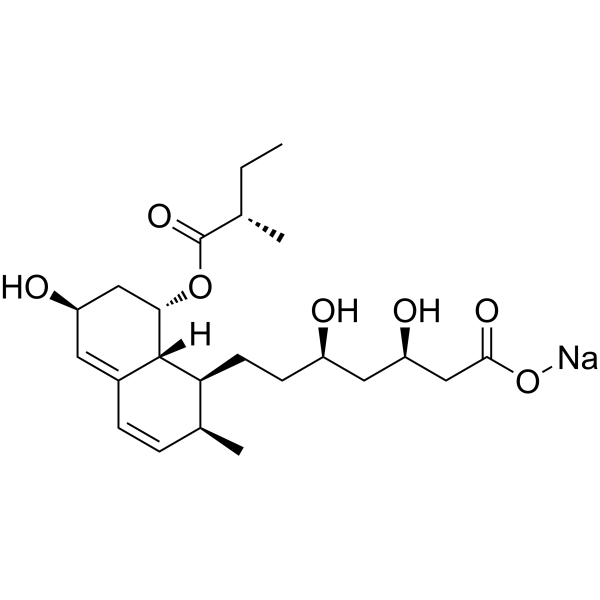 0 ImagesSynonyms: CS-514 sodium (Standard)Pravastatin (sodium) (Standard) is the analytical standard of Pravastatin (sodium). This product is intended for research and analytical applications. Pravastatin sodium (CS-514 sodium) is an HMG-CoA reductase inhibitor against sterol synthesis with IC50 of 5.6 μM.
-
Methylprednisolone (Standard)
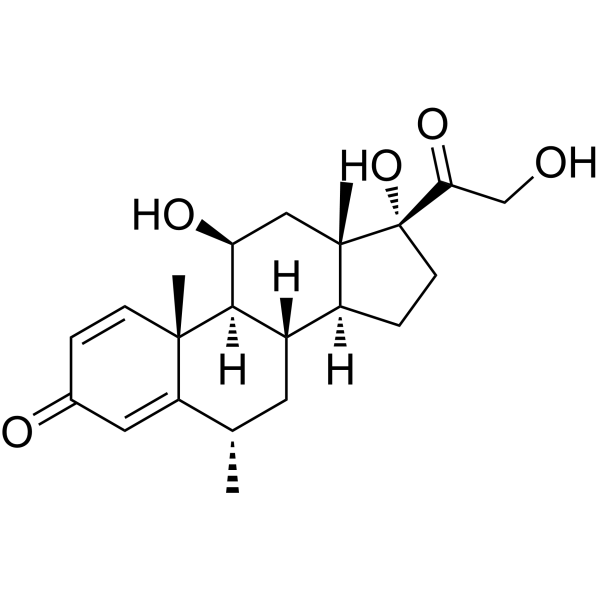 0 ImagesMethylprednisolone (Standard) is the analytical standard of Methylprednisolone. This product is intended for research and analytical applications. Methylprednisolone is a synthetic corticosteroid with anti-inflammatory and immunomodulating properties. Methylprednisolone improve severe or critical COVID-19 by activating ACE2 and reducing IL-6 levels.
-
Nicotinamide riboside chloride (Standard)
 0 ImagesNicotinamide riboside (chloride) (Standard) is the analytical standard of Nicotinamide riboside (chloride). This product is intended for research and analytical applications. Nicotinamide riboside Chloride, an orally active NAD+ precursor, increases NAD+ levels and activates SIRT1 and SIRT3. Nicotinamide riboside Chloride is a source of vitamin B3 (niacin) and enhances oxidative metabolism, protection against high fat diet-induced metabolic abnormalities[1]. Nicotinamide riboside Chloride reduces cognitive deterioration in a transgenic mouse model of Alzheimer’s disease[2].



