



A2A receptor antagonist 2
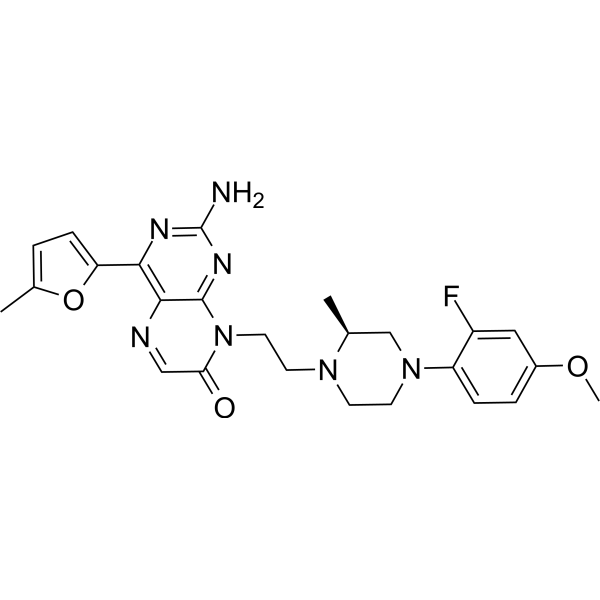
A2A receptor antagonist 2 (Compound 57) is a potent, highly selective adenosine A2A receptor (A2AR) antagonist with an IC50 of 8.3 nM.
For research use only. We do not sell to patients.
- CAS No.: 2767206-20-0
- Formula: C25H28FN7O3
- Molecular Weight:493.53
-
Storage:
Please store the product under the recommended conditions in the Certificate of Analysis.

To place orders, for customer services and technical support, please contact: MedChemExpress USA
Tel: 609-228-6898 E-mail: [email protected] [email protected]


-
 Biological Activity
-
Chemical Information
- Protocols
- Purity & Documentation
- References
-
 Help & FAQs


All Adenosine Receptor Isoforms
More

Biological Activity
Description
IC50 & Target
|
A2AR 8.3 nM (IC50) |
In Vitro
A2A receptor antagonist 2 (Compound 57) shows potent antagonistic activity in the presence of a high level of NECA (5′-N-ethylcarboxamidoadenosine, an A2AR agonist) [1].
A2A receptor antagonist 2 enhances the activation and effector function of T cells, with no obvious cytotoxicity toward the HCT116 cells and MC38 cells[1].
MedChemExpress (MCE) has not independently confirmed the accuracy of these methods. They are for reference only. Further protocols information, click here.
-
Cell Line:Jurkat T cells
-
Concentration:10 μM
-
Incubation Time:Overnight
-
Result:Increased IL-2 production in the presence of NECA
-
Cell Line:HCT116 and Jurkat T cells
-
Concentration:10 μM
-
Incubation Time:48 h
-
Result:Completely reversed NECA’s suppression of the cytotoxic function of Jurkat T cells.
In Vivo
MedChemExpress (MCE) has not independently confirmed the accuracy of these methods. They are for reference only.
-
Animal Model:C57BL/6 mice[1]
-
Dosage:2 or 10 mg/kg
-
Administration:Intraperitoneal, intravenous or oral administration (Pharmacokinetic Analysis)
-
Result:PK profiles of A2A receptor antagonist 2 (n = 3)[1]
a This value means C0 = 1091 ± 129 ng/mLParameters Dosing Route IV (2 mg/kg) PO (10 mg/kg) IP (10mg/kg) Cmax (ng/mL) 1091 ± 129a 106 ± 33.0 41.8 ± 2.75 AUC0-last (ng/mL*h) 767 ± 107 145 ± 25.9 812 ± 12.0 AUC0-t (ng/mL*h) 764 ± 107 139 ± 25.9 444 ± 13.3 T1/2 (h) 2.05 ± 0.94 2.55 ± 2.39 17.6 ± 0.68 F (%) / 3.78% 11.6%


Chemical Information
-
CAS No. 2767206-20-0
-
Molecular Weight 493.53
-
Formula C25H28FN7O3
-
SMILES
NC1=NC(C2=CC=C(O2)C)=C3C(N(C(C=N3)=O)CCN4CCN(C[C@@H]4C)C5=CC=C(C=C5F)OC)=N1
-
Shipping
Room temperature in continental US; may vary elsewhere.
-
Storage
Please store the product under the recommended conditions in the Certificate of Analysis.

Protocols
-
Cell Cytotoxicity Assay
Cytotoxicity assays are usually based on the assessment of cell membrane damage, which can also be indirectly detected by measuring cell viability. Detection methods include MTT assay, CKK-8 assay, LDH assay and ATP assay, etc.


Purity & Documentation
References

Calculators
Concentration (start) × Volume (start) = Concentration (final) × Volume (final)


A2A receptor antagonist 2 Related Classifications
HY-144672 Related Classifications
 Powered by Bioz