



Adecatumumab

Based on 1 Customer Validation
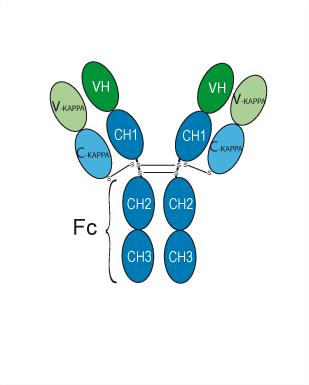
Adecatumumab (Anti-Human EPCAM Recombinant Antibody; MT201) is a full human monoclonal antibody of the IgG1 isotype, targeting human EpCAM. Adecatumumab is expressed in almost all adenocarcinomas, and its activity is not dependent of K-Ras status.
Nur für Forschungszwecke. Wir verkaufen nicht an Patienten.
- Reinheit : 99.54%
- CAS. Nr.: 503605-66-1
- Molecular Weight:147.52 kDa
-
Speicherung:
Please store the product under the recommended conditions in the Certificate of Analysis.


To place orders, for customer services and technical support, please contact: MedChemExpress USA
Tel: 609-228-6898 E-mail: [email protected] [email protected]


-
 Biologische Aktivität
-
Chemical Information
- Protokoll
- Reinheit & Dokumentation
- Verweise
-
 Help & FAQs


-

HY-P9905
CetuximabEGFR Inhibitor -

HY-P9914
EculizumabComplement C5 Antibody -

HY-P9908
AdalimumabTNF-α Inhibitor -

HY-P9954
CatumaxomabAntibody Against CD3/EpCAM -

HY-P9907
TrastuzumabHER2 Blocking Antibody -

HY-P99016B
Enfortumab vedotin-ejfv (solution)Nectin-4 ADC -

HY-P99406
PetosemtamabAnti-EGFR mAb -

HY-P99041
PanitumumabAnti-EGFR Monoclonal Antibody -
HY-112210
Shield-1FKBP Ligand -

HY-P99328
TucotuzumabAnti-EPCAM Antibody


Biologische Aktivität
Beschreibung
Isotype
Human IgG1 kappa
Recommend Isotype Controls
Species Reactivity
Human
IC50 & Target
EpCAM/TROP1/CD326
In Vitro
Adecatumumab (4 μM; 18 h) shows diverse kinetic binding activities among human Adecatumumab and murine Adecatumumab in B16/EpCAM 3E3 cells[2].
Adecatumumab (0.1 ng/mL-0.1 mg/mL; 4 h) shows a dose-dependent Antibodies depend on cell-mediated cytotoxicity (ADCC) activity in natural killing (NK) cells[2].
MedChemExpress (MCE) has not independently confirmed the accuracy of these methods. They are for reference only.
In Vivo
Both human adecatumumab and mu-adecatumumab (300 μg/mouse; i.v. bolus injection; single dose) exhibit a bi-exponential curve progression of serum concentration with an early distribution phase between 0 and 10 h and a terminal elimination phase[2].
MedChemExpress (MCE) has not independently confirmed the accuracy of these methods. They are for reference only.
-
Animal Model:Female immunocompetent C57BL/6 mice (6-10 weeks old) with B16/EpCAM (i.v.)[2]
-
Dosage:250 μg/mouse and 600 μg/mouse for human Adecatumumab; 125 μg/mouse and 300 μg/mouse for murine Adecatumumab
-
Administration:250 μg/mouse and 600 μg/mouse for human Adecatumumab; 125 μg/mouse and 300 μg/mouse for murine Adecatumumab
-
Result:Both of them exhibited anti-tumor activity against B16/EpCAM cells in mice.
Although human adecatumumab inhibited the size of tumor colonies mice, the number of colonies was only slightly reduced after treatment without significant difference.
In contrast, mu-adecatumumab induced a highly significant reduction in the number of lung tumor colonies by >85%, and the few remaining tumor colonies were of very small size.
Clinical Trial
| NCT Number | Sponsor | Condition | Start Date |
Phase

|
|---|---|---|---|---|
| NCT01329991 | 2011-05 | PHASE1 |
Gene ID
Accession
Conjugated
Unconjugated
Reconsititution
The product can be reconstituted/diluted with sterile PBS or saline.
Format
-
Human IgG1 kappa
Anwendung
ELISA, FACS, Functional assay
Verified Bioactivity
-
 Flow cytometric analysis of 1.5×10⁶ HT-29 cells labeling Adecatumumab (HY-P99278, red). Cells were fixed with 4% paraformaldehyde. Then stained with the primary antibody at 1/200 dilution for an hour at 4℃. Alexa Goat Anti-Human IgG H&L (AF488) (HY-P83776) was used as the secondary antibody at 1/1,000 dilution for 30 minutes at 4℃. Human IgG1 kappa Isotype Control (HY-P99001, blue) was used as the isotype control, cells without incubation with primary antibody were used as the unlabeled control (black).


Chemical Information
-
CAS. Nr. 503605-66-1
-
Appearance Liquid
-
Molecular Weight 147.52 kDa
-
Color Colorless to light yellow
-
SMILES
[Adecatumumab]
-
Synonyms
MT 201; Anti-Human EPCAM Recombinant Antibody
-
Versand
Shipping with dry ice.
-
Formulation
Please refer to the lot-specific COA for specific buffer information.
-
Speicherung
Please store the product under the recommended conditions in the Certificate of Analysis.


Reinheit & Dokumentation
-
Data Sheet (260 KB)
-
SDS (252 KB)
- English - EN (252 KB)
- Français - FR (252 KB)
- Deutsch - DE (252 KB)
- Norwegian - NO (252 KB)
- Español - ES (252 KB)
- Swedish - SV (252 KB)
- Italian - IT (252 KB)
- Korean - KR (252 KB)
- Portuguese - PT (252 KB)
-
Inhibitory Antibodies User Guide (603 KB)
Verweise
[1]. Kurtz JE, et al. Adecatumumab: an anti-EpCAM monoclonal antibody, from the bench to the bedside. Expert Opin Biol Ther. 2010 Jun;10(6):951-8. [Content Brief]
[2]. Lutterbuese P, et al. Exchanging human Fcgamma1 with murine Fcgamma2a highly potentiates anti-tumor activity of anti-EpCAM antibody adecatumumab in a syngeneic mouse lung metastasis model. Cancer Immunol Immunother. 2007 Apr;56(4):459-68. [Content Brief]

Calculators
Konzentration (Stammlösung) × Volumen (Stammlösung) = Konzentration (Ziellösung) × Volumen (Ziellösung)


Adecatumumab Related Classifications
HY-P99278 Related Classifications
 Powered by Bioz