



ALK5-IN-8

Based on 1 Customer Validation
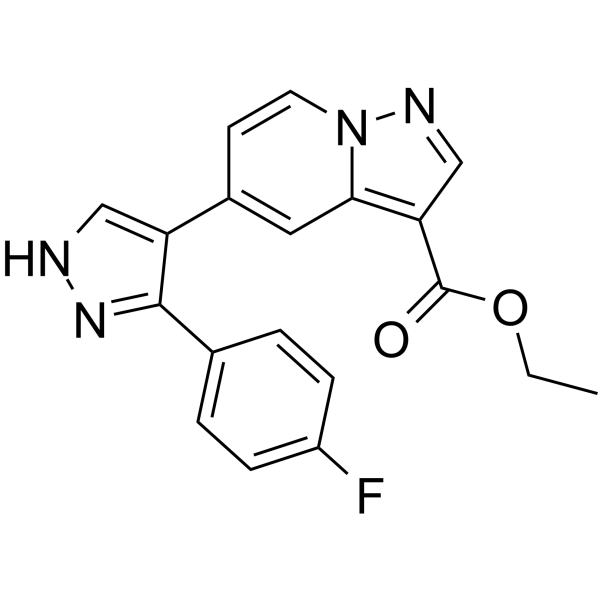
ALK5-IN-8 is a potent inhibitor of TGFβRI (ALK5). ALK5-IN-8 Inhibits the phosphorylation of ALK5 on its downstream signaling proteins (Smad2 or Smad3) by blocking the binding of TGFβRI to ligands, thereby affecting or blocking TGF-β signaling. ALK5-IN-8 has the potential for the research of various ALK5-mediated related diseases (extracted from patent WO2021190425A1, compound 1).
Nos produits utilisent uniquement pour la recherche. Nous ne vendons pas aux patients.
- Pureté : 98.21%
- CAS No.: 2705900-81-6
- Formule: C19H15FN4O2
- Masse moléculaire:350.35
-
Stockage:Powder -20°C, 3 years , 4°C, 2 years ; In solvent -80°C, 6 months , -20°C, 1 month

To place orders, for customer services and technical support, please contact: MedChemExpress USA
Tel: 609-228-6898 E-mail: [email protected] [email protected]


-
 Activité biologique
-
Chemical Information
-
Solvant et solubilité
- Protocole
- Pureté et documentation
- Références
-
 Help & FAQs




Activité biologique
Description


Chemical Information
-
CAS No. 2705900-81-6
-
Appearance Solid
-
Masse moléculaire 350.35
-
Formule C19H15FN4O2
-
Color White to light yellow
-
SMILES
O=C(C1=C2C=C(C3=CNN=C3C4=CC=C(F)C=C4)C=CN2N=C1)OCC
-
Livraison
Room temperature in continental US; may vary elsewhere.
-
Stockage
Powder -20°C 3 years 4°C 2 years In solvent -80°C 6 months -20°C 1 month


Solvant et solubilité
In Vitro:
DMSO : 50 mg/mL (142.71 mM; Need ultrasonic; Hygroscopic DMSO has a significant impact on the solubility of product, please use newly opened DMSO)
Please refer to the solubility information to select the appropriate solvent. Once prepared, please aliquot and store the solution to prevent product inactivation from repeated freeze-thaw cycles.
Storage method and period of stock solution: -80°C, 6 months; -20°C, 1 month. When stored at -80°C, please use it within 6 months. When stored at -20°C, please use it within 1 month.
Please refer to the solubility information to select the appropriate solvent. Once prepared, please aliquot and store the solution to prevent product inactivation from repeated freeze-thaw cycles.
Storage method and period of stock solution: -80°C, 6 months; -20°C, 1 month. When stored at -80°C, please use it within 6 months. When stored at -20°C, please use it within 1 month.
Concentration (start) × Volume (start) = Concentration (final) × Volume (final)


Pureté et documentation
-
Fiche technique (275 KB)
-
SDS (251 KB)
- English - EN (251 KB)
- Français - FR (251 KB)
- Deutsch - DE (251 KB)
- Norwegian - NO (251 KB)
- Español - ES (251 KB)
- Swedish - SV (251 KB)
- Italian - IT (251 KB)
- Korean - KR (251 KB)
- Portuguese - PT (251 KB)
-
Instruction de manipulation (2659 KB)
Références


Complete Stock Solution Preparation Table
Please refer to the solubility information to select the appropriate solvent. Once prepared, please aliquot and store the solution to prevent product inactivation from repeated freeze-thaw cycles.
Storage method and period of stock solution: -80°C, 6 months; -20°C, 1 month. When stored at -80°C, please use it within 6 months. When stored at -20°C, please use it within 1 month.
| Optional Solvent | Concentration Solvent Mass | 1 mg | 5 mg | 10 mg | 25 mg |
|---|---|---|---|---|---|
| DMSO | 1 mM | 2.8543 mL | 14.2714 mL | 28.5429 mL | 71.3572 mL |
| 5 mM | 0.5709 mL | 2.8543 mL | 5.7086 mL | 14.2714 mL | |
| 10 mM | 0.2854 mL | 1.4271 mL | 2.8543 mL | 7.1357 mL | |
| 15 mM | 0.1903 mL | 0.9514 mL | 1.9029 mL | 4.7571 mL | |
| 20 mM | 0.1427 mL | 0.7136 mL | 1.4271 mL | 3.5679 mL | |
| 25 mM | 0.1142 mL | 0.5709 mL | 1.1417 mL | 2.8543 mL | |
| 30 mM | 0.0951 mL | 0.4757 mL | 0.9514 mL | 2.3786 mL | |
| 40 mM | 0.0714 mL | 0.3568 mL | 0.7136 mL | 1.7839 mL | |
| 50 mM | 0.0571 mL | 0.2854 mL | 0.5709 mL | 1.4271 mL | |
| 60 mM | 0.0476 mL | 0.2379 mL | 0.4757 mL | 1.1893 mL | |
| 80 mM | 0.0357 mL | 0.1784 mL | 0.3568 mL | 0.8920 mL | |
| 100 mM | 0.0285 mL | 0.1427 mL | 0.2854 mL | 0.7136 mL |


ALK5-IN-8 Related Classifications
HY-144043 Related Classifications
 Powered by Bioz