



TRAF2 Antibody (YA032)
(Synonyms: TRAP3, TRAF2, TNF receptor-associated factor 2, E3 ubiquitin-protein ligase TRAF2, RING-type E3 ubiquitin transferase TRAF2, Tumor necrosis factor type 2 receptor-associated protein 3)
Based on 1 Customer Validation
TRAF2 Antibody (YA032) is a Rabbit-derived and non-conjugated IgG monoclonal antibody, targeting to TRAF2.
-
Host:
Rabbit
-
Isotype:
IgG
-
Application:
WB, ICC/IF, IHC-P, IP, FC
-
Reactivity :
Human, Mouse
-
Formulation:
Supplied in 1*TBS (pH7.4), 0.05% BSA and 40% Glycerol. Preservative: 0.05% Sodium Azide.
-
Conjugation:
Non-conjugated


To place orders, for customer services and technical support, please contact: MedChemExpress USA
Tel: 609-228-6898 E-mail: [email protected] [email protected]





Applications
| Application |
WB

WB: Western Blot
|
ICC/IF
ICC/IF: Immunocytochemistry/
Immunofluorescence |
IHC-P
IHC-P: Immunohistochemistry-Paraffin
|
FC
FC: Flow Cytometry
|
IP
IP: Immunoprecipitation
|
|---|---|---|---|---|---|
| Dilution Ratio | 1:1000-1:5000 | 1:50-1:200 | 1:50-1:200 | 1:50-1:100 | Use at an assay dependent concentration. |


Product Details
TRAF2 Antibody (YA032) is a Rabbit-derived and non-conjugated IgG monoclonal antibody, targeting to TRAF2.
-
Host Rabbit

-
Clonality Recombinant,Monoclonal

-
Species ReactivityHuman, Mouse
-
Observed Molecular WeightObserved band size: 53 kDa
Note: Due to possible protein modifications or aggregation, the molecular weight should be confirmed by actual measurement, and the predicted value is for reference only.

-
Calculated Molecular Weight Predicted band size: 56 kDa

Synthetic peptide within N-terminal human TRAF2.
Endogenous
Protein A affinity purified.
Non-conjugated
Unmodified
IgG


Product Properties
-
Appearance
Solution
-
Formulation
Supplied in 1*TBS (pH7.4), 0.05% BSA and 40% Glycerol. Preservative: 0.05% Sodium Azide.
-
Concentration
Batch-dependent, Please check the COA for the concentration of each lot. Check Lot Concentration
-
Storage & Stability
Stored at -20°C for 1 year. Avoid repeated freeze / thaw cycles.
-
Shipping
Shipping with blue ice.


Verification Images
-
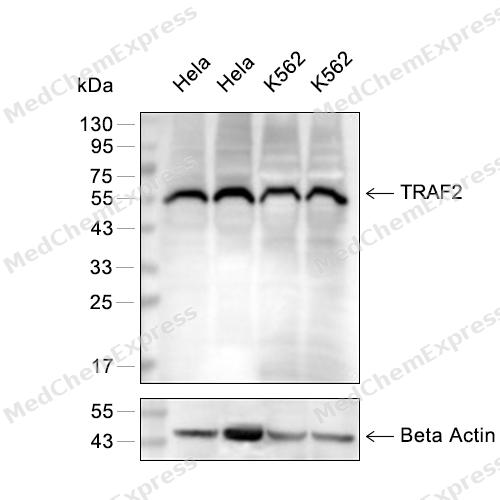 Western blot analysis of extracts from Hela (lane 2(20μg) or lane 3(40μg)) and K562 (lane 4(20μg) or lane 5(40μg)) using TRAF2 (HY-P80357) Rabbit mAb. Proteins were transferred to a PVDF membrane and blocked with 5% BSA in TBST for 2 hour at room temperature. The primary antibody (1/1000) and Loading control antibody (Beta Actin, HY-P80438, 1/10000) was used in 5% BSA in TBST at 4°C overnight. Goat Anti-Rabbit IgG-HRP Secondary Antibody (1/10,000) was used for 1 hour at room temperature.
 -
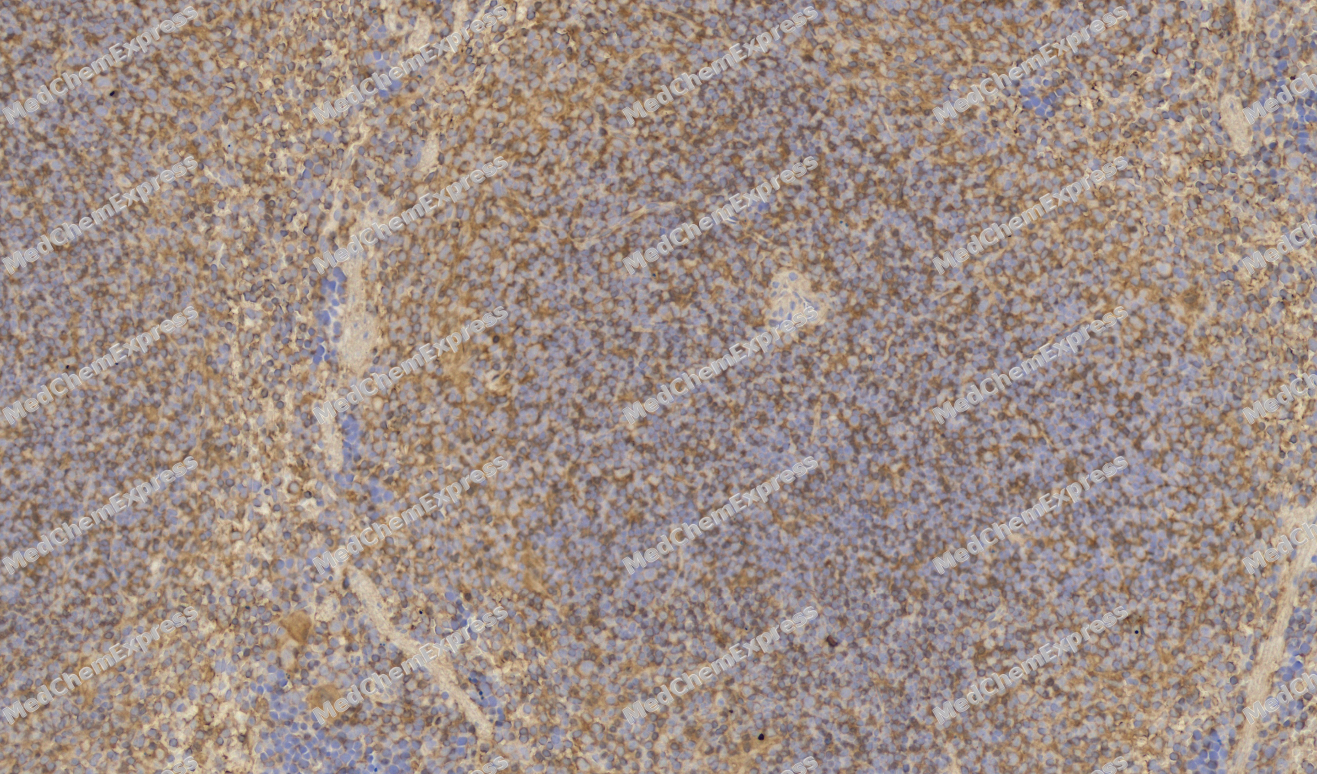 Immunohistochemical analysis of paraffin-embedded Mouse spleen tissue using TRAF2 Antibody. The section was pre-treated using heat mediated antigen retrieval with sodium citrate buffer (pH 6.0) for 8 minutes. The tissues were blocked in QuickBlock for 20 minutes at room temperature, washed with ddH2O and PBS, and then probed with the primary antibody (HY-P80357, 1/100) in 4℃ overnight. The detection was performed using an HRP conjugated compact polymer system. DAB was used as the chromogen. Tissues were counterstained with hematoxylin and mounted with DPX.
 -
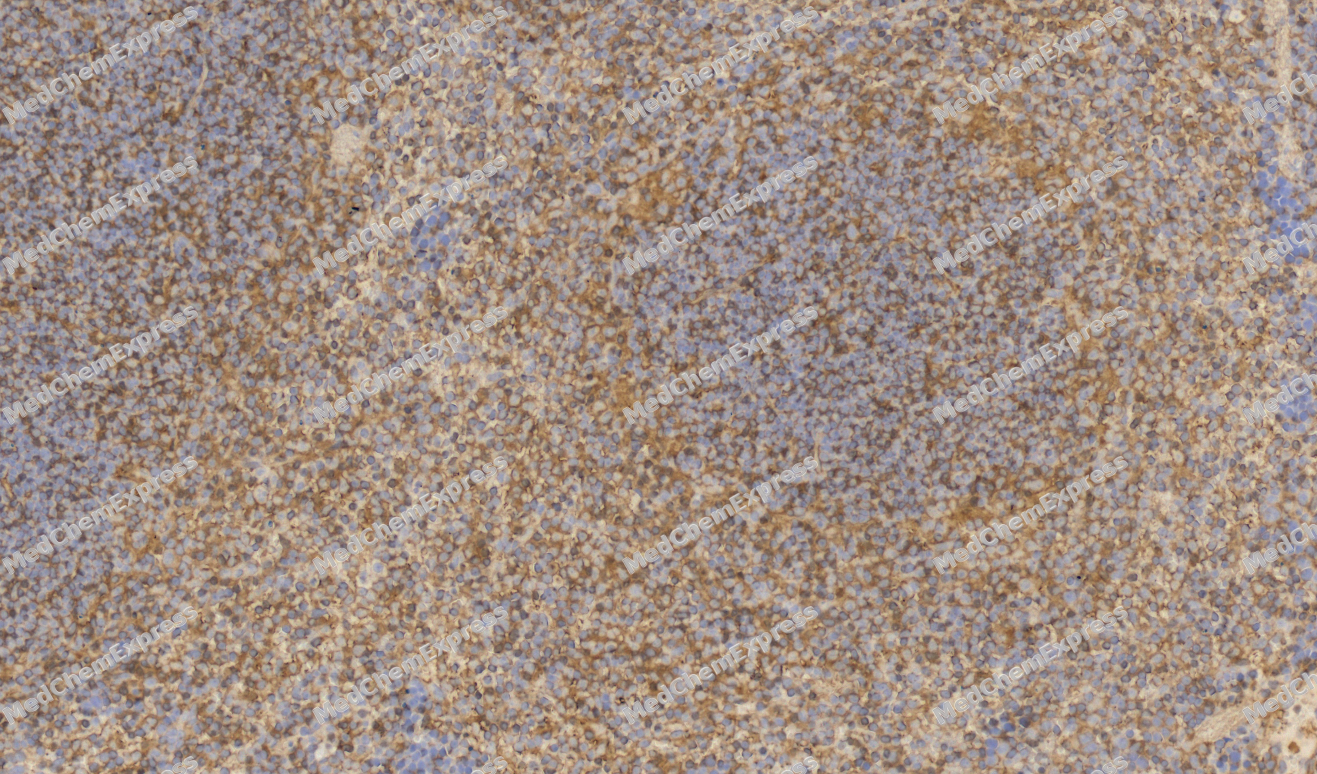 Immunohistochemical analysis of paraffin-embedded Mouse spleen tissue using TRAF2 Antibody. The section was pre-treated using heat mediated antigen retrieval with sodium citrate buffer (pH 6.0) for 8 minutes. The tissues were blocked in QuickBlock for 20 minutes at room temperature, washed with ddH2O and PBS, and then probed with the primary antibody (HY-P80357, 1/100) in 4℃ overnight. The detection was performed using an HRP conjugated compact polymer system. DAB was used as the chromogen. Tissues were counterstained with hematoxylin and mounted with DPX.
 -
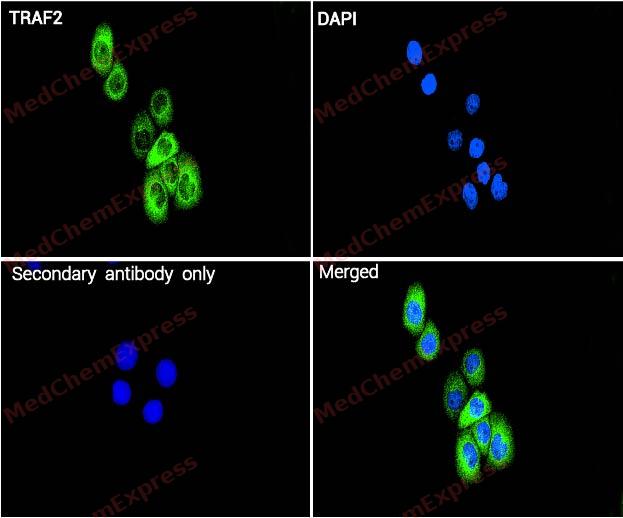 Immunocytochemistry analysis of Hela cells labeling TRAF2 with TRAF2 Antibody (HY-P80357) at 1/100 dilution. Cells were fixed in 4% paraformaldehyde for 15 minutes at room temperature, permeabilized with 0.1% Triton X-100 in PBS for 15 minutes at room temperature, then blocked with quick block buffer for 10 minutes at room temperature. Cells were then incubated with TRAF2 Antibody (HY-P80357) at 1/100 dilution in quick block buffer overnight at 4 ℃. AF488-conjugated Goat Anti-Rabbit IgG H&L(HY-P8002, Green) was used as the secondary antibody at 1/1,000 dilution. PBS instead of the primary antibody was used as the secondary antibody only control. The Nuclear counterstain was DAPI (Blue).
 -
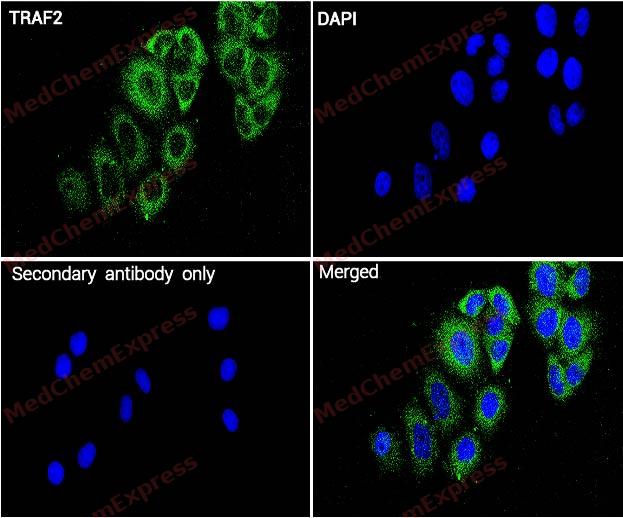 Immunocytochemistry analysis of Hela cells labeling TRAF2 with TRAF2 Antibody (HY-P80357) at 1/200 dilution. Cells were fixed in 4% paraformaldehyde for 15 minutes at room temperature, permeabilized with 0.1% Triton X-100 in PBS for 15 minutes at room temperature, then blocked with quick block buffer for 10 minutes at room temperature. Cells were then incubated with TRAF2 Antibody (HY-P80357) at 1/200 dilution in quick block buffer overnight at 4 ℃. AF488-conjugated Goat Anti-Rabbit IgG H&L(HY-P8002, Green) was used as the secondary antibody at 1/1,000 dilution. PBS instead of the primary antibody was used as the secondary antibody only control. The Nuclear counterstain was DAPI (Blue).


Background
-
Function
TRAF2 is an E3 ubiquitin-protein ligase that regulates activation of NF-kappa-B and JNK and plays a central role in the regulation of cell survival and apoptosis. Catalyzes 'Lys-63'-linked ubiquitination of target proteins, such as BIRC3, IKBKE, MLST8, RIPK1 and TICAM1. Is an essential constituent of several E3 ubiquitin-protein ligase complexes, where it promotes the ubiquitination of target proteins by bringing them into contact with other E3 ubiquitin ligases. Regulates BIRC2 and BIRC3 protein levels by inhibiting their autoubiquitination and subsequent degradation; this does not depend on the TRAF2 RING-type zinc finger domain. Plays a role in mediating activation of NF-kappa-B by EIF2AK2/PKR. In complex with BIRC2 or BIRC3, promotes ubiquitination of IKBKE. Acts as a regulator of mTORC1 and mTORC2 assembly by mediating 'Lys-63'-linked ubiquitination of MLST8, thereby inhibiting formation of the mTORC2 complex, while facilitating assembly of the mTORC1 complex. Required for normal antibody isotype switching from IgM to IgG[1][2][3][4][5][6][7][8][9][10][11][12][13][14][15][16][17][18][19].
-
Subcellular Localization
Cytoplasm
-
Subunit
Homotrimer (PubMed:8069916). Heterotrimer with TRAF1 (PubMed:8069916). Heterotrimer with TRAF3 (via TRAF domain) (PubMed:15383523, PubMed:20447407). The domain containing the RING-type and the first TRAF-type zinc finger can also form homodimers (in vitro) (PubMed:19810754). Interacts with TNFRSF1B/TNFR2 (PubMed:10206649, PubMed:7639698, PubMed:8069916). Interacts with TNFRSF5/CD40 (PubMed:9718306). Interacts with TNFRSF4, TNFRSF7/CD27, TNFRSF8/CD30, TNFRSF9/CD137, TNFRSF11A/RANK, TNFRSF13B/TACI, TNFRSF14, TNFRSF16/NGFR, TNFRSF17/BCMA, TNFRSF18/AITR, TNFRSF19/TROY, TNFRSF19L/RELT and EDAR (PubMed:10037686, PubMed:10411888, PubMed:10514511, PubMed:10809768, PubMed:10880535, PubMed:11035039, PubMed:38354704, PubMed:8627180, PubMed:9153189, PubMed:9418902, PubMed:9488716, PubMed:9607925, PubMed:9692890, PubMed:9774460). Stimulation of TNF-alpha receptor TNFRSF1A leads to the formation of two distinct signaling complexes. Plasma membrane-bound complex I is composed of TNFRSF1A, TRADD, RIPK1, TRAF2 and BIRC2/c-IAP1 or BIRC3 which interacts with CHUCK/IKK-alpha, IKBKB/IKK-beta and IKBKG/IKK-gamma promoting cell survival (PubMed:18981220, PubMed:21307340). Subsequently, TRADD, RIPK1 and TRAF2 dissociate from TNFRSF1A and form cytoplasmic complex II with FADD and caspase CASP8 promoting cell apoptosis (PubMed:21307340). Interacts with TRADD (PubMed:10892748). Identified in a complex with TNFRSF1A, RIPK1 and IKBKB/IKK-beta (PubMed:18981220). Interacts with RIPK2 (PubMed:9705938). Interacts with BIRC2 and BIRC3 N-terminus; a single BIRC2 or BIRC3 molecule interacts with a heterotrimer formed by TRAF1 and TRAF2, or a TRAF2 homotrimer (PubMed:11907583, PubMed:19506082, PubMed:20385093, PubMed:20447407). Identified in a complex composed of TRAF2, TRAF3, BIRC2 and BIRC3 (By similarity). Interacts with BIRC2; the interaction promotes BIRC2 stability (PubMed:19506082). Interaction with BIRC2 and/or BIRC3 is essential for ubiquitination of IKBKE, degradation of NFKBIA and activation of NF-kappa-B (By similarity). Within complex I, phosphorylated TRAF2 interacts (via 'Lys-63'-linked polyubiquitin chains) with CHUCK/IKK-alpha, IKBKB/IKK-beta, IKBKG/IKK-gamma TAB2, TAB3 and TAK1 in response to TNF-alpha stimulation (PubMed:19150425). Within complex I, interacts with UXT isoform 1 (via TPQE motif); the interaction prevents the recruitment of FADD and CASP8/caspase 8 to complex I (PubMed:21307340). Forms a complex composed of TNFRSF8/CD30 or TNFRSF1B/TNFR2, and TRAF1, TRAF2 and E3 ligase TRAIP (PubMed:9104814). Within the complex, interacts with TRAIP; the interaction inhibits TRAF2-mediated NF-kappa B activation (PubMed:9104814). Component of a complex composed of TANK and TBK1 (PubMed:10581243). Interacts with TRPC4AP (By similarity). Interacts with MAP3K1/MEKK1, MAP3K5/ASK1 and MAP3K11/MLK3 in response to TNF-alpha stimulation; the interaction leads to JNK activation and interaction with MAP3K5 is inhibited by PRMT1 (PubMed:10346818, PubMed:19918265, PubMed:22095282, PubMed:9774977). Component of a complex composed of MAP3K14/NIK BIRC3 and TRAF3; the interaction leads to BIRC2/3-mediated ubiquitination of TRAF3 upon CD40 engagement in a TRAF2-dependent manner (By similarity). Interacts with MAP3K14/NIK in response to TNF-alpha stimulation; the interaction leads to NF-kappa B activation (PubMed:9020361). Interacts with PEG3; the interaction may promote TRAF2-mediated NF-kappa B activation (By similarity). Interacts with HIVEP3; the interaction may inhibit TNF-alpha-TRAF2-mediated NF-kappa B and JNK activation (By similarity). Interacts with TANK/ITRAF; the interaction prevents interaction between TNFRSF1B/TNFR2 and TRAF2 (PubMed:8710854). Interacts with deubiquitinating enzyme CYLD; the interaction results in the deubiquitination and inactivation of TRAF2 (PubMed:12917691). Interacts with SIAH2; the interaction leads to TRAF2 ubiquitination and degradation (PubMed:12411493). Interacts with E2 conjugating enzyme UBE2N/Ubc13, E3 ligase ITCH and RNF11 in response to TNF-alpha stimulation (By similarity). Interacts with ubiquitin-editing enzyme TNFAIP3/A20 in response to TNF-alpha stimulation; the interaction promotes TRAF2 dissociation from UBE2N/Ubc13, ITCH, RNF11 and TAX1BP1 and prevents prolonged TRAF-2 ubiquitination (By similarity). Interacts with TAX1BP1 in response to TNF-alpha stimulation; the interaction promotes TRAF2 dissociation from UBE2N/Ubc13 and TNFAIP3/A20, and prevents prolonged TRAF-2 ubiquitination (By similarity). Interacts (via C-terminus) with EIF2AK2/PKR (via the kinase catalytic domain) (PubMed:15121867). Interacts with deubiquitinating enzyme USP48 (PubMed:16214042). Interacts with PTPN2; probably involved in TNF-mediated signaling (PubMed:15696169). Interacts with Toll-like receptor TLR4/3 adapter TICAM1/TRIF; the interaction may promote TICAM1 ubiquitination (PubMed:20047764). Interacts with kinase/endoribonuclease ERN1/IRE1 and DAB2IP in response to ER stress; the interaction requires DAB2IP (By similarity). Interacts with ERN1/IRE1 and TAOK3 in response to ER stress; the interaction may promote TRAF2 phosphorylation (PubMed:11278723). Interacts (via zinc fingers) with DAB2IP (via C-terminus PER domain)in response to TNF-alpha stimulation (PubMed:15310755, PubMed:17389591). Interacts with CASP8AP2/FLASH (By similarity). Interacts with NFATC2IP; the interaction may repress IL-4 production in T cells (By similarity). Interacts with kinase CDK9 (PubMed:9827693). Interacts with sphingosine kinase 1 SPHK1 (PubMed:20577214). Interacts with kinase TNIK (PubMed:10521462). Interacts with TRAFD1 (By similarity). Interacts with DNA phosphodiesterase TDP2 (PubMed:10764746). Interacts with MAVS/IPS1 (PubMed:16153868). Interacts with CARD14 (PubMed:21302310). Interacts with Epstein-Barr virus LMP1/BNFL1 (PubMed:10411888). Interacts with GPS2 (By similarity). Interacts with XPNPEP3 (PubMed:25609706). Interacts with RIPK3 (PubMed:29883609). Interacts with RELL2 (PubMed:19969290). Interacts with LRRC19 (PubMed:25026888). Interacts with GAPDH; promoting TRAF2 ubiquitination (PubMed:23332158)
-
SwissProt ID
-
Synonyms
TRAP3, TRAF2, TNF receptor-associated factor 2, E3 ubiquitin-protein ligase TRAF2, RING-type E3 ubiquitin transferase TRAF2, Tumor necrosis factor type 2 receptor-associated protein 3
-
Research Field
Cell Biology


Documentation
-
Data Sheet (235 KB)
-
SDS (252 KB)
- English - EN (252 KB)
- Français - FR (252 KB)
- Deutsch - DE (252 KB)
- Norwegian - NO (252 KB)
- Español - ES (252 KB)
- Swedish - SV (252 KB)
- Italian - IT (252 KB)
- Korean - KR (252 KB)
- Portuguese - PT (252 KB)
-
User Guide for Antibodies (1077 KB)

 Powered by Bioz
