



Antimalarial agent 37
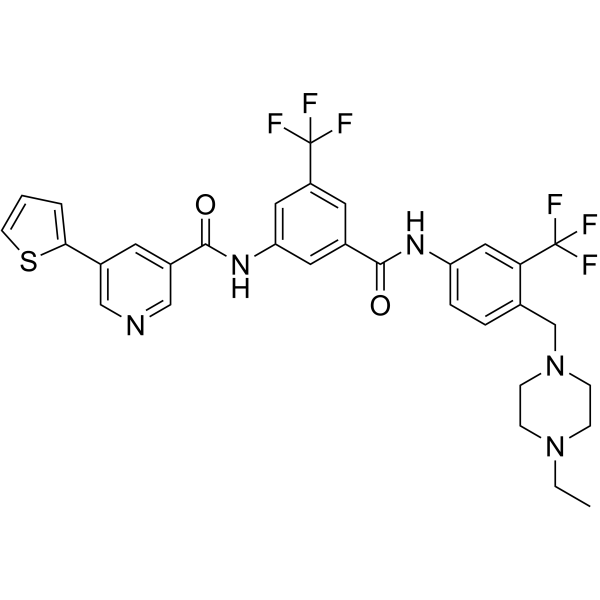
Antimalarial agent 37 (compound 33) is a selective inhibitor against Type Ⅱ kinase with antiplasmodial activity. Antimalarial agent 37 exhibited cytotoxicity and selectivity towards cancer cells HepG2 and MCF 7.
Nos produits utilisent uniquement pour la recherche. Nous ne vendons pas aux patients.
- CAS No.: 2982633-16-7
- Formule: C32H29F6N5O2S
- Masse moléculaire:661.66
-
Stockage:
Please store the product under the recommended conditions in the Certificate of Analysis.

To place orders, for customer services and technical support, please contact: MedChemExpress USA
Tel: 609-228-6898 E-mail: [email protected] [email protected]


-
 Activité biologique
-
Chemical Information
- Protocole
- Pureté et documentation
- Références
-
 Help & FAQs


Voir tous les produits spécifiques à Isoform Parasite
More

Activité biologique
Description
Cellular Effect
|
Cell Line

|
Type | Value | Description | References |
|---|---|---|---|---|
| HepG2 | EC50 |
2850 nM
Compound: 33
|
Cytotoxicity against human HepG2 cells assessed as reduction in cell viability incubated for 48 hrs by MTS assay
Cytotoxicity against human HepG2 cells assessed as reduction in cell viability incubated for 48 hrs by MTS assay
|
[PMID: 38214254] |
| MCF7 | EC50 |
3540 nM
Compound: 33
|
Cytotoxicity against human MCF7 cells assessed as reduction in cell viability incubated for 48 hrs by MTS assay
Cytotoxicity against human MCF7 cells assessed as reduction in cell viability incubated for 48 hrs by MTS assay
|
[PMID: 38214254] |
In Vitro
Antimalarial agent 37 (0-50 nM, 72 h) exhibits antiplasmodial activities, with EC50 values of 31 nM and 35 nM for strains Dd2 and 3D7, respectively[1].
Antimalarial agent 37 exhibits microsomal stability in mouse liver microsome with half-time of 41.4 min and clearance of 17 μL/min/mg[1].
Antimalarial agent 37 (0-5000 nM, 48 h) reveals cytotoxicity in cells HepG2 and MCF 7, with EC50 values of 2850 and 3540 nM[1].
MedChemExpress (MCE) has not independently confirmed the accuracy of these methods. They are for reference only.
-
Cell Line:P. falciparum Dd2 and P. falciparum 3D7 strains
-
Concentration:0-50 nM
-
Incubation Time:72 h
-
Result:Exhibited antiplasmodial activities with EC50 values of 31 nM and 35 nM for strains Dd2 and 3D7.
-
Cell Line:HepG2, MCF7
-
Concentration:0-5000 nM
-
Incubation Time:48 h
-
Result:Revealed cytotoxicity in HepG2 and MCF7, with EC50 values of 2850 nM and 3540 nM as well as selectivity index of 92 and 114, respectively


Chemical Information
-
CAS No. 2982633-16-7
-
Masse moléculaire 661.66
-
Formule C32H29F6N5O2S
-
SMILES
CCN1CCN(CC1)CC2=CC=C(C=C2C(F)(F)F)NC(C3=CC(NC(C4=CC(C5=CC=CS5)=CN=C4)=O)=CC(C(F)(F)F)=C3)=O
-
Livraison
Room temperature in continental US; may vary elsewhere.
-
Stockage
Please store the product under the recommended conditions in the Certificate of Analysis.


Pureté et documentation
Références

Calculators
Concentration (start) × Volume (start) = Concentration (final) × Volume (final)


Antimalarial agent 37 Related Classifications
HY-161171 Related Classifications
 Powered by Bioz