



Anzurstobart

Based on 1 Customer Validation
Anzurstobart (CC-95251; BMS-986351) is a CD47/SIRPα inhibitor with human SIRPα Kd of 0.0541 nM and human SIRPα IC50 of 100 nM. Anzurstobart binds SIRPα at a CD47-overlapping site, blocks CD47-SIRPα interactions, inhibits CD47-SIRPα axis signaling, and binds across 6 prevalent human SIRPα haplotypes. Anzurstobart binds SIRPγ and inhibits CD47-SIRPγ interactions. Anzurstobart can be used for the research of non-Hodgkin's lymphoma, colorectal cancer, squamous cell carcinoma of the head and neck, diffuse large B-cell lymphoma, and advanced solid and hematologic malignancies.
For research use only. We do not sell to patients.
- Purity : 98.0%
- CAS No.: 2543693-10-1
- Molecular Weight:144.66 kDa
-
Storage:
Please store the product under the recommended conditions in the Certificate of Analysis.


To place orders, for customer services and technical support, please contact: MedChemExpress USA
Tel: 609-228-6898 E-mail: [email protected] [email protected]


-
 Biological Activity
-
Chemical Information
- Purity & Documentation
- References
-
 Help & FAQs




Biological Activity
Description
Isotype
Human IgG1 kappa
Recommend Isotype Controls
Species Reactivity
Human
IC50 & Target
SIRPa/CD172a
In Vitro
Anzurstobart (CC-95251) potently blocks CD47-SIRPα binding in a dose-dependent manner, with near-complete inhibition at 100 nM[1].
Anzurstobart (50 nM; 180 seconds) demonstrates strong binding coverage across the six most prevalent human SIRPα haplotypes[1].
Anzurstobart (20 nmol/L; 10 minutes preincubation, 3-hour coculture) alone dose-dependently increases macrophage-mediated phagocytosis of GP2d, GP5d, and SW480 colorectal cancer cells[1].
Anzurstobart (20 nmol/L; 10 minutes preincubation, 3-hour coculture) in combination with Rituximab (HY-P9913) dose-dependently enhances macrophage-mediated phagocytosis of OCI-Ly3, RIVA, Pfeiffer, and Karpas 422 DLBCL cells, while Anzurstobart alone has limited phagocytic activity[1].
MedChemExpress (MCE) has not independently confirmed the accuracy of these methods. They are for reference only.
Parmacokinetics
In Vivo
Anzurstobart (10-100 mg/kg; i.v.) is well-tolerated in healthy cynomolgus monkeys with no hematologic depletion observed[2].
MedChemExpress (MCE) has not independently confirmed the accuracy of these methods. They are for reference only.
-
Animal Model:Cynomolgus monkeys[2]
-
Dosage:10 mg/kg; 30 mg/kg; 100 mg/kg
-
Administration:i.v.; single dose (day 1); repeat dose (day 15)
-
Result:Reached peak serum concentrations (Cmax) of 183 μg/mL (10 mg/kg), 632 μg/mL (30 mg/kg), and 1984 μg/mL (100 mg/kg) after day 1 dose.
Reached peak serum concentrations (Cmax) of 183 μg/mL (10 mg/kg), 664 μg/mL (30 mg/kg), and 2276 μg/mL (100 mg/kg) after day 15 dose.
Exhibited half-life (T1/2) ranging from 163 to 227 hours across individual animals.
Showed clearance rates ranging from 7.77 to 15.48 mL/day/kg.
Caused no depletion of white blood cells, monocytes, lymphocytes, or red blood cells over 28 days of exposure.
Clinical Trial
| NCT Number | Sponsor | Condition | Start Date |
Phase

|
|---|---|---|---|---|
| NCT01329991 | 2011-05 | PHASE1 |
Gene ID
Accession
Conjugated
Unconjugated
Reconsititution
The product can be reconstituted/diluted with sterile PBS or saline.
Format
-
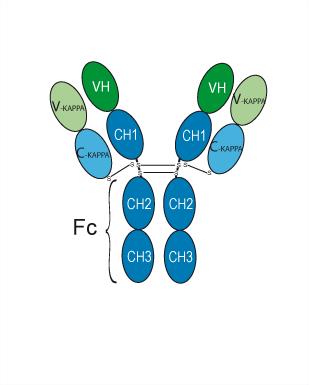
Human IgG1 kappa
Application
ELISA, FACS, Functional assay
Verified Bioactivity
-
 Flow Cytometry analysis of U937 cells labelling SIRPa/CD172a (red) with Anzurstobart (anti-SIRPa/CD172a) (HY-P990033). Goat Anti-Human IgG (Alexa Fluor 488) (HY-P83776) at a dilution of 1/1000 was used as the secondary antibody. Blue-Human IgG1 kappa (HY-P99001). Black-Unlabelled control, cells without incubation with primary antibody.


Chemical Information
-
CAS No. 2543693-10-1
-
Appearance Liquid
-
Molecular Weight 144.66 kDa
-
Color Colorless to light yellow
-
SMILES
[Anzurstobart]
-
Synonyms
CC-95251; BMS-986351
-
Shipping
Shipping with dry ice.
-
Formulation
Please refer to the lot-specific COA for specific buffer information.
-
Storage
Please store the product under the recommended conditions in the Certificate of Analysis.


Purity & Documentation
-
Data Sheet (262 KB)
-
SDS (251 KB)
- English - EN (251 KB)
- Français - FR (251 KB)
- Deutsch - DE (251 KB)
- Norwegian - NO (251 KB)
- Español - ES (251 KB)
- Swedish - SV (251 KB)
- Italian - IT (251 KB)
- Korean - KR (251 KB)
- Portuguese - PT (251 KB)
-
Inhibitory Antibodies User Guide (603 KB)
References

Calculators
Concentration (start) × Volume (start) = Concentration (final) × Volume (final)


Anzurstobart Related Classifications
HY-P990033 Related Classifications
 Powered by Bioz