



ASPER-29
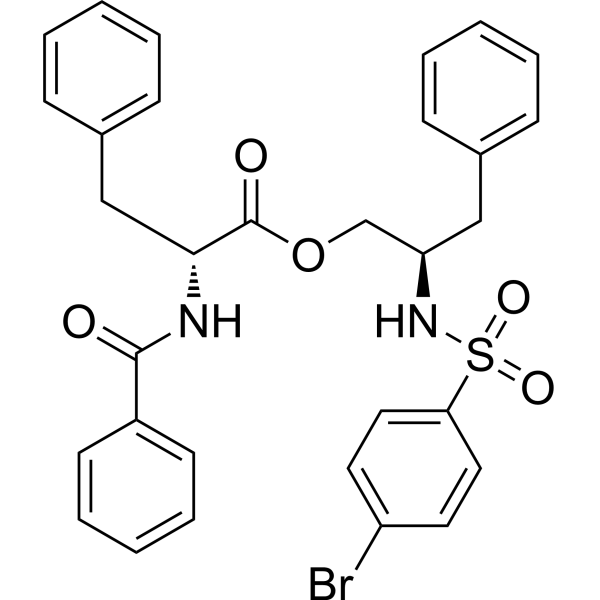
ASPER-29 is Asperphenamate HY-129578 analog. ASPER-29 also is a dual cathepsin L and S inhibitor with IC50 value of 6.03 μM and 5.02 μM, respectively. ASPER-29 can be used for the research of the migration and invasion of cancer.
For research use only. We do not sell to patients.
- CAS No.: 2630388-03-1
- Formula: C31H29BrN2O5S
- Molecular Weight:621.54
-
Storage:
Please store the product under the recommended conditions in the Certificate of Analysis.

To place orders, for customer services and technical support, please contact: MedChemExpress USA
Tel: 609-228-6898 E-mail: [email protected] [email protected]


-
 Biological Activity
-
Chemical Information
- Protocols
- Purity & Documentation
- References
-
 Help & FAQs


All Cathepsin Isoforms
More

Biological Activity
Description
IC50 & Target
|
cathepsin L 6.03 μM (IC50) |
cathepsin S 5.02 μM (IC50) |
In Vitro
ASPER-29 has dual Cat L and S inhibitory potency with IC50 value of 6.03 μM and 5.02 μM, respectively[1].
ASPER-29 shows a definite antimetastatic effect on pancreatic cancer BxPC-3 and PANC-1 cells[1].
MedChemExpress (MCE) has not independently confirmed the accuracy of these methods. They are for reference only. Further protocols information, click here.


Chemical Information
-
CAS No. 2630388-03-1
-
Molecular Weight 621.54
-
Formula C31H29BrN2O5S
-
SMILES
O=C(C1=CC=CC=C1)N[C@@H](C(OC[C@H](NS(=O)(C2=CC=C(C=C2)Br)=O)CC3=CC=CC=C3)=O)CC4=CC=CC=C4
-
Shipping
Room temperature in continental US; may vary elsewhere.
-
Storage
Please store the product under the recommended conditions in the Certificate of Analysis.

Protocols
-
Cell Cytotoxicity Assay
Cytotoxicity assays are usually based on the assessment of cell membrane damage, which can also be indirectly detected by measuring cell viability. Detection methods include MTT assay, CKK-8 assay, LDH assay and ATP assay, etc.
-
Cell migration
Cell migration is a method that plays an important role in wound healing, cell differentiation, embryonic development, etc.
-
Cell invasion
Cell invasion is the ability of cells to migrate from one area to another via the extracellular matrix. Cell invasion is the response of normal and cancer cells to chemical and mechanical stimuli. Before migrating to a new region, the extracellular matrix is degraded by proteases within the cell. Cell invasion often occurs during wound repair, vascularization and inflammation, abnormal tissue invasion, and tumor cell metastasis.


Purity & Documentation
References

Calculators
Concentration (start) × Volume (start) = Concentration (final) × Volume (final)


ASPER-29 Related Classifications
HY-152210 Related Classifications
 Powered by Bioz