



Polyoxyethylene stearate

Based on 1 Customer Validation
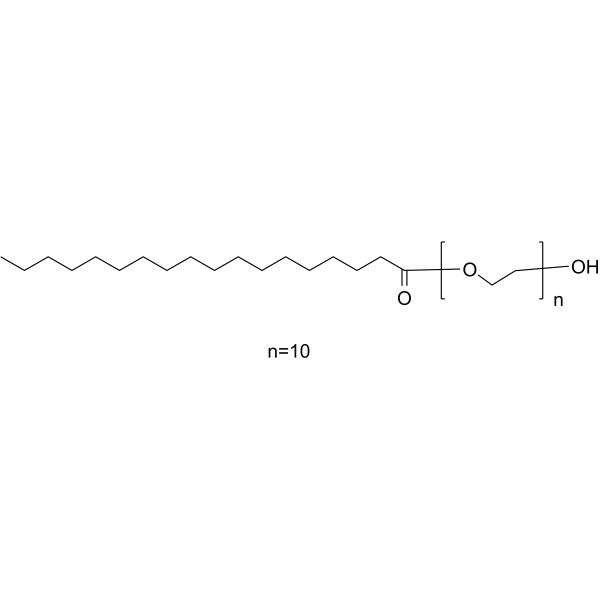
Polyoxyethylene stearate (POES) is a non-ionic emulsifying agent.
Nur für Forschungszwecke. Wir verkaufen nicht an Patienten.
- CAS. Nr.: 9004-99-3
- Formel: C20H40O3 (monomer)
- Molecular Weight:328.53 (monomer)
-
Speicherung:Powder -20°C, 3 years , 4°C, 2 years ; In solvent -80°C, 2 years , -20°C, 1 year

To place orders, for customer services and technical support, please contact: MedChemExpress USA
Tel: 609-228-6898 E-mail: [email protected] [email protected]


-
 Biologische Aktivität
-
Chemical Information
-
Lösungsmittel & Löslichkeit
- Reinheit & Dokumentation
- Verweise
-
 Help & FAQs


-
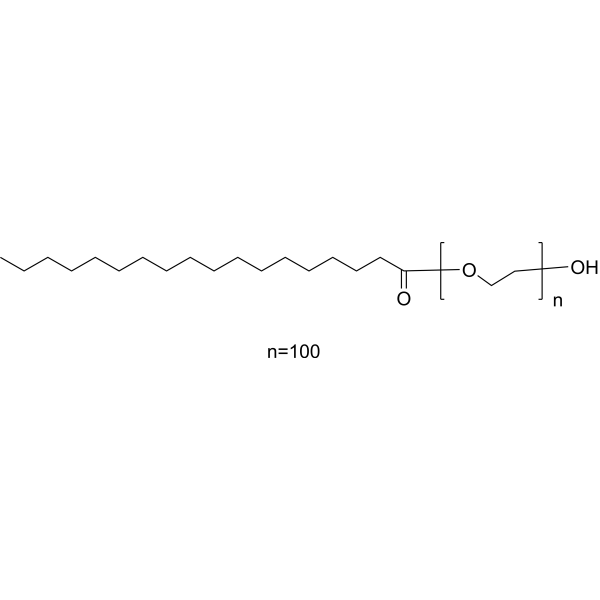
HY-101530C
Polyoxyl 100 stearateNon-ionic Surfactant -
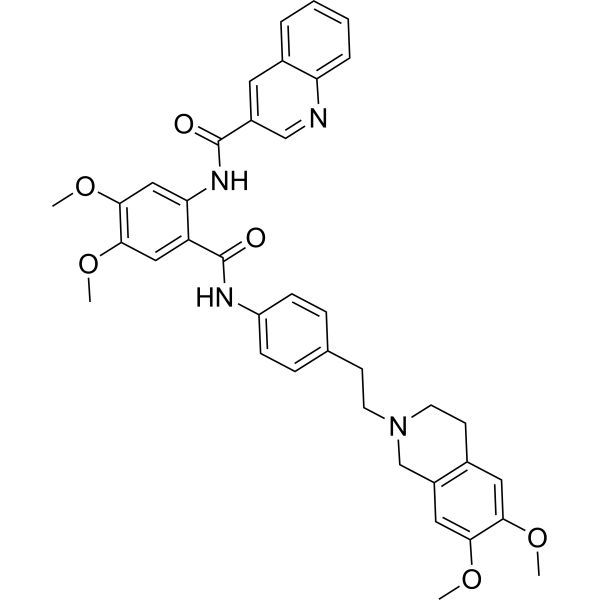
HY-10550
TariquidarP-gp Inhibitor -
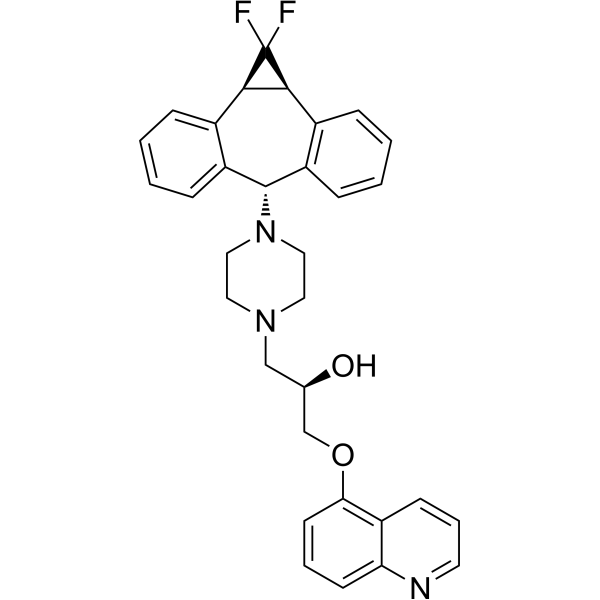
HY-15255
ZosuquidarP-gp Inhibitor -
HY-N0450
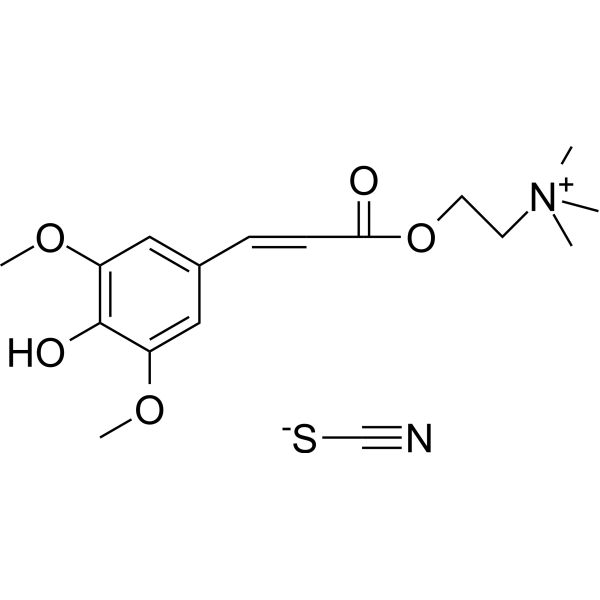
Sinapine thiocyanateCholinesterase (ChE) Inhibitor -
HY-10550A
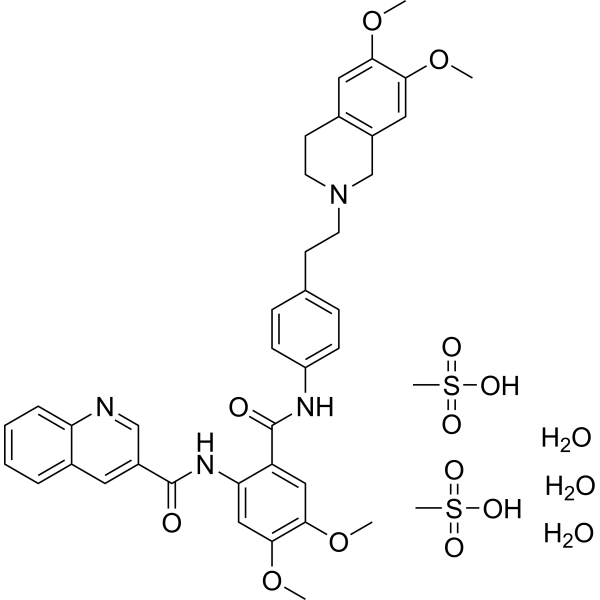
Tariquidar methanesulfonate, hydrateP-gp Inhibitor -
HY-N0144
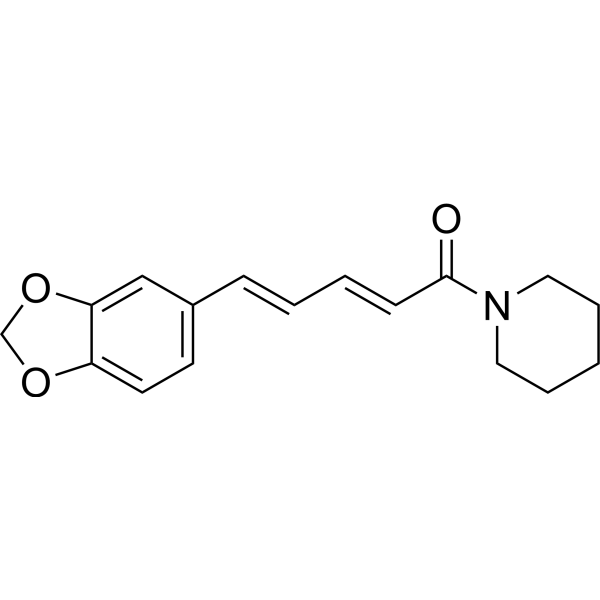
PiperineAutophagy Inducer -

HY-Y1891
Tween 80 -
HY-141415
Tween 20Nonionic Surfactant -
HY-Y1883
Polyethylene glycol mono(4-tert-octylphenyl) ether surfactantNonionic Surfactant -
HY-N0797
(20S)-ProtopanaxadiolAkt activity inhibitor -
HY-Y1883A
Polyethylene glycol mono(4-tert-octylphenyl) etherNonionic Surfactant -

HY-N0144R
Piperine (Standard)Autophagy Inducer


Biologische Aktivität
Beschreibung
In Vitro
Polyoxyethylene stearate has been recommended as an additive to the radiolabelled 7H12 Middlebrook TB media and as such has been shown to enhance growth of mycobacteria in the radiometric BACTEC rapid culture system. Polyoxyethylene (50) stearate produces the greatest enhancement in growth and reduction in the time taken to detect growth for M. tuberculosis and polyoxyethylene (30) stearate and polyoxyethylene (JL) stearate for species of mycobacteria other than M. tuberculosis[1]. Polyoxyethylene stearate inhibits P-gp mediated efflux in a concentration dependent manner mainly by modulating substrate-stimulated P-gp ATPase activity[2]. Polyoxyethylene 40 stearate reduces vinblastine sulfate efllux. The cytotoxicity of vinblastine to K562/ADR cells is significantly enhanced when the cells are cotreated with 100 or 150 μg/mL polyoxyethylene 40 stearate[3].
MedChemExpress (MCE) has not independently confirmed the accuracy of these methods. They are for reference only.
In Vivo
MedChemExpress (MCE) has not independently confirmed the accuracy of these methods. They are for reference only.
Clinical Trial
| NCT Number | Sponsor | Condition | Start Date |
Phase

|
|---|---|---|---|---|
| NCT01329991 | Plexxikon| | 2011-05 | PHASE1 |


Chemical Information
-
CAS. Nr. 9004-99-3
-
Appearance Solid
-
Molecular Weight 328.53 (monomer)
-
Formel C20H40O3 (monomer)
-
Color White to off-white
-
SMILES
O=C(OCCO)CCCCCCCCCCCCCCCCC.[n=10].[n]
-
Synonyms
POES
-
Versand
Room temperature in continental US; may vary elsewhere.
-
Speicherung
Powder -20°C 3 years 4°C 2 years In solvent -80°C 2 years -20°C 1 year


Lösungsmittel & Löslichkeit
In Vitro:
DMSO : 100 mg/mL (Need ultrasonic; Hygroscopic DMSO has a significant impact on the solubility of product, please use newly opened DMSO)
In Vivo:
Select the appropriate dissolution method based on your experimental animal and administration route.
- For the following dissolution methods, please ensure to first prepare a clear stock solution using an In Vitro approach and then sequentially add co-solvents:
- To ensure reliable experimental results, the clarified stock solution can be appropriately stored based on storage conditions. As for the working solution for In Vivo experiments, it is recommended to prepare freshly and use it on the same day.
- The percentages shown for the solvents indicate their volumetric ratio in the final prepared solution. If precipitation or phase separation occurs during preparation, heat and/or sonication can be used to aid dissolution.
Add each solvent one by one: 10% DMSO 40% PEG300 5% Tween-80 45% Saline
Solubility: ≥ 2.5 mg/mL; Clear solution
This protocol yields a clear solution of ≥ 2.5 mg/mL (saturation unknown).
Taking 1 mL working solution as an example, add 100 μL DMSO stock solution (25.0 mg/mL) to 400 μL PEG300, and mix evenly; then add 50 μL Tween-80 and mix evenly; then add 450 μL Saline to adjust the volume to 1 mL.
Preparation of Saline: Dissolve 0.9 g sodium chloride in ddH₂O and dilute to 100 mL to obtain a clear Saline solution.
Add each solvent one by one: 10% DMSO 90% (20% SBE-β-CD in Saline)
Solubility: 2.5 mg/mL; Suspended solution; Need ultrasonic
This protocol yields a suspended solution of 2.5 mg/mL. Suspended solution can be used for oral and intraperitoneal injection.
Taking 1 mL working solution as an example, add 100 μL DMSO stock solution (25.0 mg/mL) to 900 μL 20% SBE-β-CD in Saline, and mix evenly.
Preparation of 20% SBE-β-CD in Saline (4°C, storage for one week): 2 g SBE-β-CD powder is dissolved in 10 mL Saline, completely dissolve until clear.
In Vivo Dissolution Calculator
Please enter the basic information of animal experiments:
-
-
-
-
Recommended: Prepare an additional quantity of animals to account for potential losses during experiments.
Please enter your animal formula composition:
-
%DMSO +
Recommended: Keep the proportion of DMSO in working solution below 2% if your animal is weak.
-
%+
-
+%Tween-80 + +
-
%Saline +
The co-solvents required include: DMSO, . All of co-solvents are available by MedChemExpress (MCE). , Tween 80. All of co-solvents are available by MedChemExpress (MCE).
Working solution concentration: 0.22 mg/mL
Method for preparing stock solution: mg drug dissolved in μL DMSO. Stock solution concentration: mg/mL.
1. Take μL DMSO stock solution;
2. Add μL .
μL , mix evenly;
3. Then add μL Tween 80, mix evenly;
4. Then add μL
Please ensure that the stock solution in the first step is dissolved to a clear state, and add co-solvents in sequence. You can use ultrasonic heating (ultrasonic cleaner, recommended frequency 20-40 kHz), vortexing, etc. to assist dissolution.


Reinheit & Dokumentation
-
Data Sheet (267 KB)
-
SDS (252 KB)
- English - EN (252 KB)
- Français - FR (252 KB)
- Deutsch - DE (252 KB)
- Norwegian - NO (252 KB)
- Español - ES (252 KB)
- Swedish - SV (252 KB)
- Italian - IT (252 KB)
- Korean - KR (252 KB)
- Portuguese - PT (252 KB)
-
Handling Instructions (2659 KB)
Verweise
[1]. Cutler RR, et al. The effect of polyoxyethylene stearate (POES) on the growth of mycobacteria in radiometric 7H12 Middlebrook TB medium. Tubercle. 1987 Sep;68(3):209-20. [Content Brief]
[2]. Zhu S, et al. Effects of polyoxyethylene (40) stearate on the activity of P-glycoprotein and cytochrome P450. Eur J Pharm Sci. 2009 Jul 12;37(5):573-80. [Content Brief]
[3]. Luo L, et al. Polyoxyethylene 40 stearate modulates multidrug resistance and enhances antitumor activity of vinblastine sulfate. AAPS J. 2007 Oct 5;9(3):E329-35. [Content Brief]

Calculators
Konzentration (Stammlösung) × Volumen (Stammlösung) = Konzentration (Ziellösung) × Volumen (Ziellösung)


Polyoxyethylene stearate Related Classifications
HY-101530 Related Classifications
 Powered by Bioz