



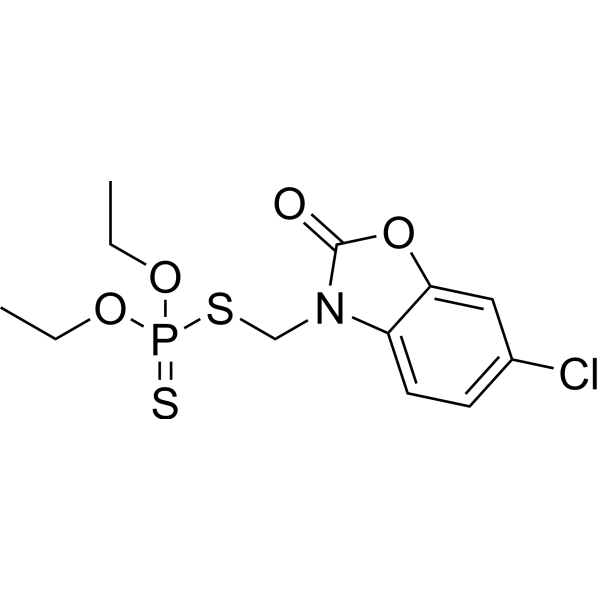
Phosalone
Based on 1 publication(s) in Google Scholar
Phosalone is an orally active, blood-brain barrier penetrant Insecticide and acaricide. Phosalone inhibits the activity of Acetylcholinesterase. Phosalone acts as a substrate for detoxifying esterases. Phosalone induces symptoms of cholinergic hyperactivity, toxic reactions, mortality, oxidative stress, and changes in pro-inflammatory protein levels, and exerts toxic effects on colonic tissues and cells. Phosalone controls pistachio psyllids. Phosalone can be used in studies related to colitis.
For research use only. We do not sell to patients.
- Purity : 98.04%
- CAS No.: 2310-17-0
- Formula: C12H15ClNO4PS2
- Molecular Weight:367.81
-
Storage:Powder -20°C, 3 years , 4°C, 2 years ; In solvent -80°C, 2 years , -20°C, 1 year

To place orders, for customer services and technical support, please contact: MedChemExpress USA
Tel: 609-228-6898 E-mail: [email protected] [email protected]


-
 Biological Activity
-
Chemical Information
-
Solvent & Solubility
- Protocols
- Purity & Documentation
- References
-
 Help & FAQs



Publications Citing Use of MedChemExpress (MCE) Phosalone
More

Biological Activity
Description
IC50 & Target
[1]|
Mite |
AChE |
In Vitro
Phosalone (Five or six distinct concentrations; 24 h) exhibits variable toxicity to 5th instar nymphs of nine Agonoscena pistaciae populations, with the Rafsanjan (RF) population showing the highest resistance (11.3-fold) and the Bam (BA) population being the most susceptible (LC50 = 55 mg/L)[3].
Phosalone (Various concentrations; 8 h) is 15.65-fold more toxic to susceptible (BA) adult Agonoscena pistaciae (LC50 = 1.14 mg/L) than to resistant (RF) adults, with TPP (synergist ratio 3.14) and DEM (synergist ratio 1.41) enhancing phosalone toxicity in RF adults, while PBO acts antagonistically (synergist ratio 0.45)[3].
MedChemExpress (MCE) has not independently confirmed the accuracy of these methods. They are for reference only.
In Vivo
Phosalone (4-36 mg/kg; p.o.; single dose) inhibits erythrocyte, plasma, and brain cholinesterase in female CD (COBS) rats after single oral administration, with peak erythrocyte cholinesterase inhibition (ID50 = 10.5 mg/kg) occurring 5 hours post-dose[1].
Phosalone (6-40 mg/kg; gavage; daily; 30 days) induces dose-dependent colon inflammation and oxidative stress in male Wistar rats, with the highest tested dose (40 mg/kg, 1/3 LD50) causing the most severe reductions in AChE activity, total thiols, and antioxidant power, plus the greatest elevations in inflammatory markers, myeloperoxidase activity, and lipid peroxidation[2].
MedChemExpress (MCE) has not independently confirmed the accuracy of these methods. They are for reference only.
-
Animal Model:Wistar (male, 180-200 g)[2]
-
Dosage:6-40 mg/kg
-
Administration:gavage; daily; 30 days
-
Result:Caused severe degeneration of mucosal muscle cells and muscle layers, plus significant infiltration of mononuclear inflammatory cells between mucosal glands at 40 mg/kg.
Caused relatively severe muscle layer degeneration and mononuclear cell infiltration at 20 mg/kg.
Caused significant muscle layer degeneration and mild mononuclear cell infiltration at 12 mg/kg.
Caused mild muscle layer degeneration and mild mucosal inflammation at 6 mg/kg.
Reduced AChE activity to 25% (40 mg/kg), 29% (20 mg/kg), 33% (12 mg/kg), and 50% (6 mg/kg) of normal levels, with significant decreases for 40 mg/kg and 20 mg/kg groups compared to normal or ellagic acid-only groups (p < 0.01 to p < 0.05).
Increased MPO activity to 0.387 U/mg protein (40 mg/kg), 0.292 U/mg protein (20 mg/kg), 0.214 U/mg protein (12 mg/kg), and 0.194 U/mg protein (6 mg/kg), with significant elevations for 40 mg/kg and 20 mg/kg groups compared to normal or ellagic acid-only groups (p < 0.01 to p < 0.001).
Increased TBARS levels to 447.46 μg (40 mg/kg), 422.88 μg (20 mg/kg), 390.03 μg (12 mg/kg), and 351.88 μg (6 mg/kg), with significant elevations for all doses compared to normal groups (p < 0.01 to p < 0.001).
Reduced TTM levels to 0.249 mmol/L (40 mg/kg), 0.317 mmol/L (20 mg/kg), 0.304 mmol/L (12 mg/kg), and 0.347 mmol/L (6 mg/kg), with significant decreases for all doses compared to normal groups (p < 0.05 to p < 0.01).
Reduced FRAP levels to 18.22 μmol/L (40 mg/kg), 24.70 μmol/L (20 mg/kg), 20.31 μmol/L (12 mg/kg), and 23.25 μmol/L (6 mg/kg), with significant decreases for all doses compared to normal or ellagic acid-only groups (p < 0.001).
Increased TNF-α levels to 546.43 pg/mg protein (40 mg/kg), 433.87 pg/mg protein (20 mg/kg), 375.13 pg/mg protein (12 mg/kg), and 309.50 pg/mg protein (6 mg/kg), with significant elevations for 40 mg/kg and 20 mg/kg groups compared to normal or ellagic acid-only groups (p < 0.05 to p < 0.001).
Increased IL-6β levels to 21.55 pg/mg protein (40 mg/kg), 17.54 pg/mg protein (20 mg/kg), 16.60 pg/mg protein (12 mg/kg), and 14.83 pg/mg protein (6 mg/kg), with significant elevations for all doses compared to normal groups (p < 0.001).
Increased NF-κB levels to 51.41 pg/mg protein (40 mg/kg), 32.36 pg/mg protein (20 mg/kg), 31.68 pg/mg protein (12 mg/kg), and 26.87 pg/mg protein (6 mg/kg), with significant elevations for all doses compared to normal groups (p < 0.05 to p < 0.001).


Chemical Information
-
CAS No. 2310-17-0
-
Appearance Solid
-
Molecular Weight 367.81
-
Formula C12H15ClNO4PS2
-
Color Off-white to pink
-
SMILES
S=P(OCC)(SCN1C(OC2=CC(Cl)=CC=C12)=O)OCC
-
Shipping
Room temperature in continental US; may vary elsewhere.
-
Storage
Powder -20°C 3 years 4°C 2 years In solvent -80°C 2 years -20°C 1 year


Publications (1)
-
Journal Impact Factor
-
Most Recent
-
ACS Environ Au
Machine Learning-Assisted Recognition of Environmental Sulfur-Containing Chemicals in Nontargeted Mass Spectrometry Analysis of Inadequate Mass Resolution. [Abstract]2025 Aug 5;5(6):573-582. PMID: 41277996


Solvent & Solubility
In Vitro:
DMSO : ≥ 41 mg/mL (111.47 mM; Hygroscopic DMSO has a significant impact on the solubility of product, please use newly opened DMSO)
* "≥" means soluble, but saturation unknown.
Please refer to the solubility information to select the appropriate solvent. Once prepared, please aliquot and store the solution to prevent product inactivation from repeated freeze-thaw cycles.
Storage method and period of stock solution: -80°C, 2 years; -20°C, 1 year. When stored at -80°C, please use it within 2 years. When stored at -20°C, please use it within 1 year.
Please refer to the solubility information to select the appropriate solvent. Once prepared, please aliquot and store the solution to prevent product inactivation from repeated freeze-thaw cycles.
Storage method and period of stock solution: -80°C, 2 years; -20°C, 1 year. When stored at -80°C, please use it within 2 years. When stored at -20°C, please use it within 1 year.
Concentration (start) × Volume (start) = Concentration (final) × Volume (final)


Purity & Documentation
-
Data Sheet (280 KB)
-
SDS (624 KB)
- English - EN (624 KB)
- Français - FR (624 KB)
- Deutsch - DE (624 KB)
- Norwegian - NO (624 KB)
- Español - ES (624 KB)
- Swedish - SV (624 KB)
- Italian - IT (624 KB)
- Korean - KR (624 KB)
- Portuguese - PT (624 KB)
-
Handling Instructions (2659 KB)
References
[1]. Pasquet J, et al. Acute oral and percutaneous toxicity of phosalone in the rat, in comparison with azinphosmethyl and parathion. Toxicol Appl Pharmacol. 1976 Jul;37(1):85-92. ID: 968909. [Content Brief]
[2]. Ghasemi-Niri SF, et al. Phosalone-induced inflammation and oxidative stress in the colon: Evaluation and treatment. World J Gastroenterol. 2016;22(21):4999-5011. [Content Brief]


Complete Stock Solution Preparation Table
Please refer to the solubility information to select the appropriate solvent. Once prepared, please aliquot and store the solution to prevent product inactivation from repeated freeze-thaw cycles.
Storage method and period of stock solution: -80°C, 2 years; -20°C, 1 year. When stored at -80°C, please use it within 2 years. When stored at -20°C, please use it within 1 year.
| Optional Solvent | Concentration Solvent Mass | 1 mg | 5 mg | 10 mg | 25 mg |
|---|---|---|---|---|---|
| DMSO | 1 mM | 2.7188 mL | 13.5940 mL | 27.1880 mL | 67.9699 mL |
| 5 mM | 0.5438 mL | 2.7188 mL | 5.4376 mL | 13.5940 mL | |
| 10 mM | 0.2719 mL | 1.3594 mL | 2.7188 mL | 6.7970 mL | |
| 15 mM | 0.1813 mL | 0.9063 mL | 1.8125 mL | 4.5313 mL | |
| 20 mM | 0.1359 mL | 0.6797 mL | 1.3594 mL | 3.3985 mL | |
| 25 mM | 0.1088 mL | 0.5438 mL | 1.0875 mL | 2.7188 mL | |
| 30 mM | 0.0906 mL | 0.4531 mL | 0.9063 mL | 2.2657 mL | |
| 40 mM | 0.0680 mL | 0.3398 mL | 0.6797 mL | 1.6992 mL | |
| 50 mM | 0.0544 mL | 0.2719 mL | 0.5438 mL | 1.3594 mL | |
| 60 mM | 0.0453 mL | 0.2266 mL | 0.4531 mL | 1.1328 mL | |
| 80 mM | 0.0340 mL | 0.1699 mL | 0.3398 mL | 0.8496 mL | |
| 100 mM | 0.0272 mL | 0.1359 mL | 0.2719 mL | 0.6797 mL |


Phosalone Related Classifications
HY-B2029 Related Classifications
 Powered by Bioz