



Ecopipam

Based on 1 Customer Validation
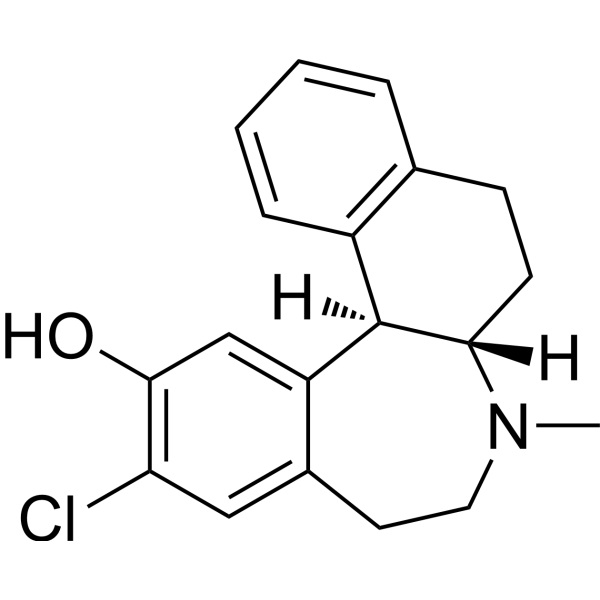
Ecopipam (SCH 39166) is a potent, selective and orally active antagonist of dopamine D1/D5 receptor, with Kis of 1.2 nM and 2.0 nM, respectively. Ecopipam shows more than 40-flod selectivity over D2, D4, 5-HT, and α2a receptor (Ki=0.98, 5.52, 0.08, and 0.73 μM, respectively). Ecopipam can be used for the research of schizophrenia and obesity.
For research use only. We do not sell to patients.
- Purity: 99.77%
- CAS No.: 112108-01-7
- Formula: C19H20ClNO
- Molecular Weight:313.82
-
Storage:
4°C, sealed storage, away from moisture
* In solvent : -80°C, 6 months; -20°C, 1 month (sealed storage, away from moisture)

To place orders, for customer services and technical support, please contact: MedChemExpress USA
Tel: 609-228-6898 E-mail: [email protected] [email protected]


-
 Biological Activity
-
Chemical Information
-
Solvent & Solubility
- Purity & Documentation
- References
-
 Help & FAQs
-

GPCR/G Protein Compound Library
HY-L006
-
Neuronal Signaling Compound Library
HY-L013
-
Orally Active Compound Library
HY-L061
-
Neurotransmitter Receptor Compound Library
HY-L062
-
Anti-Alzheimer's Disease Compound Library
HY-L069
-
Anti-Parkinson's Disease Compound Library
HY-L085
-
Neurodegenerative Disease-related Compound Library
HY-L086
-
Rare Diseases Drug Library
HY-L102
-
Antidepressant Compound Library
HY-L108
-
5-HT Receptor Compound Library
HY-L121
-
Human Metabolite Library
HY-L123
-
Coagulation and Anti-coagulation Compound Library
HY-L136
-
Antihypertensive Compound Library
HY-L145
-
Membrane Protein-targeted Compound Library
HY-L149
-
Membrane Receptor-targeted Compound Library
HY-L150
-
Highly Selective Inhibitors Library
HY-L158
-
Dopamine Receptor Compound Library
HY-L165
-
Multi-Target Compound Library
HY-L176
-
Bioactive Compound Library Max
HY-L181
-
MCE Bioactive Compound Library
HY-L001V
-
Bioactive Compound Library
HY-L001
-
High-Throughput Bioactive Compound Library
HY-L205
-
Mass Spectrometry Human Metabolite Library
HY-L215
-
Lactylation Compound Library
HY-L249


All Dopamine Receptor Isoforms
MoreAll 5-HT Receptor Isoforms
MoreAll Adrenergic Receptor Isoforms
More

Biological Activity
|
D1 Receptor 1.2 nM (Ki) |
D5 Receptor 2.0 nM (Ki) |
D2 Receptor 980 nM (Ki) |
D4 Receptor 5520 nM (Ki) |
5-HT Receptor 80 nM (Ki) |
Alpha-2A adrenergic receptor 731 nM (Ki) |
Ecopipam (2 μM) completely abolishes the proconvulsive effect of Dopamine (10 μM) in isolated corticohippocampal formation[2].
MedChemExpress (MCE) has not independently confirmed the accuracy of these methods. They are for reference only.
Ecopipam (10, mg/kg, oral administration) antagonizes Apomorphine-induced stereotypy in rats[4].
Ecopipam (5 and 10 μM, perfusion, 1 μL/min) reversibly and dose-dependently decreases acetylcholine release in the rat striatum[5].
MedChemExpress (MCE) has not independently confirmed the accuracy of these methods. They are for reference only.
-
Animal Model:Male young adult Long-Evans rats injected with Nicotine[3]
-
Dosage:0.003, 0.01, 0.03, 0.1, 0.3 mg/kg
-
Administration:A single s.c. 20 min before Nicotine (0.1 mg/kg)
-
Result:Dose-dependently reduced pressing on both active and inactive levers.


Chemical Information
-
CAS No. 112108-01-7
-
Appearance Solid
-
Molecular Weight 313.82
-
Formula C19H20ClNO
-
Color White to off-white
-
SMILES
OC1=C(Cl)C=C2C([C@]3([H])[C@@](CCC4=C3C=CC=C4)([H])N(C)CC2)=C1
-
Synonyms
SCH 39166
-
Shipping
Room temperature in continental US; may vary elsewhere.
-
Storage
4°C, sealed storage, away from moisture
* In solvent : -80°C, 6 months; -20°C, 1 month (sealed storage, away from moisture)


Solvent & Solubility
DMSO : 25 mg/mL (79.66 mM; Need ultrasonic; Hygroscopic DMSO has a significant impact on the solubility of product, please use newly opened DMSO)
Please refer to the solubility information to select the appropriate solvent. Once prepared, please aliquot and store the solution to prevent product inactivation from repeated freeze-thaw cycles.
Storage method and period of stock solution: -80°C, 6 months; -20°C, 1 month (sealed storage, away from moisture). When stored at -80°C, please use it within 6 months. When stored at -20°C, please use it within 1 month.
Please refer to the solubility information to select the appropriate solvent. Once prepared, please aliquot and store the solution to prevent product inactivation from repeated freeze-thaw cycles.
Storage method and period of stock solution: -80°C, 6 months; -20°C, 1 month (sealed storage, away from moisture). When stored at -80°C, please use it within 6 months. When stored at -20°C, please use it within 1 month.
Concentration (start) × Volume (start) = Concentration (final) × Volume (final)
Select the appropriate dissolution method based on your experimental animal and administration route.
- For the following dissolution methods, please ensure to first prepare a clear stock solution using an In Vitro approach and then sequentially add co-solvents:
- To ensure reliable experimental results, the clarified stock solution can be appropriately stored based on storage conditions. As for the working solution for In Vivo experiments, it is recommended to prepare freshly and use it on the same day.
- The percentages shown for the solvents indicate their volumetric ratio in the final prepared solution. If precipitation or phase separation occurs during preparation, heat and/or sonication can be used to aid dissolution.
Please enter the basic information of animal experiments:
-
-
-
-
Recommended: Prepare an additional quantity of animals to account for potential losses during experiments.
Please enter your animal formula composition:
-
%DMSO +
Recommended: Keep the proportion of DMSO in working solution below 2% if your animal is weak.
-
%+
-
+%Tween-80 + +
-
%Saline +
The co-solvents required include: DMSO, . All of co-solvents are available by MedChemExpress (MCE). , Tween 80. All of co-solvents are available by MedChemExpress (MCE).
Working solution concentration: 0.22 mg/mL
Method for preparing stock solution: mg drug dissolved in μL DMSO. Stock solution concentration: mg/mL. * In solvent : -80°C, 6 months; -20°C, 1 month (sealed storage, away from moisture)
1. Take μL DMSO stock solution;
2. Add μL .
μL , mix evenly;
3. Then add μL Tween 80, mix evenly;
4. Then add μL
Please ensure that the stock solution in the first step is dissolved to a clear state, and add co-solvents in sequence. You can use ultrasonic heating (ultrasonic cleaner, recommended frequency 20-40 kHz), vortexing, etc. to assist dissolution.


Purity & Documentation
-
Data Sheet (282 KB)
-
SDS (252 KB)
- English - EN (252 KB)
- Français - FR (252 KB)
- Deutsch - DE (252 KB)
- Norwegian - NO (252 KB)
- Español - ES (252 KB)
- Swedish - SV (252 KB)
- Italian - IT (252 KB)
- Korean - KR (252 KB)
- Portuguese - PT (252 KB)
-
Handling Instructions (2659 KB)
References
[1]. Wu WL, et, al. Dopamine D1/D5 receptor antagonists with improved pharmacokinetics: design, synthesis, and biological evaluation of phenol bioisosteric analogues of benzazepine D1/D5 antagonists. J Med Chem. 2005 Feb 10;48(3):680-93. [Content Brief]
[2]. Sharopov S, et al. Dopaminergic modulation of low-Mg²⁺-induced epileptiform activity in the intact hippocampus of the newborn mouse in vitro. J Neurosci Res. 2012 Oct;90(10):2020-33. [Content Brief]
[3]. Satanove DJ, et al. Nicotine-induced enhancement of a sensory reinforcer in adult rats: antagonist pretreatment effects. Psychopharmacology (Berl). 2021 Feb;238(2):475-486. [Content Brief]
[4]. R E Chipkin, et al. Pharmacological profile of SCH39166: a dopamine D1 selective benzonaphthazepine with potential antipsychotic activity. J Pharmacol Exp Ther. 1988 Dec;247(3):1093-102. [Content Brief]
[5]. E Acquas, et al. Local application of SCH 39166 reversibly and dose-dependently decreases acetylcholine release in the rat striatum. Eur J Pharmacol. 1999 Nov 3;383(3):275-9. [Content Brief]


Complete Stock Solution Preparation Table
Please refer to the solubility information to select the appropriate solvent. Once prepared, please aliquot and store the solution to prevent product inactivation from repeated freeze-thaw cycles.
Storage method and period of stock solution: -80°C, 6 months; -20°C, 1 month (sealed storage, away from moisture). When stored at -80°C, please use it within 6 months. When stored at -20°C, please use it within 1 month.
| Optional Solvent | Concentration Solvent Mass | 1 mg | 5 mg | 10 mg | 25 mg |
|---|---|---|---|---|---|
| DMSO | 1 mM | 3.1865 mL | 15.9327 mL | 31.8654 mL | 79.6635 mL |
| 5 mM | 0.6373 mL | 3.1865 mL | 6.3731 mL | 15.9327 mL | |
| 10 mM | 0.3187 mL | 1.5933 mL | 3.1865 mL | 7.9663 mL | |
| 15 mM | 0.2124 mL | 1.0622 mL | 2.1244 mL | 5.3109 mL | |
| 20 mM | 0.1593 mL | 0.7966 mL | 1.5933 mL | 3.9832 mL | |
| 25 mM | 0.1275 mL | 0.6373 mL | 1.2746 mL | 3.1865 mL | |
| 30 mM | 0.1062 mL | 0.5311 mL | 1.0622 mL | 2.6554 mL | |
| 40 mM | 0.0797 mL | 0.3983 mL | 0.7966 mL | 1.9916 mL | |
| 50 mM | 0.0637 mL | 0.3187 mL | 0.6373 mL | 1.5933 mL | |
| 60 mM | 0.0531 mL | 0.2655 mL | 0.5311 mL | 1.3277 mL |


Ecopipam Related Classifications
HY-14690 Related Classifications
 Powered by Bioz