



(R)-Lisofylline

Based on 1 Customer Validation
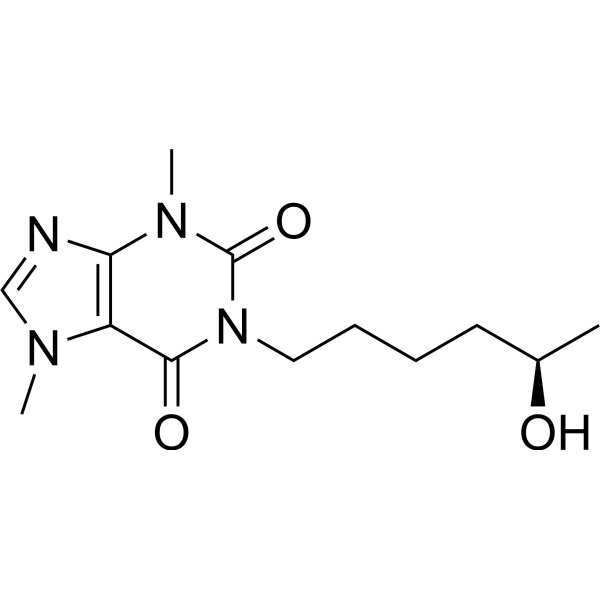
(R)-Lisofylline ((R)-Lisophylline) is a (R)-enantiomer of the metabolite of Pentoxifylline with anti-inflammatory properties. (R)-Lisofylline is a lysophosphatidic acid acyltransferase inhibitor with an IC50 of 0.6 μM and interrupts IL-12 signaling-mediated STAT4 activation. (R)-Lisofylline has the potential for type 1 diabetes, autoimmune disorders research.
For research use only. We do not sell to patients.
- Purity : 99.99%
- CAS No.: 100324-81-0
- Formula: C13H20N4O3
- Molecular Weight:280.32
-
Storage:
-20°C, stored under nitrogen
* In solvent : -80°C, 6 months; -20°C, 1 month (stored under nitrogen)

To place orders, for customer services and technical support, please contact: MedChemExpress USA
Tel: 609-228-6898 E-mail: [email protected] [email protected]


-
 Biological Activity
-
Chemical Information
-
Solvent & Solubility
- Protocols
- Purity & Documentation
- References
-
 Help & FAQs




Biological Activity
Description
IC50 & Target
IC50: 0.6 µM (Lysophosphatidic acid acyltransferase)[1]
STAT4[1]
In Vitro
In Vivo
(R)-Lisofylline prevents β cell dysfunction in NOD mice by inhibition of STAT4 phosphorylation which interrupts IL-12 signaling. (R)-Lisofylline ameliorates experimental allergic encephalomyelitis in mice[1].
(R)-Lisofylline also improves survival in mice injected with a lethal dose of LPS and ameliorates sepsis-induced lung injury in minipigs. In rats given IL-1 intratracheally (R)-Lisofylline pretreatment reduces lung leak but does not decrease neutrophil accumulation in lungs[1].
(R)-Lisofylline also suppresses release of TNF-α in vivo in mice and ex vivo in human blood stimulated with endotoxin derived from Salmonella or Escherichia coli[1].
MedChemExpress (MCE) has not independently confirmed the accuracy of these methods. They are for reference only.


Chemical Information
-
CAS No. 100324-81-0
-
Appearance Solid
-
Molecular Weight 280.32
-
Formula C13H20N4O3
-
Color White to off-white
-
SMILES
O=C(N1CCCC[C@H](O)C)N(C)C2=C(N(C)C=N2)C1=O
-
Synonyms
(R)-Lisophylline
-
Shipping
Room temperature in continental US; may vary elsewhere.
-
Storage
-20°C, stored under nitrogen
* In solvent : -80°C, 6 months; -20°C, 1 month (stored under nitrogen)


Solvent & Solubility
In Vitro:
DMSO : 100 mg/mL (356.74 mM; Need ultrasonic; Hygroscopic DMSO has a significant impact on the solubility of product, please use newly opened DMSO)
Please refer to the solubility information to select the appropriate solvent. Once prepared, please aliquot and store the solution to prevent product inactivation from repeated freeze-thaw cycles.
Storage method and period of stock solution: -80°C, 6 months; -20°C, 1 month (stored under nitrogen). When stored at -80°C, please use it within 6 months. When stored at -20°C, please use it within 1 month.
Please refer to the solubility information to select the appropriate solvent. Once prepared, please aliquot and store the solution to prevent product inactivation from repeated freeze-thaw cycles.
Storage method and period of stock solution: -80°C, 6 months; -20°C, 1 month (stored under nitrogen). When stored at -80°C, please use it within 6 months. When stored at -20°C, please use it within 1 month.
Concentration (start) × Volume (start) = Concentration (final) × Volume (final)


Purity & Documentation
-
Data Sheet (274 KB)
-
SDS (252 KB)
- English - EN (252 KB)
- Français - FR (252 KB)
- Deutsch - DE (252 KB)
- Norwegian - NO (252 KB)
- Español - ES (252 KB)
- Swedish - SV (252 KB)
- Italian - IT (252 KB)
- Korean - KR (252 KB)
- Portuguese - PT (252 KB)
-
Handling Instructions (2659 KB)
References
[1]. Elżbieta Wyska, et al. Physiologically Based Modeling of Lisofylline Pharmacokinetics Following Intravenous Administration in Mice. Eur J Drug Metab Pharmacokinet. 2016 Aug;41(4):403-12. [Content Brief]
[2]. B M Hybertson, et al. Lisofylline Prevents Leak, but Not Neutrophil Accumulation, in Lungs of Rats Given IL-1 Intratracheally. J Appl Physiol (1985). 1997 Jan;82(1):226-32. [Content Brief]
[3]. J J Bright, et al. Prevention of Experimental Allergic Encephalomyelitis via Inhibition of IL-12 Signaling and IL-12-mediated Th1 Differentiation: An Effect of the Novel Anti-Inflammatory Drug Lisofylline. J Immunol. 1998 Dec 15;161(12):7015-22. [Content Brief]


Complete Stock Solution Preparation Table
Please refer to the solubility information to select the appropriate solvent. Once prepared, please aliquot and store the solution to prevent product inactivation from repeated freeze-thaw cycles.
Storage method and period of stock solution: -80°C, 6 months; -20°C, 1 month (stored under nitrogen). When stored at -80°C, please use it within 6 months. When stored at -20°C, please use it within 1 month.
| Optional Solvent | Concentration Solvent Mass | 1 mg | 5 mg | 10 mg | 25 mg |
|---|---|---|---|---|---|
| DMSO | 1 mM | 3.5674 mL | 17.8368 mL | 35.6735 mL | 89.1838 mL |
| 5 mM | 0.7135 mL | 3.5674 mL | 7.1347 mL | 17.8368 mL | |
| 10 mM | 0.3567 mL | 1.7837 mL | 3.5674 mL | 8.9184 mL | |
| 15 mM | 0.2378 mL | 1.1891 mL | 2.3782 mL | 5.9456 mL | |
| 20 mM | 0.1784 mL | 0.8918 mL | 1.7837 mL | 4.4592 mL | |
| 25 mM | 0.1427 mL | 0.7135 mL | 1.4269 mL | 3.5674 mL | |
| 30 mM | 0.1189 mL | 0.5946 mL | 1.1891 mL | 2.9728 mL | |
| 40 mM | 0.0892 mL | 0.4459 mL | 0.8918 mL | 2.2296 mL | |
| 50 mM | 0.0713 mL | 0.3567 mL | 0.7135 mL | 1.7837 mL | |
| 60 mM | 0.0595 mL | 0.2973 mL | 0.5946 mL | 1.4864 mL | |
| 80 mM | 0.0446 mL | 0.2230 mL | 0.4459 mL | 1.1148 mL | |
| 100 mM | 0.0357 mL | 0.1784 mL | 0.3567 mL | 0.8918 mL |


(R)-Lisofylline Related Classifications
HY-109854A Related Classifications
 Powered by Bioz