



Azure A chloride

Based on 1 Customer Validation
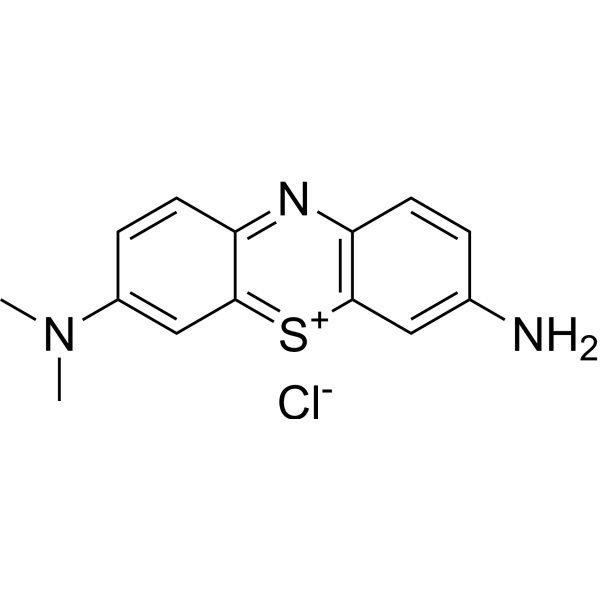
Azure A chloride is a phenothiazine dye. Azure A chloride is an alternative DNA dye used for the separation of DNA and protein fragments in agarose gel electrophoresis and PAGE. Azure A chloride can be chemisorbed on the surface of mild steel according to the Langmuir adsorption isotherm to form a protective film. Azure A chloride binds to double-stranded DNA in a non-cooperative manner via weak intercalation, triggering molecular conformational disturbance, restricted rotational motion, and changes in optical activity.
For research use only. We do not sell to patients.
- Purity : 70%
- CAS No.: 531-53-3
- Formula: C14H14ClN3S
- Molecular Weight:291.81
-
Storage:
4°C, sealed storage, away from moisture and light
* In solvent : -80°C, 6 months; -20°C, 1 month (sealed storage, away from moisture and light)

To place orders, for customer services and technical support, please contact: MedChemExpress USA
Tel: 609-228-6898 E-mail: [email protected] [email protected]


-
 Biological Activity
-
Chemical Information
-
Solvent & Solubility
- Protocols
- Purity & Documentation
- References
-
 Help & FAQs


-
HY-D0974
Sulforhodamine B sodium saltFluorescent Dye -
HY-D0309
Rhodamine 6GLaser Dye -
HY-D0961
Gallocyanine chlorideDKK1 Inhibitor -

HY-D0309R
Rhodamine 6G (Standard)Laser Dye -
HY-W040226
Indigo carmine -
HY-D0166
Neutral RedBiochemical Assay Reagent -
HY-D1168
Oil Red ODiazol Dye -
HY-D0166A
Neutral Red (IND)Biochemical Assay Reagent -
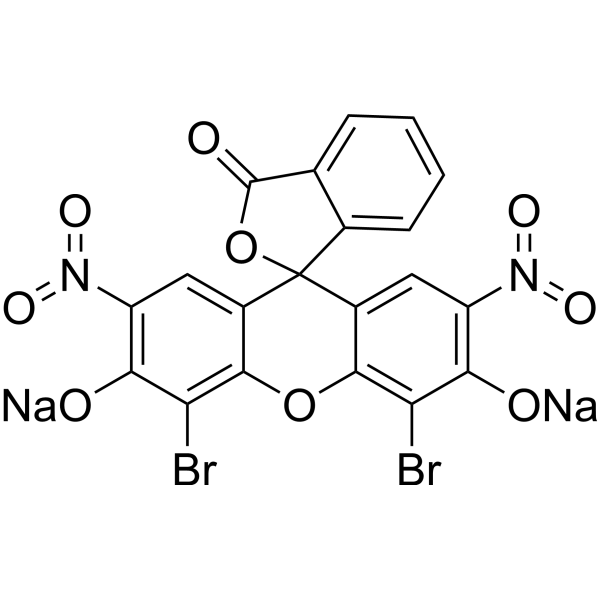
HY-D1198
Eosin BDye -
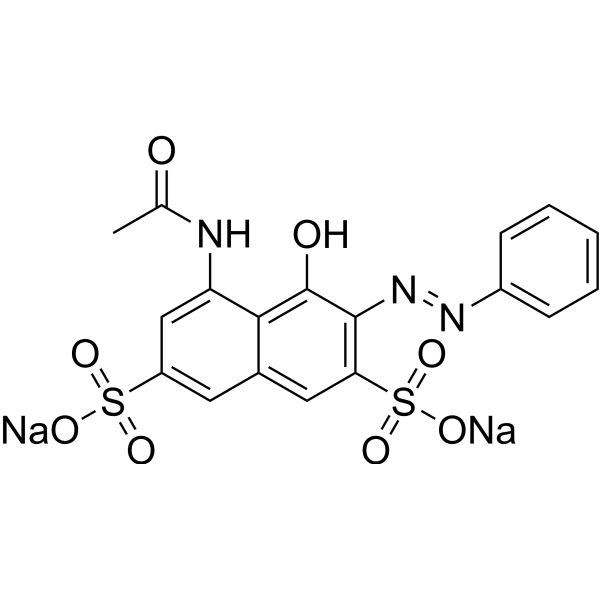
HY-D1379
AzophloxineRed Azo Dye -

HY-W040226R
Indigo carmine (Standard)


Biological Activity
Description
In Vitro
Azure A chloride (1-100 μM; 1-120 h, 298-328 K) acts as a stable, mixed-type corrosion inhibitor for mild steel in 1.0 M HCl, achieving a maximum inhibition efficiency of 88% at 100 μM after 1 h immersion at 298 K, and maintaining efficiencies above 86% even after 120 h of exposure at the highest concentration[2].
Azure A chloride inhibits mild steel corrosion via electron donation from nitrogen atoms (N19, N30) and heterocyclic ring carbon atoms (C3, C8) to the metal surface, with enhanced electron-donor activity in aqueous acidic conditions, supporting a chemisorption mechanism[2].
Azure A chloride (1-60 μM; incubated at 20 ± 0.5-1.0°C) binds to herring testes double-stranded DNA in a non-cooperative, weak intercalative manner with an intrinsic binding constant of ~0.88 × 10⁵/M, a binding stoichiometry of ~4.5 base pairs per dye molecule, and induces minor changes to DNA conformation and optical activity in the dye molecule[3].
MedChemExpress (MCE) has not independently confirmed the accuracy of these methods. They are for reference only. Further protocols information, click here.


Chemical Information
-
CAS No. 531-53-3
-
Appearance Solid
-
Molecular Weight 291.81
-
Formula C14H14ClN3S
-
Color Brown to black
-
SMILES
CN(C1=CC2=[S+]C3=C(C=CC(N)=C3)N=C2C=C1)C.[Cl-]
-
Shipping
Room temperature in continental US; may vary elsewhere.
-
Storage
4°C, sealed storage, away from moisture and light
* In solvent : -80°C, 6 months; -20°C, 1 month (sealed storage, away from moisture and light)


Solvent & Solubility
In Vitro:
H2O : < 0.1 mg/mL (insoluble)

Protocols
-
Agarose gel electrophoresis (200 bp-5 kb)
Agarose gel electrophoresis is a molecular biology technique that uses agarose gel as a support medium to separate DNA fragments through a combination of molecular sieving and charge effects.
-
Polyacrylamide gel electrophoresis (PAGE) (<1 kb)
Gel electrophoresis is a method for separating biological macromolecules (such as nucleic acids or proteins) by forcing them through a gel matrix under an electric field.
-
Protocol for Protein Electrophoresis
Protein electrophoresis separates proteins in a polyacrylamide gel under an electric field; in SDS-PAGE, sodium dodecyl sulfate denatures proteins and gives them a broadly similar negative charge-to-mass ratio, so migration mainly reflects apparent molecular mass through the gel matrix. The readout is a stained protein band pattern: band position estimates apparent molecular mass using protein standards, band intensity reflects relative protein abundance within the linear range of staining/detection, and changes in band pattern can reflect protein expression, degradation, purification, or sample composition.


Purity & Documentation
-
Data Sheet (271 KB)
-
SDS (393 KB)
- English - EN (393 KB)
- Français - FR (393 KB)
- Deutsch - DE (393 KB)
- Norwegian - NO (393 KB)
- Español - ES (393 KB)
- Swedish - SV (393 KB)
- Italian - IT (393 KB)
- Korean - KR (393 KB)
- Portuguese - PT (393 KB)
-
Handling Instructions (2659 KB)
References

Calculators
Concentration (start) × Volume (start) = Concentration (final) × Volume (final)


Azure A chloride Related Classifications
HY-D0947 Related Classifications
 Powered by Bioz