



Benralizumab
Based on 1 publication(s) in Google Scholar
Benralizumab (MEDI-563) is an interleukin-5 receptor α (IL-5Rα)-directed cytolytic monoclonal antibody that induces direct, rapid and nearly complete depletion of eosinophils via enhanced antibody-dependent cell-mediated cytotoxicity. Benralizumab can be used for severe eosinophilic asthma.
For research use only. We do not sell to patients.
- Purity : 95%
- CAS No.: 1044511-01-4
- Molecular Weight:146.06 kDa
-
Storage:
Please store the product under the recommended conditions in the Certificate of Analysis.


To place orders, for customer services and technical support, please contact: MedChemExpress USA
Tel: 609-228-6898 E-mail: [email protected] [email protected]


-
 Biological Activity
-
Chemical Information
- Protocols
- Purity & Documentation
- References
-
 Help & FAQs


-

HY-P9945
MepolizumabIL-5 Inhibitor -

HY-P99162
NemolizumabIL-31 Inhibitor -
HY-P9923A
Benralizumab (anti-IL5RA)IL-5Rα Monoclonal Antibody -

HY-P9917
TocilizumabIL-6R Neutralizing Antibody -

HY-P99412
LusvertikimabAnti-IL7R Antibody -

HY-P9916
Sarilumabmonoclonal antibody -

HY-P99018
EtokimabIL-33 mAb -

HY-P99439
AnrukinzumabAnti-IL-13 mAb -
HY-N0283
DiacereinIL-1 Inhibitor -
HY-15898
Y-320Apoptosis Inducer -
HY-17002
Suplatast (Tosilate)Th2 Cytokine Inhibitor -

HY-P99238
RolinsatamabPRLR Antibody
Publications Citing Use of MedChemExpress (MCE) Benralizumab
More

Biological Activity
Description
Isotype
Human IgG1 kappa
Recommend Isotype Controls
Species Reactivity
Human
IC50 & Target
[1]|
IL-5Rα |
In Vitro
Benralizumab (MEDI-563) binds to recombinant human and cynomolgus monkey IL-5Rα extracellular domains with a dissociation constant of 11 and 42 pM, respectively[2].
Benralizumab (1 pM-100 nM, 48 h) inhibits IL-5–induced proliferation of CTLL-2 cells transfected with recombinant human IL-5Rαβ with an IC50 of 0.3 nM[2].
Benralizumab binds only to the constructs containing human IL-5Rα D1[2].
Benralizumab mediates ADCC (antibody-dependent cell-mediated cytotoxicity) of human eosinophils and basophils with EC50s of 0.9 pM and 0.5 pM, respectively, and mediates eosinophil apoptosis[2].
MedChemExpress (MCE) has not independently confirmed the accuracy of these methods. They are for reference only. Further protocols information, click here.
-
Cell Line:CTLL-2 human IL-5Rαβ cells
-
Concentration:1 pM-100 nM
-
Incubation Time:48 h
-
Result:Inhibited cell proliferation with an IC50 of 0.3 nM.
In Vivo
MedChemExpress (MCE) has not independently confirmed the accuracy of these methods. They are for reference only.
-
Animal Model:Female and male cynomolgus monkeys[2]
-
Dosage:0.1, 1, 10, and 30 mg/kg
-
Administration:Intravenous injection, once every 3 weeks for 12 weeks
-
Result:Blood eosinophil counts decreased close to the limit of detection after the first administration at all dose levels and remained undetectable. Eosinophil precursors in the bone marrow were reduced 80% or greater in all doses 3 days after the last administration (terminal necropsy) and remained undetectable until 18 days after the last dose in the 30 mg/kg group. The profound effect observed in the bone marrow was specific for the eosinophil lineage.
Clinical Trial
| NCT Number | Sponsor | Condition | Start Date |
Phase

|
|---|---|---|---|---|
| NCT01329991 | Plexxikon| | 2011-05 | PHASE1 |
Gene ID
Accession
Conjugated
Unconjugated
Reconsititution
The product can be reconstituted/diluted with sterile PBS or saline.
Format
-
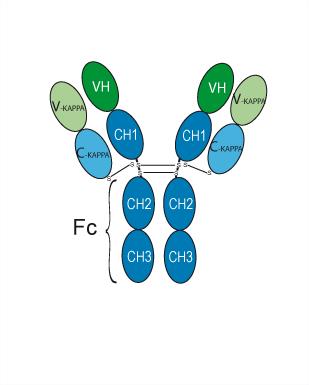
Human IgG1 kappa
Application
ELISA, FACS, Functional assay


Chemical Information
-
CAS No. 1044511-01-4
-
Appearance Liquid
-
Molecular Weight 146.06 kDa
-
Color Colorless to light yellow
-
SMILES
[Benralizumab]
-
Synonyms
MEDI-563; BIW-8405; KHK4563
-
Formulation
Please refer to the lot-specific COA for specific buffer information.
-
Storage
Please store the product under the recommended conditions in the Certificate of Analysis.


Publications (1)
-
Journal Impact Factor
-
Most Recent
-
Epigenomes
2026 Feb 23;10(1):14. PMID: 41892363

Protocols
-
Cell Cytotoxicity Assay
Cytotoxicity assays are usually based on the assessment of cell membrane damage, which can also be indirectly detected by measuring cell viability. Detection methods include MTT assay, CKK-8 assay, LDH assay and ATP assay, etc.
-
Mammalian live/dead viability and cytotoxicity staining
Live/dead viability and cytotoxicity staining assays are based on the simultaneous detection of intracellular esterase activity in metabolically active (viable) cells and membrane integrity loss in non-viable cells. In commonly used dual-staining approaches, membrane-permeant fluorogenic substrates are converted by intracellular esterases into fluorescent products in live cells, while impermeant DNA-binding dyes selectively enter cells with compromised plasma membranes and label nucleic acids in dead or dying cells, enabling discrimination between viable and non-viable populations by fluorescence microscopy or flow cytometry.
-
Cell Viability Determination by MTT Colorimetric Assay
The following protocol uses the MTT colorimetric assay as a classic literature-established method for assessing cell viability/metabolic activity in cultured mammalian cells. MTT[3-(4,5-dimethylthiazol-2-yl)-2,5-diphenyltetrazolium bromide] is reduced by metabolically active cells to a colored formazan product; the amount of formazan is quantified spectrophotometrically and provides an indirect measure of metabolically active viable cells. Importantly, MTT reduction reflects cellular oxidoreductase/metabolic activity rather than an absolute direct count of living cells, so changes in cellular metabolism can alter the signal independently of cell number.


Purity & Documentation
-
Data Sheet (275 KB)
-
SDS (251 KB)
- English - EN (251 KB)
- Français - FR (251 KB)
- Deutsch - DE (251 KB)
- Norwegian - NO (251 KB)
- Español - ES (251 KB)
- Swedish - SV (251 KB)
- Italian - IT (251 KB)
- Korean - KR (251 KB)
- Portuguese - PT (251 KB)
-
Inhibitory Antibodies User Guide (603 KB)
References
[1]. Menzies-Gow A, et al. Corticosteroid tapering with benralizumab treatment for eosinophilic asthma: PONENTE Trial. ERJ Open Res. 2019 Sep 25;5(3). pii: 00009-2019. [Content Brief]
[2]. Kolbeck R, et al. MEDI-563, a humanized anti-IL-5 receptor alpha mAb with enhanced antibody-dependent cell-mediated cytotoxicity function. J Allergy Clin Immunol. 2010 Jun;125(6):1344-1353.e2. [Content Brief]

Calculators
Concentration (start) × Volume (start) = Concentration (final) × Volume (final)


Benralizumab Related Classifications
HY-P9923 Related Classifications
 Powered by Bioz