



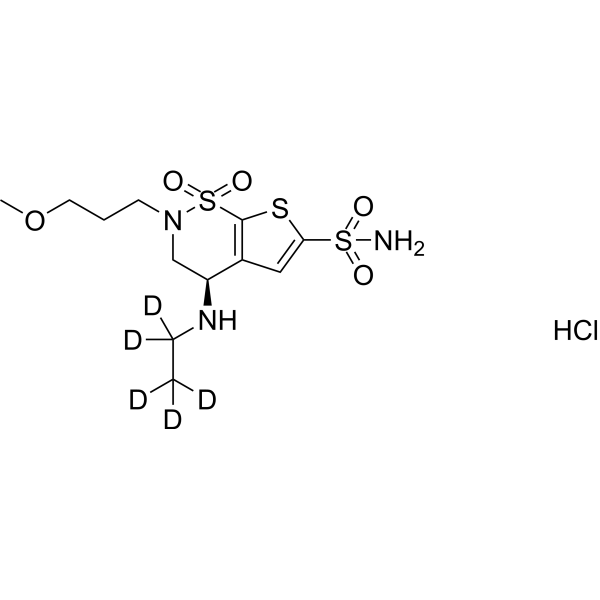
Brinzolamide-d5 hydrochloride
Brinzolamide-d5 (hydrochloride) is the deuterium labeled Brinzolamide hydrochloride. Brinzolamide (AL-4862) hydrochloride is a selective carbonic anhydrase II inhibitor with an IC50 value of 3.2 nM. Brinzolamide hydrochloride reduces intraocular pressure (IOP) by inhibiting ciliary CA-II and decreasing atrial fluid secretion. Brinzolamide hydrochloride can be used in glaucoma disease research.
For research use only. We do not sell to patients.
- Formula: C12H17D5ClN3O5S3
- Molecular Weight:425.00
-
Storage:
Please store the product under the recommended conditions in the Certificate of Analysis.

To place orders, for customer services and technical support, please contact: MedChemExpress USA
Tel: 609-228-6898 E-mail: [email protected] [email protected]


-
 Biological Activity
-
Chemical Information
- Protocols
- Purity & Documentation
- References
-
 Help & FAQs




Biological Activity
Description
In Vitro
Stable heavy isotopes of hydrogen, carbon, and other elements have been incorporated into drug molecules, largely as tracers for quantitation during the drug development process. Deuteration has gained attention because of its potential to affect the pharmacokinetic and metabolic profiles of drugs[1].
MedChemExpress (MCE) has not independently confirmed the accuracy of these methods. They are for reference only. Further protocols information, click here.
Application
1. This compound can be used as a tracer
2. This compound can be used as an internal standard for quantitative analysis by NMR, GC-MS, or LC-MS.


Chemical Information
-
Unlabeled CAS 150937-43-2
-
Molecular Weight 425.00
-
Formula C12H17D5ClN3O5S3
-
SMILES
O=S(C(S1)=CC2=C1S(N(CCCOC)C[C@@H]2NC(C([2H])([2H])[2H])([2H])[2H])(=O)=O)(N)=O.Cl
-
Synonyms
AL-4862-d5 hydrochloride
-
Shipping
Room temperature in continental US; may vary elsewhere.
-
Storage
Please store the product under the recommended conditions in the Certificate of Analysis.

Protocols
-
Cell Cytotoxicity Assay
Cytotoxicity assays are usually based on the assessment of cell membrane damage, which can also be indirectly detected by measuring cell viability. Detection methods include MTT assay, CKK-8 assay, LDH assay and ATP assay, etc.


Purity & Documentation
References
[1]. Russak EM, et al. Impact of Deuterium Substitution on the Pharmacokinetics of Pharmaceuticals. Ann Pharmacother. 2019 Feb;53(2):211-216. [Content Brief]
[2]. Vatsala Naageshwaran, et al. Comprehensive Ocular and Systemic Pharmacokinetics of Brinzolamide in Rabbits After Intracameral, Topical, and Intravenous Administration. J Pharm Sci. 2021 Jan;110(1):529-535. [Content Brief]

Calculators
Concentration (start) × Volume (start) = Concentration (final) × Volume (final)


Brinzolamide-d5 hydrochloride Related Classifications
HY-B0588AS Related Classifications
 Powered by Bioz