



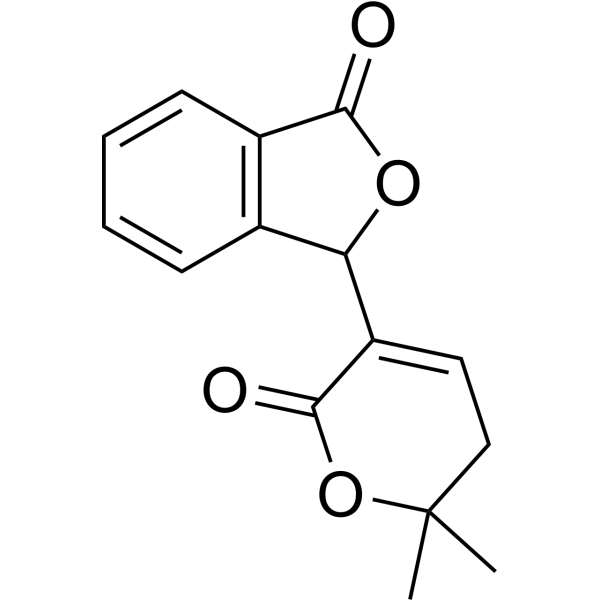
Catalpalactone
Based on 1 publication(s) in Google Scholar
Catalpalactone has anti-inflammatory effect. Catalpalactone inhibits LPS-induced NO production and iNOS expression in RAW264.7 cells, and also inhibits IRF3, NF-κB, and IFN-β/STAT-1 activation. Catalpalactone also inhibits dopamine biosynthesis by reducing tyrosine hydroxylase (TH) and aromatic-l-amino acid decarboxylase (AADC) activities.
Nos produits utilisent uniquement pour la recherche. Nous ne vendons pas aux patients.
- CAS No.: 1585-68-8
- Formule: C15H14O4
- Masse moléculaire:258.27
-
Stockage:
Please store the product under the recommended conditions in the Certificate of Analysis.

To place orders, for customer services and technical support, please contact: MedChemExpress USA
Tel: 609-228-6898 E-mail: [email protected] [email protected]


-
 Activité biologique
-
Chemical Information
- Protocole
- Pureté et documentation
- Références
-
 Help & FAQs


Publications Citing Use of MedChemExpress (MCE) Catalpalactone
More

Activité biologique
Description


Chemical Information
-
CAS No. 1585-68-8
-
Masse moléculaire 258.27
-
Formule C15H14O4
-
SMILES
O=C1OC(C2=CCC(C)(C)OC2=O)C3=C1C=CC=C3
-
Structure Classification
-
Initial Source
-
Livraison
Room temperature in continental US; may vary elsewhere.
-
Stockage
Please store the product under the recommended conditions in the Certificate of Analysis.


Publications (1)
-
Journal Impact Factor
-
Most Recent
-
Eur J Med Res
Catalpalactone protects rats nerve function from hypoxic lesion by polarizing microglial cells toward M2 phenotype. [Abstract]2025 Feb 12;30(1):96. PMID: 39940010


Pureté et documentation
Références
[1]. Kim HY, et al. Anti-Inflammatory Effects of Catalpalactone Isolated from Catalpa ovata in LPS-Induced RAW264.7 Cells. Molecules. 2019 Mar 29;24(7):1236. [Content Brief]
[2]. Huang HS, et al. Effects of catalpalactone on dopamine biosynthesis and L-DOPA-induced cytotoxicity in PC12 cells. Environ Toxicol Pharmacol. 2008 Jul;26(1):86-91. [Content Brief]

Calculators
Concentration (start) × Volume (start) = Concentration (final) × Volume (final)


Catalpalactone Related Classifications
HY-N3548 Related Classifications
 Powered by Bioz