



DLX-105
DLX-105 is a human monoclonal antibody (mAb) targeting TNFSF2/TNFa. DLX-105 reduces skin epidermal thickness and the expression of K16 and Ki67. DLX-105 down-regulates the mRNA levels of IL-17, TNF-α, IL-23p19, IL-12p40, and IFN-γ. DLX-105 can be used in psoriasis research.
Nos produits utilisent uniquement pour la recherche. Nous ne vendons pas aux patients.
-
Stockage:
Please store the product under the recommended conditions in the Certificate of Analysis.


To place orders, for customer services and technical support, please contact: MedChemExpress USA
Tel: 609-228-6898 E-mail: [email protected] [email protected]


-
 Activité biologique
-
Chemical Information
- Protocole
- Pureté et documentation
- Références
-
 Help & FAQs


Voir tous les produits spécifiques à Isoform TNF Receptor
More

Activité biologique
Description
Species Reactivity
Human
IC50 & Target
TNFSF2/TNFa
Essai clinique
| NCT Number | Sponsor | Condition | Start Date |
Phase

|
|---|---|---|---|---|
| NCT01329991 | Plexxikon| | 2011-05 | PHASE1 |
Gene ID
Accession
Conjugated
Unconjugated
Reconsititution
The product can be reconstituted/diluted with sterile PBS or saline.
Format
-
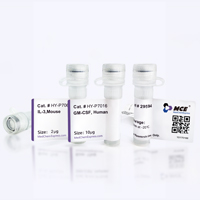
Product Image
Application
ELISA, FACS, Functional assay


Chemical Information
-
SMILES
[DLX-105]
-
Formulation
Please refer to the lot-specific COA for specific buffer information.
-
Stockage
Please store the product under the recommended conditions in the Certificate of Analysis.


Pureté et documentation
Références

Calculators
Concentration (start) × Volume (start) = Concentration (final) × Volume (final)


DLX-105 Related Classifications
HY-P991408 Related Classifications
 Powered by Bioz