



1130852-41-3

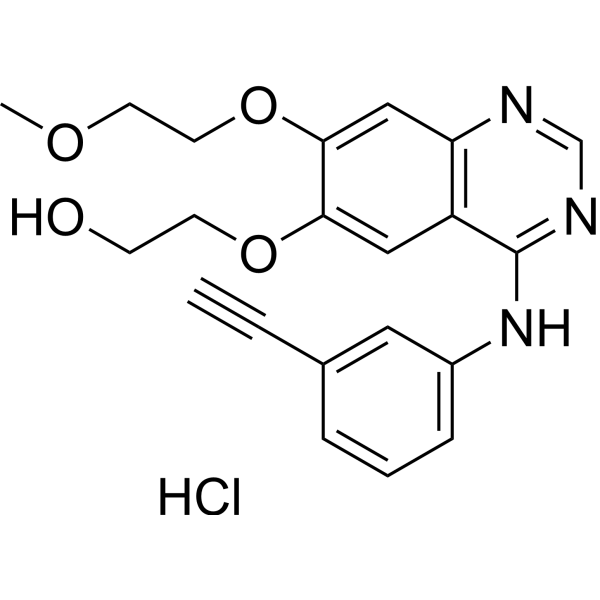
Chemical Structure
Erlotinib-d4
Synonym(s): CP-358774-d4; NSC 718781-d4; OSI-774-d4
- CAS No.: 1130852-41-3
- Formula:C22H19D4N3O4
- Molecular Weight:397.46
InChIKey: AAKJLRGGTJKAMG-HPGZLSOESA-N
SMILES: COCCOC(C(OCCOC)=C1)=CC2=C1C(NC3=C([2H])C(C#C)=C([2H])C([2H])=C3[2H])=NC=N2
Biological Activity: Erlotinib-d4 (CP-358774-d4) is the deuterated-labeled Erlotinib (HY-50896). Erlotinib (CP-358774) is a selective, orally active EGFR tyrosine kinase inhibitor. Erlotinib also acts as a substrate and inhibitor of OATP2B1, with an IC50 of approximately 0.079 μM for inhibiting OATP2B1-mediated uptake of estrone 3-sulfate. Erlotinib blocks EGFR phosphorylation, downstream signal transduction, as well as the growth and proliferation of cancer cells. Erlotinib inhibits MMP-10-mediated renal injury, fibrotic lesions, the ERK1/2, GSK-3β and β-catenin signaling pathways, fibronectin, α-SMA, collagen deposition, and renal injury markers. Erlotinib is metabolized via CYP3A to produce the active metabolite OSI-420. Erlotinib can be used in research related to non-small cell lung cancer, gastric cancer, papillary renal cell carcinoma, pancreatic cancer, renal fibrosis, and other conditions[1][2][3][4][5].
| Cat. No. | Product Name | Purity | Description | Pricing | |||||||||||||||||||
|---|---|---|---|---|---|---|---|---|---|---|---|---|---|---|---|---|---|---|---|---|---|---|---|
|
|
Erlotinib-d4 | Erlotinib-d4 (CP-358774-d4) is the deuterated-labeled Erlotinib (HY-50896). Erlotinib (CP-358774) is a selective, orally active EGFR tyrosine kinase inhibitor. Erlotinib also acts as a substrate and inhibitor of OATP2B1, with an IC50 of approximately 0.079 μM for inhibiting OATP2B1-mediated uptake of estrone 3-sulfate. Erlotinib blocks EGFR phosphorylation, downstream signal transduction, as well as the growth and proliferation of cancer cells. Erlotinib inhibits MMP-10-mediated renal injury, fibrotic lesions, the ERK1/2, GSK-3β and β-catenin signaling pathways, fibronectin, α-SMA, collagen deposition, and renal injury markers. Erlotinib is metabolized via CYP3A to produce the active metabolite OSI-420. Erlotinib can be used in research related to non-small cell lung cancer, gastric cancer, papillary renal cell carcinoma, pancreatic cancer, renal fibrosis, and other conditions. | |||||||||||||||||||||
|
loading...
/
|
|||||||||||||||||||||||
|
|
Erlotinib (Standard) | 99.97% | Erlotinib Standard (CP-358774 Standard) is the analytical standard of Erlotinib (HY-50896). This product is intended for research and analytical applications. Erlotinib (CP-358774) is a selective, orally active EGFR tyrosine kinase inhibitor. Erlotinib also acts as a substrate and inhibitor of OATP2B1, with an IC50 of approximately 0.079 μM for inhibiting OATP2B1-mediated uptake of estrone 3-sulfate. Erlotinib blocks EGFR phosphorylation, downstream signal transduction, as well as the growth and proliferation of cancer cells. Erlotinib inhibits MMP-10-mediated renal injury, fibrotic lesions, the ERK1/2, GSK-3β and β-catenin signaling pathways, as well as the deposition of fibronectin, α-SMA, collagen and renal injury markers. Erlotinib is metabolized via CYP3A to produce the active metabolite OSI-420. Erlotinib can be used in research related to non-small cell lung cancer, gastric cancer, papillary renal cell carcinoma, EGFR inhibitor resistance and renal fibrosis. | ||||||||||||||||||||
|
loading...
/
|
|||||||||||||||||||||||
|
|
Erlotinib-d6 | 99.83% | Erlotinib-d6 (CP-358774-d6) is the deuterated-labeled Erlotinib (HY-50896). Erlotinib (CP-358774) is a selective, orally active EGFR tyrosine kinase inhibitor. Erlotinib also acts as a substrate and inhibitor of OATP2B1, with an IC50 of approximately 0.079 μM for inhibiting OATP2B1-mediated uptake of estrone 3-sulfate. Erlotinib blocks EGFR phosphorylation, downstream signal transduction, as well as the growth and proliferation of cancer cells. Erlotinib inhibits MMP-10-mediated renal injury, fibrotic lesions, the ERK1/2, GSK-3β and β-catenin signaling pathways, fibronectin, α-SMA, collagen deposition, and renal injury markers. Erlotinib is metabolized via CYP3A to produce the active metabolite OSI-420. Erlotinib can be used in research related to non-small cell lung cancer, gastric cancer, papillary renal cell carcinoma, pancreatic cancer, renal fibrosis, and other conditions. | ||||||||||||||||||||
|
loading...
/
|
|||||||||||||||||||||||
|
|
Erlotinib-d8 | Erlotinib-d8 (CP-358774-d8) is the deuterated-labeled Erlotinib (HY-50896). Erlotinib (CP-358774) is a selective, orally active EGFR tyrosine kinase inhibitor. Erlotinib also acts as a substrate and inhibitor of OATP2B1, with an IC50 of approximately 0.079 μM for inhibiting OATP2B1-mediated uptake of estrone 3-sulfate. Erlotinib blocks EGFR phosphorylation, downstream signal transduction, as well as the growth and proliferation of cancer cells. Erlotinib inhibits MMP-10-mediated renal injury, fibrotic lesions, the ERK1/2, GSK-3β and β-catenin signaling pathways, as well as the deposition of fibronectin, α-SMA, collagen and renal injury markers. Erlotinib is metabolized via CYP3A to produce the active metabolite OSI-420. Erlotinib can be used in research related to non-small cell lung cancer, gastric cancer, papillary renal cell carcinoma, EGFR inhibitor resistance and renal fibrosis. | |||||||||||||||||||||
|
loading...
/
|
|||||||||||||||||||||||
|
|
Erlotinib-13C6 | Erlotinib-13C6 (CP-358774-13C6) is the 13C-labeled Erlotinib (HY-50896). Erlotinib (CP-358774) is a selective, orally active EGFR tyrosine kinase inhibitor. Erlotinib also acts as a substrate and inhibitor of OATP2B1, with an IC50 of approximately 0.079 μM for inhibiting OATP2B1-mediated uptake of estrone 3-sulfate. Erlotinib blocks EGFR phosphorylation, downstream signal transduction, as well as the growth and proliferation of cancer cells. Erlotinib inhibits MMP-10-mediated renal injury, fibrotic lesions, the ERK1/2, GSK-3β and β-catenin signaling pathways, fibronectin, α-SMA, collagen deposition, and renal injury markers. Erlotinib is metabolized via CYP3A to produce the active metabolite OSI-420. Erlotinib can be used in research related to non-small cell lung cancer, gastric cancer, papillary renal cell carcinoma, pancreatic cancer, renal fibrosis, and other conditions. | |||||||||||||||||||||
|
loading...
/
|
|||||||||||||||||||||||
|
|
Erlotinib | 99.96% | Erlotinib (CP-358774) is a selective, orally active EGFR tyrosine kinase inhibitor. Erlotinib also acts as a substrate and inhibitor of OATP2B1, with an IC50 of approximately 0.079 μM for inhibiting OATP2B1-mediated uptake of estrone 3-sulfate. Erlotinib blocks EGFR phosphorylation, downstream signal transduction, as well as the growth and proliferation of cancer cells. Erlotinib inhibits MMP-10-mediated renal injury, fibrotic lesions, the ERK1/2, GSK-3β and β-catenin signaling pathways, fibronectin, α-SMA, collagen deposition, and renal injury markers. Erlotinib is metabolized via CYP3A to produce the active metabolite OSI-420. Erlotinib can be used in research related to non-small cell lung cancer, gastric cancer, papillary renal cell carcinoma, pancreatic cancer, renal fibrosis, and other conditions. | ||||||||||||||||||||
|
loading...
/
|
|||||||||||||||||||||||
-
Similarity Score 0.99
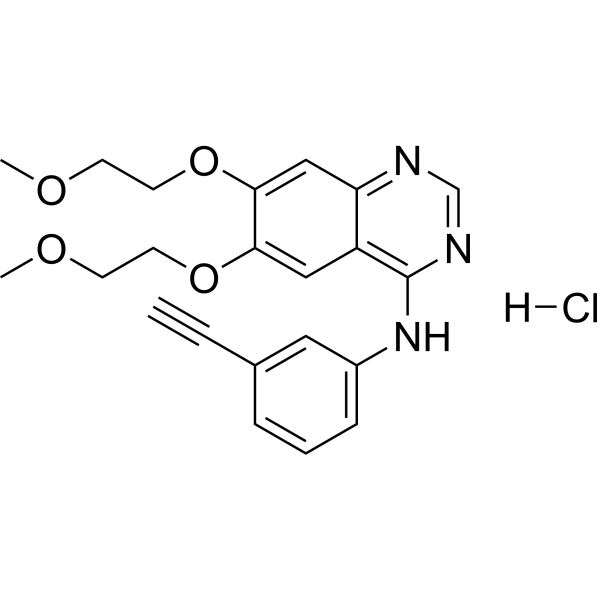 HY-12008Erlotinib Hydrochloride
-
Similarity Score 0.99
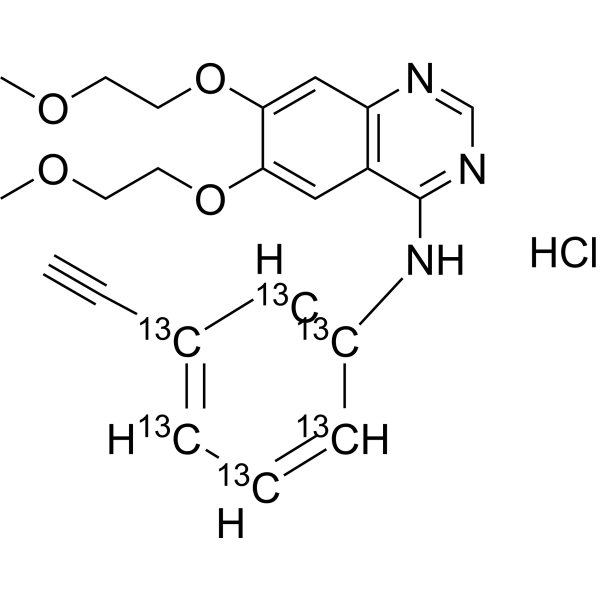 HY-12008S1Erlotinib-13C6 hydrochloride
-
Similarity Score 0.93
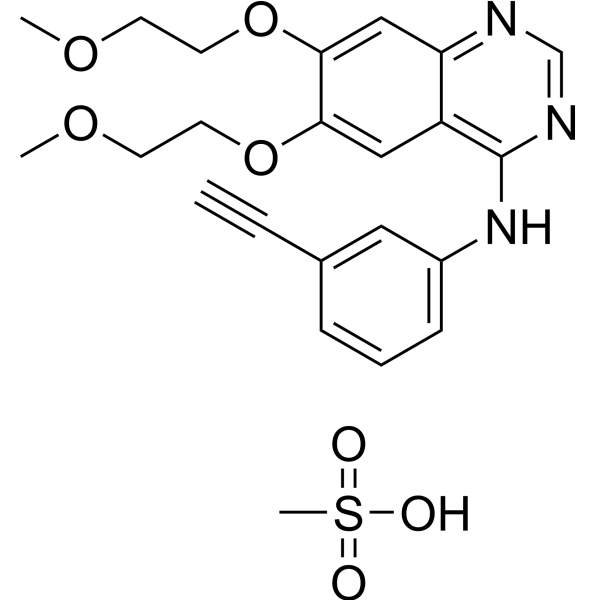 HY-12008AErlotinib mesylate
-
Similarity Score 0.92
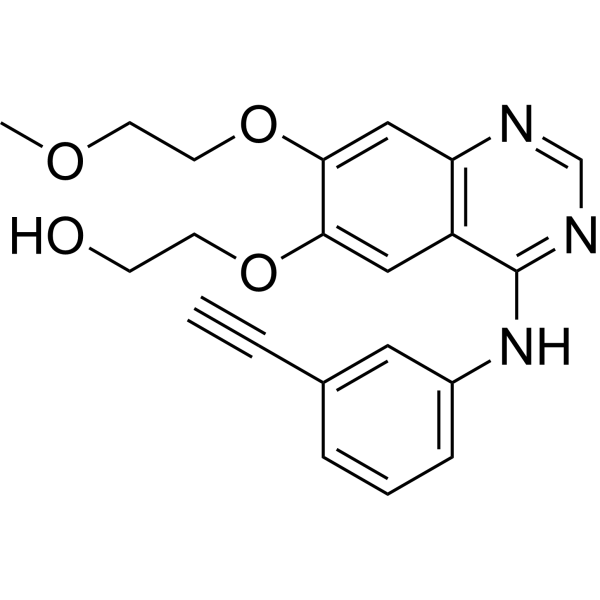 HY-13256ADesmethyl Erlotinib
-
Similarity Score 0.92
 HY-15661AOSI-413 free base
-
Similarity Score 0.91
 HY-12008YErlotinib impurity 45
-
Similarity Score 0.91
 HY-13256Desmethyl Erlotinib hydrochloride
-
Similarity Score 0.91
 HY-12008ZErlotinib impurity 44
-
Similarity Score 0.86
 HY-1295104-Methyl erlotinib
-

Explore the MedChemAI to find more analogs


References
- [1]. Li S, et al. Ephrin A1 functions as a ligand of EGFR to promote EMT and metastasis in gastric cancer. The EMBO journal. 2025 Mar;44(5):1464-1487. [Content Brief]
- [2]. Ferrarone JR, et al. Genome-wide CRISPR screens in spheroid culture reveal that the tumor suppressor LKB1 inhibits growth via the PIKFYVE lipid kinase. Proceedings of the National Academy of Sciences of the United States of America. 2024 May 21;121(21):e2403685121. [Content Brief]
- [3]. Rysz MA et al. Erlotinib-A substrate and inhibitor of OATP2B1: pharmacokinetics and CYP3A-mediated metabolism in rSlco2b1-/- and SLCO2B1+/+ rats. Drug Metab Dispos. 2025 May;53(5):100069. [Content Brief]
- [4]. Sun X, et al. Matrix metalloproteinase-10 promotes kidney fibrosis by transactivating β-catenin signaling. Cell death discovery. 2025 May 17;11(1):241. [Content Brief]
- [5]. Ito F, et al. GRHL2-HER3 and E-cadherin mediate EGFR-bypass drug resistance in lung cancer cells. Frontiers in cell and developmental biology. 2024;12:1511190. [Content Brief]



