



33016-12-5
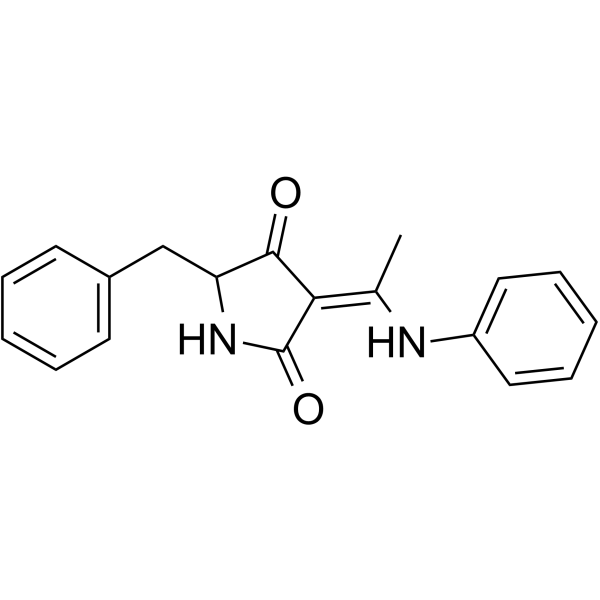
Chemical Structure
TN-16
- CAS No.: 33016-12-5
- Formula:C19H18N2O2
- Molecular Weight:306.36
IUPAC Name: (Z)-5-benzyl-3-(1-(phenylamino)ethylidene)pyrrolidine-2,4-dione
InChIKey: KWSXUGYAGMSUTN-LGMDPLHJSA-N
SMILES: O=C(NC(C/1=O)CC2=CC=CC=C2)C1=C(C)/NC3=CC=CC=C3
Biological Activity: TN-16 is a Microtubule polymerization inhibitor. TN-16 induces G2/M cell cycle arrest, metaphase mitotic arrest and Apoptotic cell death in cells, and blocks late Autophagic flux by inhibiting autophagosome-lysosome fusion. TN-16 suppresses tumor growth in syngeneic mouse breast cancer models. TN-16 can be used in research related to neuroblastoma, cervical cancer, breast cancer and other tumors[1][2][3].
| Cat. No. | Product Name | Purity | Description | Pricing | |||||||||||||||||||
|---|---|---|---|---|---|---|---|---|---|---|---|---|---|---|---|---|---|---|---|---|---|---|---|
|
|
TN-16 | 99.78% | TN-16 is a Microtubule polymerization inhibitor. TN-16 induces G2/M cell cycle arrest, metaphase mitotic arrest and Apoptotic cell death in cells, and blocks late Autophagic flux by inhibiting autophagosome-lysosome fusion. TN-16 suppresses tumor growth in syngeneic mouse breast cancer models. TN-16 can be used in research related to neuroblastoma, cervical cancer, breast cancer and other tumors. | ||||||||||||||||||||
|
loading...
/
|
|||||||||||||||||||||||
-
Similarity Score 0.65
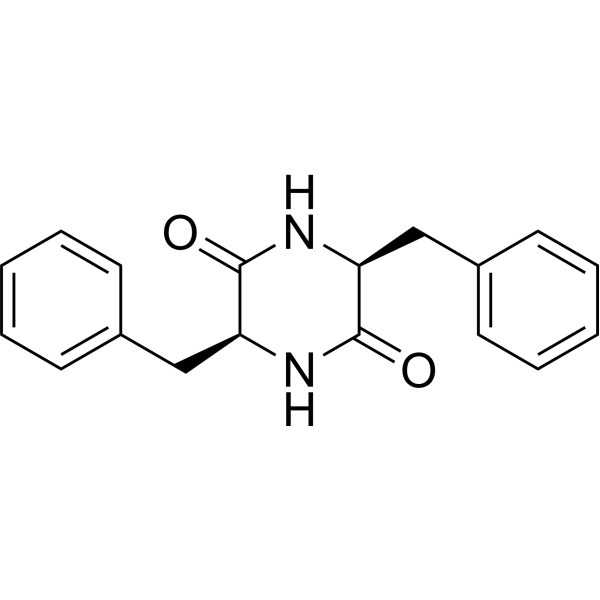 HY-W549438Cyclo(Phe-Phe)
-
Similarity Score 0.60
 HY-N13465Cyclo(Tyr-Phe)
-
Similarity Score 0.60
 HY-W176199DPPD-Q
-
Similarity Score 0.57
 HY-124886N-(Phenylacetyl)-L-phenylalanine
-
Similarity Score 0.57
 HY-119492Phenchlobenpyrrone
-
Similarity Score 0.56
 HY-129931Phenylalanylphenylalanylamide
-
Similarity Score 0.56
 HY-79080(3R,5S)-5-([1,1′-Biphenyl]-4-ylmethyl)-3-methyl-2-pyrrolidinone
-
Similarity Score 0.56
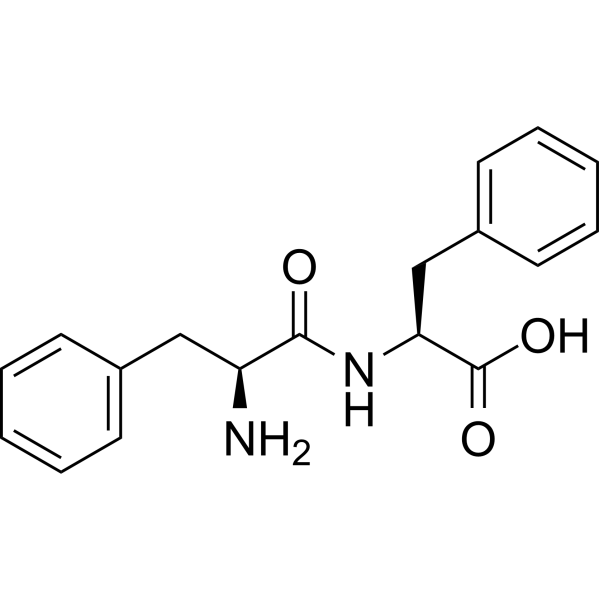 HY-W007970H-Phe-Phe-OH
-
Similarity Score 0.55
 HY-163650DTPD-Q
-

Explore the MedChemAI to find more analogs


References
- [1]. Foroutan A, et al. Identification of novel aza-analogs of TN-16 as disrupters of microtubule dynamics through a multicomponent reaction. Eur J Med Chem. 2023;245(Pt 1):114895. [Content Brief]
- [2]. Hasanain M, et al. Microtubule disrupting agent-mediated inhibition of cancer cell growth is associated with blockade of autophagic flux and simultaneous induction of apoptosis. Cell Prolif. 2020;53(4):e12749. [Content Brief]
- [3]. Arai T, et al. Inhibition of microtubule assembly in vitro by TN-16, a synthetic antitumor drug. FEBS Lett. 1983;155(2):273-276. [Content Brief]



