



33159-27-2
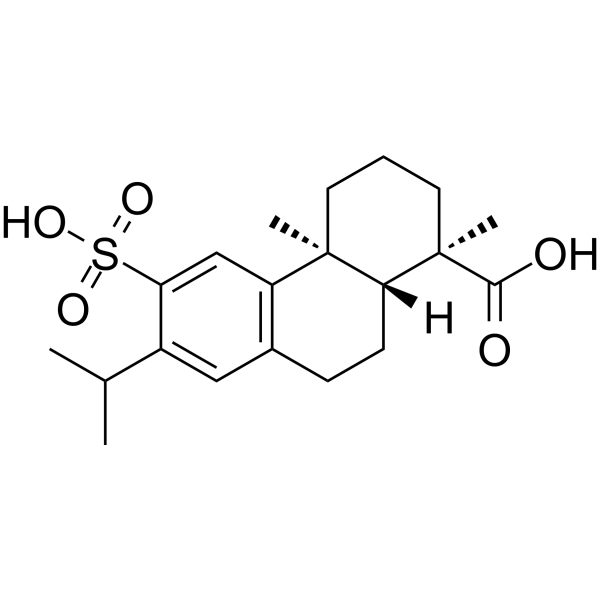
Chemical Structure
Ecabet
Synonym(s): TA-2711 free acid
- CAS. Nr.: 33159-27-2
- Formula:C20H28O5S
- Molecular Weight:380.50
IUPAC Name: (1R,4aS,10aR)-7-isopropyl-1,4a-dimethyl-6-sulfo-1,2,3,4,4a,9,10,10a-octahydrophenanthrene-1-carboxylic acid
InChIKey: IWCWQNVIUXZOMJ-MISYRCLQSA-N
SMILES: O=C([C@]1(C)CCC[C@]2(C)C3=C(CC[C@@]12[H])C=C(C(C)C)C(S(=O)(O)=O)=C3)O
Biological Activity: Ecabet (TA-2711 (free acid)) is a locally acting anti-ulcer compound. Ecabet irreversibly inhibits H. pylori urease, binds and precipitates pepsin (HY-P1635) and pepsinogen, and inhibits gastric juice proteolysis as well as pepsin-mediated mucolysis; it blocks the TLR4 signaling pathway activated by H. pylori lipopolysaccharide, reducing downstream superoxide production. Ecabet binds to gastric mucin to enhance mucus viscosity and strengthen the mucus barrier, promotes mucin synthesis and secretion, upregulates endogenous prostaglandins, activates capsaicin (HY-10448)-sensitive sensory nerves and the nitric oxide system, and induces ERK1/2-dependent COX‑2 and TGF‑α expression. Ecabet can be used in research related to H. pylori infection, reflux esophagitis, ulcerative colitis, and ulcerative proctosigmoiditis[1][2][3][4][5].
| Art. -Nr. | Produktname | Reinheit | Beschreibung | Pricing | |||||||||||||||||||
|---|---|---|---|---|---|---|---|---|---|---|---|---|---|---|---|---|---|---|---|---|---|---|---|
|
|
Ecabet | 98.51% | Ecabet (TA-2711 (free acid)) is a locally acting anti-ulcer compound. Ecabet irreversibly inhibits H. pylori urease, binds and precipitates pepsin (HY-P1635) and pepsinogen, and inhibits gastric juice proteolysis as well as pepsin-mediated mucolysis; it blocks the TLR4 signaling pathway activated by H. pylori lipopolysaccharide, reducing downstream superoxide production. Ecabet binds to gastric mucin to enhance mucus viscosity and strengthen the mucus barrier, promotes mucin synthesis and secretion, upregulates endogenous prostaglandins, activates capsaicin (HY-10448)-sensitive sensory nerves and the nitric oxide system, and induces ERK1/2-dependent COX‑2 and TGF‑α expression. Ecabet can be used in research related to H. pylori infection, reflux esophagitis, ulcerative colitis, and ulcerative proctosigmoiditis. | ||||||||||||||||||||
|
loading...
/
|
|||||||||||||||||||||||
References
- [1]. Kono T, et al. Effect of ecabet sodium enema on mildly to moderately active ulcerative proctosigmoiditis: an open-label study. The American journal of gastroenterology. 2001 Mar;96(3):793-7.
- [2]. Kusumoto K, et al. Ecabet sodium inhibits Helicobacter pylori lipopolysaccharide-induced activation of NADPH oxidase 1 or apoptosis of guinea pig gastric mucosal cells. Am J Physiol Gastrointest Liver Physiol. 2005 Feb;288(2):G300-7. [Content Brief]
- [3]. Ito Y, et al. Ecabet sodium, a locally acting antiulcer drug, inhibits urease activity of Helicobacter pylori. European journal of pharmacology. 1998 Mar 19;345(2):193-8.
- [4]. Pearson JP, et al. Mucosal protective effects of ecabet sodium: pepsin inhibition and interaction with mucus. Clinical science (London, England : 1979). 2001 Apr;100(4):411-7.
- [5]. Sasaki K, et al. Ecabet sodium prevents the delay of wound repair in intestinal epithelial cells induced by hydrogen peroxide. Journal of gastroenterology. 2005 May;40(5):474-82.



