



TBHBA
Based on 1 publication(s) in Google Scholar
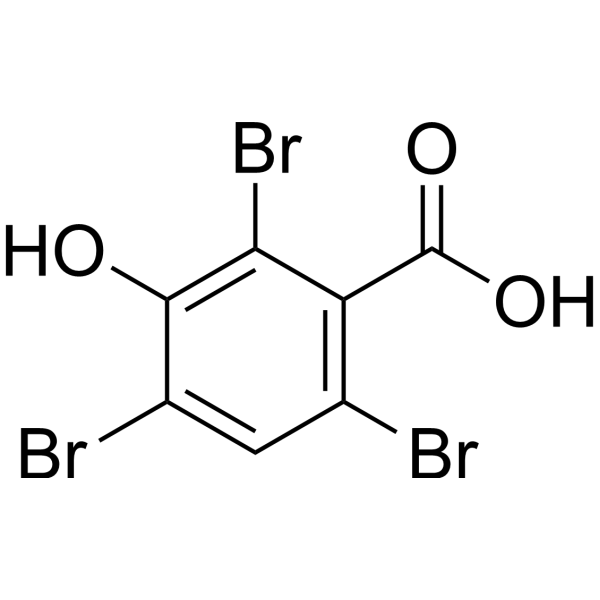
TBHBA (2,4,6-Tribromo-3-hydroxybenzoic acid) is a chemical colorimetric agent and nanomaterial surface modifier. TBHBA can react with some oxidants (such as H2O2) to generate high-absorbance quinoneimine dyes, which enhance the sensitivity of HDL cholesterol enzymatic determination. TBHBA can be used as a bromine-containing coupling agent to modify the surface of silica nanoparticles through esterification reaction. Thereby, organic flame retardant groups are introduced to improve the thermal stability and flame retardant properties of nanocomposites. TBHBA can be used in clinical biochemical testing (such as serum lipoprotein analysis) and the preparation of flame-retardant polymer nanocomposites.
Nur für Forschungszwecke. Wir verkaufen nicht an Patienten.
- Reinheit : 99.89%
- CAS. Nr.: 14348-40-4
- Formel: C7H3Br3O3
- Molecular Weight:374.81
-
Speicherung:Powder -20°C, 3 years , 4°C, 2 years ; In solvent -80°C, 2 years , -20°C, 1 year

To place orders, for customer services and technical support, please contact: MedChemExpress USA
Tel: 609-228-6898 E-mail: [email protected] [email protected]


-
 Biologische Aktivität
-
Chemical Information
-
Lösungsmittel & Löslichkeit
- Reinheit & Dokumentation
- Verweise
-
 Help & FAQs


Publications Citing Use of MedChemExpress (MCE) TBHBA
More

Biologische Aktivität
Beschreibung
In Vitro
Application example: TBHBA enhances the sensitivity of enzymatic detection of HDL cholesterol[1]
1. Reagent preparation:
Basic reagent: Boehringer Mannheim CHOD-PAP reagent (containing cholesterol esterase, oxidase, and peroxidase), add 10 mmol/L TBHBA to replace the original phenolic colorimetric agent.
Precipitant: 200 g/L PEG 6000, pH=10 glycine-NaOH buffer.
2. Sample processing:
Plasma:PEG=1:1 mixture, stand at room temperature for 10 minutes, centrifuge at 4°C (2000 g, 20 minutes), and take the supernatant (containing HDL).
3. Detection process (Cobas Bio analyzer):
Sample volume 15 μL, containing 350 μL TBHBA reagent, incubated at 30°C for 30 seconds, read the absorbance change from 10 to 60 seconds (ΔA/50 seconds), and detected at 515 nm.
4. Experimental results:
TBHBA increased the absorbance difference by 3 times, with a linear range of 0.25-3.88 mmol/L (r=0.9980), intra-group CV≤2.0%, and inter-group CV≤2.9% (P586).
TBHBA-assisted HDL cholesterol detection method has strong anti-interference ability (bilirubin≤100 mg/L, hemoglobin≤2000 mg/L has no significant interference) (P585-586).
MedChemExpress (MCE) has not independently confirmed the accuracy of these methods. They are for reference only.


Chemical Information
-
CAS. Nr. 14348-40-4
-
Appearance Solid
-
Molecular Weight 374.81
-
Formel C7H3Br3O3
-
Color White to off-white
-
SMILES
O=C(O)C1=C(Br)C=C(Br)C(O)=C1Br
-
Synonyms
2,4,6-Tribromo-3-hydroxybenzoic acid
-
Versand
Room temperature in continental US; may vary elsewhere.
-
Speicherung
Powder -20°C 3 years 4°C 2 years In solvent -80°C 2 years -20°C 1 year


Publications (1)
-
Journal Impact Factor
-
Most Recent
-
Anal Chem
Exposome-Scale Investigation of Cl-/Br-Containing Chemicals Using High-Resolution Mass Spectrometry, Multistage Machine Learning, and Cloud Computing. [Abstract]2025 Jun 3;97(21):11099-11109. PMID: 40401576


Lösungsmittel & Löslichkeit
In Vitro:
DMSO : 100 mg/mL (266.80 mM; Need ultrasonic; Hygroscopic DMSO has a significant impact on the solubility of product, please use newly opened DMSO)
Please refer to the solubility information to select the appropriate solvent. Once prepared, please aliquot and store the solution to prevent product inactivation from repeated freeze-thaw cycles.
Storage method and period of stock solution: -80°C, 2 years; -20°C, 1 year. When stored at -80°C, please use it within 2 years. When stored at -20°C, please use it within 1 year.
Please refer to the solubility information to select the appropriate solvent. Once prepared, please aliquot and store the solution to prevent product inactivation from repeated freeze-thaw cycles.
Storage method and period of stock solution: -80°C, 2 years; -20°C, 1 year. When stored at -80°C, please use it within 2 years. When stored at -20°C, please use it within 1 year.
Konzentration (Stammlösung) × Volumen (Stammlösung) = Konzentration (Ziellösung) × Volumen (Ziellösung)
In Vivo:
Select the appropriate dissolution method based on your experimental animal and administration route.
- For the following dissolution methods, please ensure to first prepare a clear stock solution using an In Vitro approach and then sequentially add co-solvents:
- To ensure reliable experimental results, the clarified stock solution can be appropriately stored based on storage conditions. As for the working solution for In Vivo experiments, it is recommended to prepare freshly and use it on the same day.
- The percentages shown for the solvents indicate their volumetric ratio in the final prepared solution. If precipitation or phase separation occurs during preparation, heat and/or sonication can be used to aid dissolution.
Add each solvent one by one: 10% DMSO 40% PEG300 5% Tween-80 45% Saline
Solubility: ≥ 2.5 mg/mL (6.67 mM); Clear solution
This protocol yields a clear solution of ≥ 2.5 mg/mL (saturation unknown).
Taking 1 mL working solution as an example, add 100 μL DMSO stock solution (25.0 mg/mL) to 400 μL PEG300, and mix evenly; then add 50 μL Tween-80 and mix evenly; then add 450 μL Saline to adjust the volume to 1 mL.
Preparation of Saline: Dissolve 0.9 g sodium chloride in ddH₂O and dilute to 100 mL to obtain a clear Saline solution.
Add each solvent one by one: 10% DMSO 90% (20% SBE-β-CD in Saline)
Solubility: ≥ 2.5 mg/mL (6.67 mM); Clear solution
This protocol yields a clear solution of ≥ 2.5 mg/mL (saturation unknown).
Taking 1 mL working solution as an example, add 100 μL DMSO stock solution (25.0 mg/mL) to 900 μL 20% SBE-β-CD in Saline, and mix evenly.
Preparation of 20% SBE-β-CD in Saline (4°C, storage for one week): 2 g SBE-β-CD powder is dissolved in 10 mL Saline, completely dissolve until clear.
In Vivo Dissolution Calculator
Please enter the basic information of animal experiments:
-
-
-
-
Recommended: Prepare an additional quantity of animals to account for potential losses during experiments.
Please enter your animal formula composition:
-
%DMSO +
Recommended: Keep the proportion of DMSO in working solution below 2% if your animal is weak.
-
%+
-
+%Tween-80 + +
-
%Saline +
The co-solvents required include: DMSO, . All of co-solvents are available by MedChemExpress (MCE). , Tween 80. All of co-solvents are available by MedChemExpress (MCE).
Working solution concentration: 0.22 mg/mL
Method for preparing stock solution: mg drug dissolved in μL DMSO. Stock solution concentration: mg/mL.
1. Take μL DMSO stock solution;
2. Add μL .
μL , mix evenly;
3. Then add μL Tween 80, mix evenly;
4. Then add μL
Please ensure that the stock solution in the first step is dissolved to a clear state, and add co-solvents in sequence. You can use ultrasonic heating (ultrasonic cleaner, recommended frequency 20-40 kHz), vortexing, etc. to assist dissolution.


Reinheit & Dokumentation
-
Data Sheet (276 KB)
-
SDS (393 KB)
- English - EN (393 KB)
- Français - FR (393 KB)
- Deutsch - DE (393 KB)
- Norwegian - NO (393 KB)
- Español - ES (393 KB)
- Swedish - SV (393 KB)
- Italian - IT (393 KB)
- Korean - KR (393 KB)
- Portuguese - PT (393 KB)
-
Handling Instructions (2659 KB)
Verweise


Complete Stock Solution Preparation Table
Please refer to the solubility information to select the appropriate solvent. Once prepared, please aliquot and store the solution to prevent product inactivation from repeated freeze-thaw cycles.
Storage method and period of stock solution: -80°C, 2 years; -20°C, 1 year. When stored at -80°C, please use it within 2 years. When stored at -20°C, please use it within 1 year.
| Optional Solvent | Concentration Solvent Mass | 1 mg | 5 mg | 10 mg | 25 mg |
|---|---|---|---|---|---|
| DMSO | 1 mM | 2.6680 mL | 13.3401 mL | 26.6802 mL | 66.7005 mL |
| 5 mM | 0.5336 mL | 2.6680 mL | 5.3360 mL | 13.3401 mL | |
| 10 mM | 0.2668 mL | 1.3340 mL | 2.6680 mL | 6.6700 mL | |
| 15 mM | 0.1779 mL | 0.8893 mL | 1.7787 mL | 4.4467 mL | |
| 20 mM | 0.1334 mL | 0.6670 mL | 1.3340 mL | 3.3350 mL | |
| 25 mM | 0.1067 mL | 0.5336 mL | 1.0672 mL | 2.6680 mL | |
| 30 mM | 0.0889 mL | 0.4447 mL | 0.8893 mL | 2.2233 mL | |
| 40 mM | 0.0667 mL | 0.3335 mL | 0.6670 mL | 1.6675 mL | |
| 50 mM | 0.0534 mL | 0.2668 mL | 0.5336 mL | 1.3340 mL | |
| 60 mM | 0.0445 mL | 0.2223 mL | 0.4447 mL | 1.1117 mL | |
| 80 mM | 0.0334 mL | 0.1668 mL | 0.3335 mL | 0.8338 mL | |
| 100 mM | 0.0267 mL | 0.1334 mL | 0.2668 mL | 0.6670 mL |


TBHBA Related Classifications
HY-15929 Related Classifications
 Powered by Bioz