



EphB
EphB receptors constitute the B-class subgroup of the Eph receptor tyrosine kinase family and mediate contact-dependent cell-cell communication through interactions with transmembrane ephrin-B ligands, thereby regulating tissue patterning, cell positioning, and developmental morphogenesis[1][2]. Mechanistically, EphB-ephrin-B engagement induces bidirectional signaling, including forward signaling in receptor-expressing cells and reverse signaling in ligand-expressing cells, which coordinates cytoskeletal remodeling, cell adhesion, cell repulsion, and directed migration[1][3]. Through these signaling networks, EphB receptors regulate axon guidance, synapse formation, tissue boundary establishment, angiogenesis, and epithelial organization during embryonic and postnatal development[1][2][4]. In disease-associated contexts, dysregulated EphB signaling has been linked to cancer progression, tumor cell migration, angiogenesis, and alterations in tissue homeostasis, although biological outcomes are highly context dependent[5][6]. Compared with related EphA family receptors, EphB receptors preferentially interact with ephrin-B ligands and exhibit distinct functions in neuronal connectivity, vascular specification, and bidirectional signaling mechanisms[1][6]. Among individual isoforms, EphB2 is extensively studied for its roles in excitatory synapse organization and neuronal signaling, whereas EphB4 is particularly associated with vascular development and endothelial cell identity[4][7]. For experimental applications, recombinant ephrin-B-Fc fusion proteins, soluble receptor ectodomains, and EphB-targeting inhibitors or blocking reagents are widely used to manipulate EphB signaling and investigate cell migration, angiogenesis, neural development, and cancer-related mechanisms[5][8].
Verweise:
- [1]. Kullander K, et al. Mechanisms and functions of Eph and ephrin signalling. Nat Rev Mol Cell Biol. 2002 Jul;3(7):475-86. [Content Brief]
- [2]. Poliakov A, et al. Diverse roles of eph receptors and ephrins in the regulation of cell migration and tissue assembly. Dev Cell. 2004 Oct;7(4):465-80. [Content Brief]
- [3]. Arvanitis D, et al. Eph/ephrin signaling: networks. Genes Dev. 2008 Feb 15;22(4):416-29. [Content Brief]
- [4]. Pasquale EB. Eph-ephrin bidirectional signaling in physiology and disease. Cell. 2008 Apr 4;133(1):38-52. [Content Brief]
- [5]. Liang LY, et al. Eph receptor signalling: from catalytic to non-catalytic functions. Oncogene. 2019 Sep;38(39):6567-6584. [Content Brief]
- [6]. Kania A, et al. Mechanisms of ephrin-Eph signalling in development, physiology and disease. Nature reviews. Molecular Cell Biology. 2016 Apr;17(4):240-256. DOI: 10.1038/nrm.2015.16. [Content Brief]
- [7]. Arthur A, et al. Eph-Ephrin Signaling Mediates Cross-Talk Within the Bone Microenvironment. Front Cell Dev Biol. 2021 Feb 9;9:598612. [Content Brief]
- [8]. Mekala S, et al. Ephrin-Eph receptor tyrosine kinases for potential therapeutics against hepatic pathologies. J Cell Commun Signal. 2023 Sep;17(3):549-561. [Content Brief]
-
EphB Verwandte Produkte (7)
Verwandte Produkte (7)

-
Sorafenib
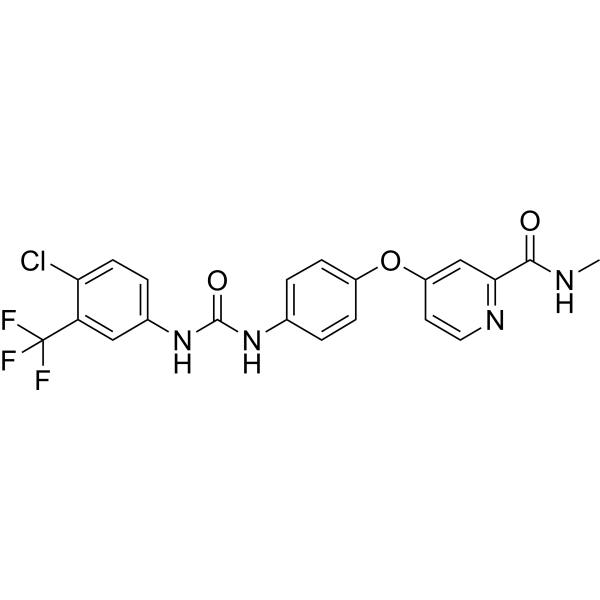 0 ImagesSynonyms: Bay 43-9006Sorafenib (Bay 43-9006) is a potent oral active multikinase inhibitor. Sorafenib blocks autophosphorylation and activity of receptor tyrosine kinases (VEGFR-2, VEGFR-3) and RAF family kinases, thereby suppressing the RAF/MEK/ERK and PI3K/Akt pathways, inhibiting STAT3 phosphorylation, and selectively inhibiting the MAPK pathway in cancer cells. Sorafenib induces cell cycle arrest, autophagy, apoptosis, and PARP cleavage, reduces Bcl-2, Bcl-XL, cyclin D1 levels, and activates Bak and Bax. Sorafenib inhibits tumor growth and metastasis in mouse and rat models. Sorafenib can be used for cancer research, such as colon, breast, non-small-cell lung cancer (NSCLC), ovarian, pancreatic, melanoma, colorectal and hepatocellular carcinoma.
-
JI-101
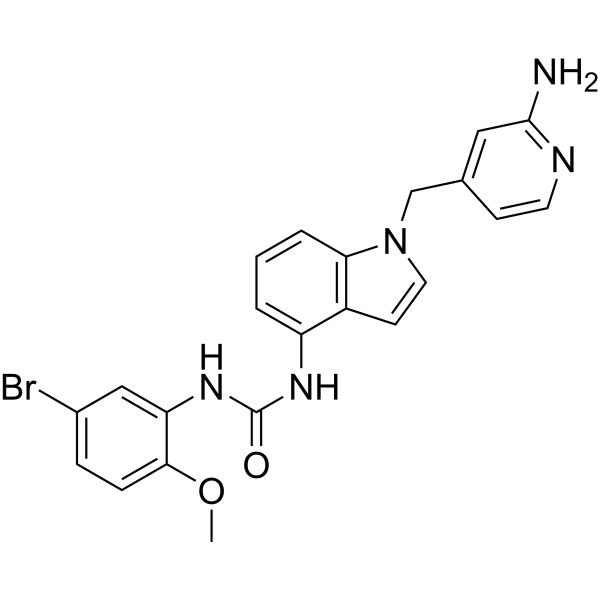 0 ImagesJI-101 is an orally active multi-kinase inhibitor. JI-101 inhibits EphB4, VEGFR-2 and PDGFR-β. JI-101 exhibits anticancer activity. JI-101 can be used in research related to ovarian cancer.
-
EphB4-IN-1
 0 ImagesArt. -Nr.: HY-185227CAS. Nr.: 1394837-94-5EphB4-IN-1 is a selective EphB4 tyrosine kinase inhibitor with IC50 values of 0.16-0.30 μM. EphB4-IN-1 binds to the ATP binding site of EphB4 in a DFG-in conformation, forming four stable intermolecular hydrogen bonds. EphB4-IN-1 also inhibits Src, Abl1, Lck, and EGFR kinases. EphB4-IN-1 inhibits EphB4 autophosphorylation. EphB4-IN-1 can be used for the research of cancer, such as non small cell lung cancer.
-
PP124
 0 ImagesArt. -Nr.: HY-134468CAS. Nr.: 1092788-95-8PP124 is a multi-kinase inhibitor. PP124 inhibits the phosphoinositide 3-kinase (PI3K) catalytic isoforms p110α, p110β, p110δ, and p110γ (IC50 = 4 μM, 7 μM, 0.966 μM, and 1.5 μM), mTOR and DNAPK (IC50 = 0.493 μM and 0.054 μM), as well as the tyrosine kinases Abl, Hck, Src, mutant Src (T/I), VEGFR, EGFR, and EphB4 (IC50 = 0.165 μM, 0.005 μM, 0.017 μM, 0.25 μM, 0.134 μM, 0.085 μM, and 0.17 μM). PP124 can be used for cancer research.
-
SA-PA
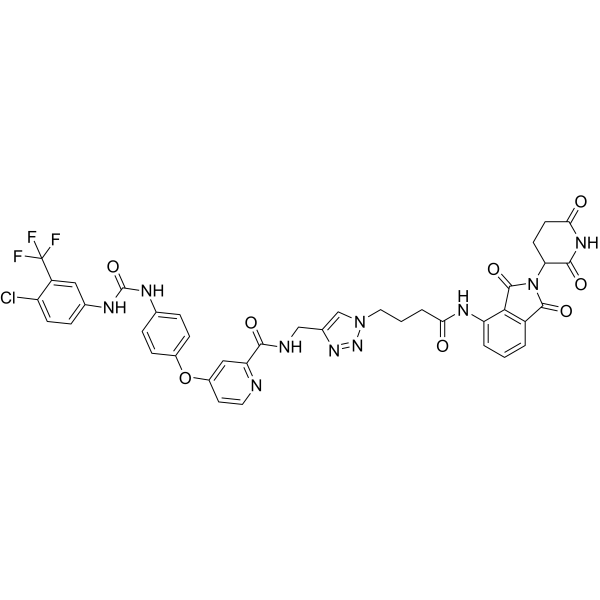 0 ImagesArt. -Nr.: HY-155684CAS. Nr.: 3058085-76-7SA-PA is an intracellular self-assembling CRBN-recruiting PROTAC composed of an alkynylated Sorafenib precursor (SA) and an azidated Pomalidomide precursor (PA). SA-PA promotes the ubiquitination and proteasomal degradation of VEGFR-2, EphB4, and PDGFR-β, and exhibits inhibitory activity against U87 and A549 cell proliferation. SA-PA is used in cancer-related research, such as glioblastoma and non-small cell lung cancer.
-
JI-101 hydrochloride
 0 ImagesArt. -Nr.: HY-16265ACAS. Nr.: 2514957-81-2JI-101 hydrochloride is an orally active angiogenesis inhibitor and anticancer agent with 55% oral bioavailability in Sprague Dawley rats, high permeability, and no P-gp substrate activity.JI-101 hydrochloride modulates angiogenesis signaling pathways in tumor vessel beds, downregulates EphB4, targets EphB4, VEGFR-2, and PDGFR-β, and inhibits multiple stages of tumor angiogenesis.JI-101 hydrochloride exerts activity against cancer cells and xenografts, exhibits mild to moderate inhibition of CYP3A4, and shows stability in pre-clinical and human liver microsomes.JI-101 hydrochloride undergoes rapid oral absorption in Sprague Dawley rats, has extensive tissue distribution with preferred lung uptake, and is excreted via bile with mono- and di-hydroxy metabolites, with feces as the primary elimination route.JI-101 hydrochloride can be used for the research of ovarian cancer and solid tumors.
-
EphB4-IN-2
 0 ImagesArt. -Nr.: HY-10654CAS. Nr.: 1192216-03-7EphB4-IN-2 is a tyrosine kinase inhibitor targeting the Eph family and Src family. EphB4-IN-2 binds to the ATP-binding site of the kinase domain of EphB4, and exhibits high affinity for tyrosine kinases with threonine as the gatekeeper residue, such as Abl, Lck and Src. EphB4-IN-2 can be used in research related to tumor-associated angiogenesis.



