



Aldehyde reactive probe TFA
Based on 1 publication(s) in Google Scholar
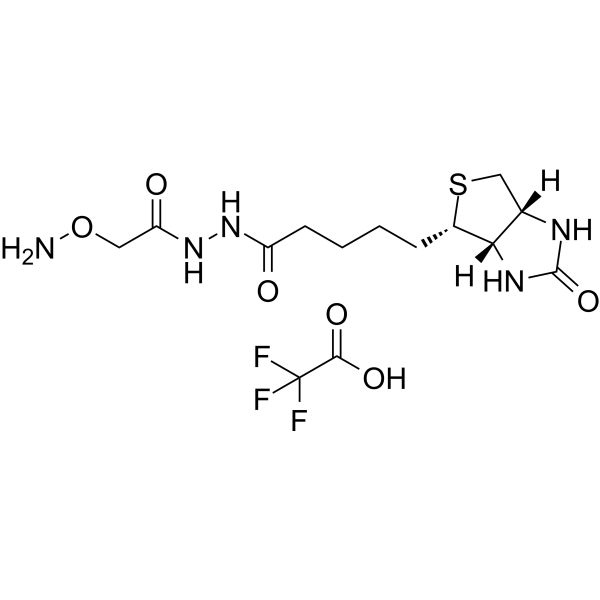
Aldehyde reactive probe TFA is an aldehyde reactive probe. Aldehyde reactive probe TFA specifically labels the AP site in DNA with biotin residues. Aldehyde reactive probe TFA can detect RNA oxidation-induced debasement sites. Aldehyde reactive probe TFA can be used to quantify AP sites or detect other aldehyde-containing DNA damage and RNA oxidation-induced debasement sites.
Nur für Forschungszwecke. Wir verkaufen nicht an Patienten.
- Reinheit : 97.63%
- CAS. Nr.: 627090-10-2
- Formel: C14H22F3N5O6S
- Molecular Weight:445.41
-
Speicherung:
-20°C, sealed storage, away from moisture
* In solvent : -80°C, 6 months; -20°C, 1 month (sealed storage, away from moisture)

To place orders, for customer services and technical support, please contact: MedChemExpress USA
Tel: 609-228-6898 E-mail: [email protected] [email protected]


-
 Biologische Aktivität
-
Chemical Information
-
Lösungsmittel & Löslichkeit
- Protokoll
- Reinheit & Dokumentation
- Verweise
-
 Help & FAQs




Publications Citing Use of MedChemExpress (MCE) Aldehyde reactive probe TFA
More

Biologische Aktivität
Beschreibung
In Vitro
Aldehyde reactive probe TFA (100 μL; 1 h at 37 °C) detects AP sites and related aldehyde-containing damages in DNA isolated from heat-inactivated, X-irradiated E. coli AB1157 cells, with signal intensity proportional to radiation dose[1].
Aldehyde reactive probe TFA (100 μL; 1 h at 37 °C) detects AP sites formed in the DNA of MMS-treated E. coli AB1157 cells. Its signal is proportional to the concentration of MMS and decreases during the repair process after treatment[1].
Aldehyde reactive probe TFA (2 mM; 1 h) specifically reacts with apurinic sites in acid-apurinized yeast tRNAPhe, and its reaction activity is directly proportional to the degree of apurinization[2].
Aldehyde reactive probe TFA (0-10 mM; 1 h) specifically binds to abasic sites in chemically synthesized RNA, with a limit of detection of 10 fmoles of abasic sites[2].
The reactivity of Aldehyde reactive probe TFA (0-10 mM; 0.5-2 h) with synthetic abasic RNA increases with elevated temperature, prolonged incubation time up to 1 h, acidic pH, and increased ARP concentration[2].
Aldehyde reactive probe TFA (2 mM; 1 h) detects apurinic/apyrimidinic sites in in vitro synthesized RNA irradiated with γ-rays in a dose-dependent manner, and this effect occurs at doses ≥5 Gy[2].
Aldehyde reactive probe TFA (2 mM; 1 h) detects apurinic/apyrimidinic (AP) sites in in vitro synthesized RNA oxidized by the Fenton reaction in a dose-dependent manner, and covalently binds to abasic glycosyl groups in Fenton reaction-oxidized RNA to form ribose-ARP adducts detectable by LC/MS[2].
Aldehyde reactive probe TFA (2 mM; 1 h) detects apurinic/apyrimidinic sites in in vitro synthesized RNA oxidized by peroxynitrite in a dose-dependent manner[2].
Aldehyde reactive probe TFA (2 mM; 1 h) detected an increase in the formation of abasic sites in the total RNA of HeLa cells treated with hydrogen peroxide or peroxynitrite[2].
MedChemExpress (MCE) has not independently confirmed the accuracy of these methods. They are for reference only. Further protocols information, click here.


Chemical Information
-
CAS. Nr. 627090-10-2
-
Appearance Solid
-
Molecular Weight 445.41
-
Formel C14H22F3N5O6S
-
Color White to off-white
-
SMILES
O=C(NNC(CON)=O)CCCC[C@@H]1SC[C@]([C@]1([H])N2)([H])NC2=O.O=C(O)C(F)(F)F
-
Versand
Room temperature in continental US; may vary elsewhere.
-
Speicherung
-20°C, sealed storage, away from moisture
* In solvent : -80°C, 6 months; -20°C, 1 month (sealed storage, away from moisture)


Publications (1)
-
Journal Impact Factor
-
Most Recent
-
Biosens Bioelectron
2026 Nov 1:311:118940. PMID: 42322945


Lösungsmittel & Löslichkeit
In Vitro:
DMSO : 25 mg/mL (56.13 mM; Need ultrasonic; Hygroscopic DMSO has a significant impact on the solubility of product, please use newly opened DMSO)
Please refer to the solubility information to select the appropriate solvent. Once prepared, please aliquot and store the solution to prevent product inactivation from repeated freeze-thaw cycles.
Storage method and period of stock solution: -80°C, 6 months; -20°C, 1 month (sealed storage, away from moisture). When stored at -80°C, please use it within 6 months. When stored at -20°C, please use it within 1 month.
Please refer to the solubility information to select the appropriate solvent. Once prepared, please aliquot and store the solution to prevent product inactivation from repeated freeze-thaw cycles.
Storage method and period of stock solution: -80°C, 6 months; -20°C, 1 month (sealed storage, away from moisture). When stored at -80°C, please use it within 6 months. When stored at -20°C, please use it within 1 month.
Konzentration (Stammlösung) × Volumen (Stammlösung) = Konzentration (Ziellösung) × Volumen (Ziellösung)
In Vivo:
Select the appropriate dissolution method based on your experimental animal and administration route.
- For the following dissolution methods, please ensure to first prepare a clear stock solution using an In Vitro approach and then sequentially add co-solvents:
- To ensure reliable experimental results, the clarified stock solution can be appropriately stored based on storage conditions. As for the working solution for In Vivo experiments, it is recommended to prepare freshly and use it on the same day.
- The percentages shown for the solvents indicate their volumetric ratio in the final prepared solution. If precipitation or phase separation occurs during preparation, heat and/or sonication can be used to aid dissolution.
Add each solvent one by one: 10% DMSO 40% PEG300 5% Tween-80 45% Saline
Solubility: ≥ 2.5 mg/mL (5.61 mM); Clear solution
This protocol yields a clear solution of ≥ 2.5 mg/mL (saturation unknown).
Taking 1 mL working solution as an example, add 100 μL DMSO stock solution (25.0 mg/mL) to 400 μL PEG300, and mix evenly; then add 50 μL Tween-80 and mix evenly; then add 450 μL Saline to adjust the volume to 1 mL.
Preparation of Saline: Dissolve 0.9 g sodium chloride in ddH₂O and dilute to 100 mL to obtain a clear Saline solution.
Add each solvent one by one: 10% DMSO 90% (20% SBE-β-CD in Saline)
Solubility: ≥ 2.5 mg/mL (5.61 mM); Clear solution
This protocol yields a clear solution of ≥ 2.5 mg/mL (saturation unknown).
Taking 1 mL working solution as an example, add 100 μL DMSO stock solution (25.0 mg/mL) to 900 μL 20% SBE-β-CD in Saline, and mix evenly.
Preparation of 20% SBE-β-CD in Saline (4°C, storage for one week): 2 g SBE-β-CD powder is dissolved in 10 mL Saline, completely dissolve until clear.
In Vivo Dissolution Calculator
Please enter the basic information of animal experiments:
-
-
-
-
Recommended: Prepare an additional quantity of animals to account for potential losses during experiments.
Please enter your animal formula composition:
-
%DMSO +
Recommended: Keep the proportion of DMSO in working solution below 2% if your animal is weak.
-
%+
-
+%Tween-80 + +
-
%Saline +
The co-solvents required include: DMSO, . All of co-solvents are available by MedChemExpress (MCE). , Tween 80. All of co-solvents are available by MedChemExpress (MCE).
Working solution concentration: 0.22 mg/mL
Method for preparing stock solution: mg drug dissolved in μL DMSO. Stock solution concentration: mg/mL. * In solvent : -80°C, 6 months; -20°C, 1 month (sealed storage, away from moisture)
1. Take μL DMSO stock solution;
2. Add μL .
μL , mix evenly;
3. Then add μL Tween 80, mix evenly;
4. Then add μL
Please ensure that the stock solution in the first step is dissolved to a clear state, and add co-solvents in sequence. You can use ultrasonic heating (ultrasonic cleaner, recommended frequency 20-40 kHz), vortexing, etc. to assist dissolution.

Protokoll
-
Genotoxicity/Mutagenicity Study
The bacterial reverse mutation assay detects point mutations that restore amino-acid prototrophy in auxotrophic Salmonella typhimurium or Escherichia coli tester strains; after exposure to a test article, mutagenic activity is read out as an increased number of revertant colonies on minimal agar compared with the vehicle control. The assay uses tester strains with different mutation targets so that base-substitution and frameshift mutagens can be detected, and testing is performed with and without exogenous mammalian metabolic activation because some chemicals require biotransformation to become mutagenic.


Reinheit & Dokumentation
-
Data Sheet (273 KB)
-
SDS (252 KB)
- English - EN (252 KB)
- Français - FR (252 KB)
- Deutsch - DE (252 KB)
- Norwegian - NO (252 KB)
- Español - ES (252 KB)
- Swedish - SV (252 KB)
- Italian - IT (252 KB)
- Korean - KR (252 KB)
- Portuguese - PT (252 KB)
-
Handling Instructions (2659 KB)
Verweise
[1]. Kubo K, et al. A novel, sensitive, and specific assay for abasic sites, the most commonly produced DNA lesion. Biochemistry. 1992;31(14):3703-3708. [Content Brief]
[2]. Tanaka M, et al. An assay for RNA oxidation induced abasic sites using the Aldehyde Reactive Probe. Free Radic Res. 2011;45(2):237-247. [Content Brief]


Complete Stock Solution Preparation Table
Please refer to the solubility information to select the appropriate solvent. Once prepared, please aliquot and store the solution to prevent product inactivation from repeated freeze-thaw cycles.
Storage method and period of stock solution: -80°C, 6 months; -20°C, 1 month (sealed storage, away from moisture). When stored at -80°C, please use it within 6 months. When stored at -20°C, please use it within 1 month.
| Optional Solvent | Concentration Solvent Mass | 1 mg | 5 mg | 10 mg | 25 mg |
|---|---|---|---|---|---|
| DMSO | 1 mM | 2.2451 mL | 11.2256 mL | 22.4512 mL | 56.1281 mL |
| 5 mM | 0.4490 mL | 2.2451 mL | 4.4902 mL | 11.2256 mL | |
| 10 mM | 0.2245 mL | 1.1226 mL | 2.2451 mL | 5.6128 mL | |
| 15 mM | 0.1497 mL | 0.7484 mL | 1.4967 mL | 3.7419 mL | |
| 20 mM | 0.1123 mL | 0.5613 mL | 1.1226 mL | 2.8064 mL | |
| 25 mM | 0.0898 mL | 0.4490 mL | 0.8980 mL | 2.2451 mL | |
| 30 mM | 0.0748 mL | 0.3742 mL | 0.7484 mL | 1.8709 mL | |
| 40 mM | 0.0561 mL | 0.2806 mL | 0.5613 mL | 1.4032 mL | |
| 50 mM | 0.0449 mL | 0.2245 mL | 0.4490 mL | 1.1226 mL |


Aldehyde reactive probe TFA Related Classifications
HY-135136 Related Classifications
 Powered by Bioz