



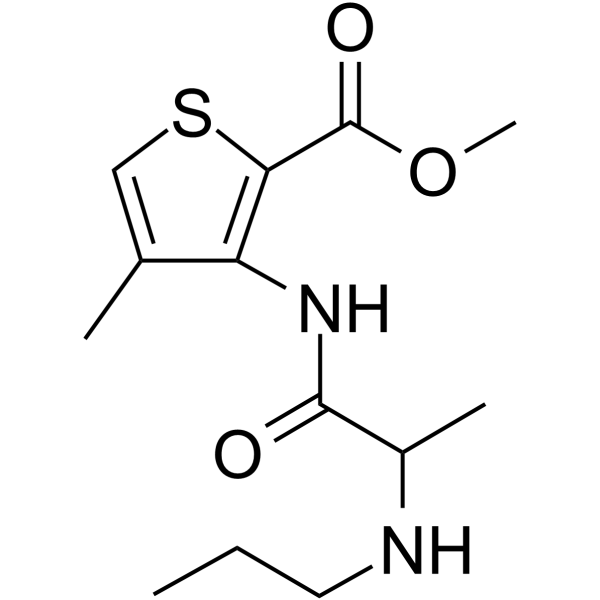
Articaine
Articaine (Hoe-045) is a selective inhibitor of voltage-gated sodium channels (such as rNav1.4, hNav1.7, and rNav1.8), with an IC50 of 15.8 μM for open-state Na+ channels, and IC50 of 40.6 μM and 378 μM for inactivated and resting-state Na+ channels, respectively. Articaine exerts local anesthetic activity by inhibiting Na+ influx to block nerve impulse conduction, and can also inhibit NF-κB activation and NLRP3 inflammasome pathways, exhibiting anti-inflammatory function. Articaine can be used in the study of dental local anesthesia and inflammatory-related diseases (such as acute kidney injury).
Nur für Forschungszwecke. Wir verkaufen nicht an Patienten.
- CAS. Nr.: 23964-58-1
- Formel: C13H20N2O3S
- Molecular Weight:284.37
-
Speicherung:
Please store the product under the recommended conditions in the Certificate of Analysis.

To place orders, for customer services and technical support, please contact: MedChemExpress USA
Tel: 609-228-6898 E-mail: [email protected] [email protected]


-
 Biologische Aktivität
-
Chemical Information
- Protokoll
- Reinheit & Dokumentation
- Verweise
-
 Help & FAQs




Biologische Aktivität
Beschreibung
IC50 & Target
|
NLRP3 |
In Vivo
Articaine (0.5 mM, 1 mM; immersion for 1 h) can enhance the anesthetic effect in the zebrafish model, inhibiting the tactile response rate by 100% and reducing the heart rate by 60%. In combination with nanolipid carriers (NLCs), it can prolong the duration of anesthesia[3].
MedChemExpress (MCE) has not independently confirmed the accuracy of these methods. They are for reference only.
-
Animal Model:Swiss albino mice with LPS-induced acute kidney injury model[2]
-
Dosage:20 mg/kg, 40 mg/kg
-
Administration:Intraperitoneal injection; single dose
-
Result:Reduced serum BUN, creatinine, and cystatin C levels, alleviated renal histopathological damage, inhibited production of TNF-α, IL-6, IL-1β, and reduced MDA levels while increasing SOD and GSH activities.
Suppressed NF-κB activation, TLR4 expression, and NLRP3 inflammasome pathway, and restored Bcl-2/Bax ratio.


Chemical Information
-
CAS. Nr. 23964-58-1
-
Molecular Weight 284.37
-
Formel C13H20N2O3S
-
SMILES
O=C(C(C)NCCC)NC(C(C)=CS1)=C1C(OC)=O
-
Synonyms
Hoe-045 free base
-
Versand
Room temperature in continental US; may vary elsewhere.
-
Speicherung
Please store the product under the recommended conditions in the Certificate of Analysis.


Reinheit & Dokumentation
Verweise
[1]. Wang GK, et al. State-dependent block of Na+ channels by articaine via the local anesthetic receptor. J Membr Biol. 2009 May;229(1):1-9. [Content Brief]
[2]. Zhao G, et al. Local anesthetic articaine ameliorates LPS-induced acute kidney injury via inhibition of NF-ĸB activation and the NLRP3 inflammasome pathway. J Biochem Mol Toxicol. 2020 Oct;34(10):e22554. [Content Brief]
[3]. Rodrigues da Silva GH, et al. Articaine in functional NLC show improved anesthesia and anti-inflammatory activity in zebrafish. Sci Rep. 2020 Nov 12;10(1):19733. [Content Brief]

Calculators
Konzentration (Stammlösung) × Volumen (Stammlösung) = Konzentration (Ziellösung) × Volumen (Ziellösung)


Articaine Related Classifications
HY-B0516A Related Classifications
 Powered by Bioz