



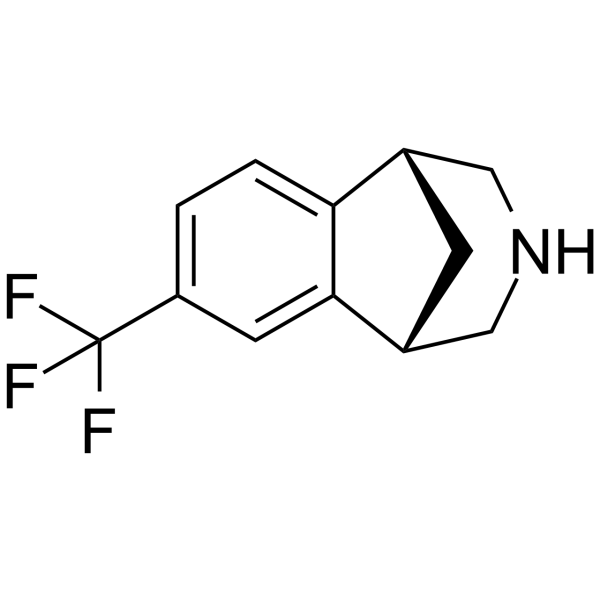
CP-601927

Based on 1 Customer Validation
CP-601927 is a selective α4β2 nicotinic acetylcholine receptor (nAChR) partial agonist (Ki=1.2 nM; EC50=2.6 μM). CP-601927 shows good brain penetration and antidepressant-like properties.
Nur für Forschungszwecke. Wir verkaufen nicht an Patienten.
- Reinheit: 98.24%
- CAS. Nr.: 357425-02-6
- Formel: C12H12F3N
- Molecular Weight:227.23
-
Speicherung:Pure form -20°C, 3 years , 4°C, 2 years ; In solvent -80°C, 6 months , -20°C, 1 month

To place orders, for customer services and technical support, please contact: MedChemExpress USA
Tel: 609-228-6898 E-mail: [email protected] [email protected]


-
 Biologische Aktivität
-
Chemical Information
-
Lösungsmittel & Löslichkeit
- Reinheit & Dokumentation
- Verweise
-
 Help & FAQs


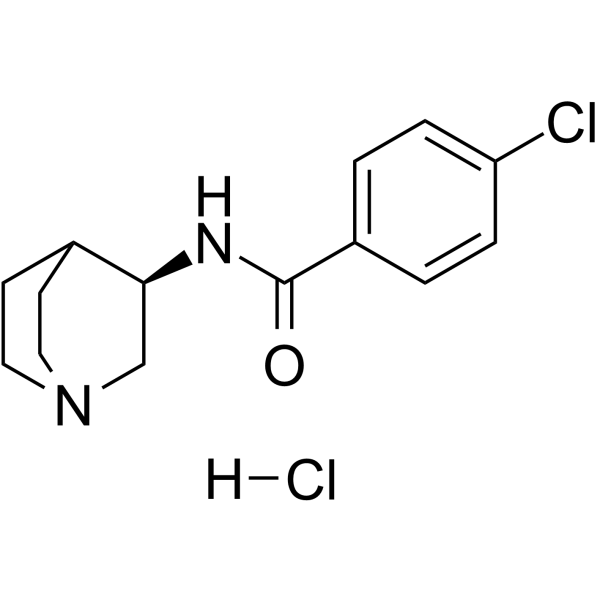
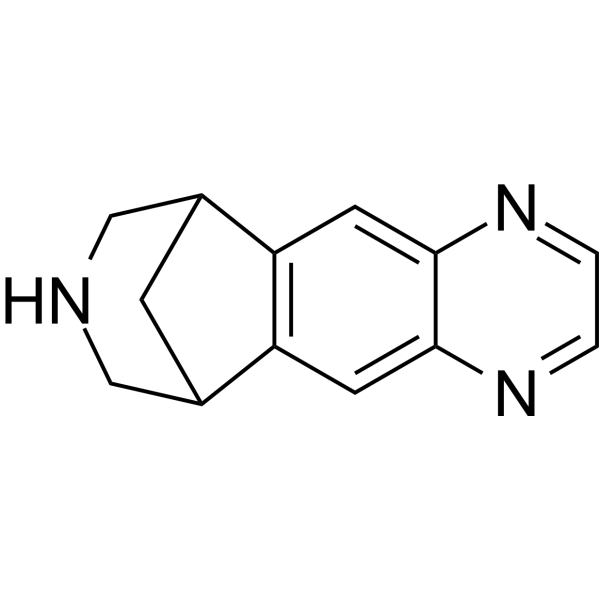
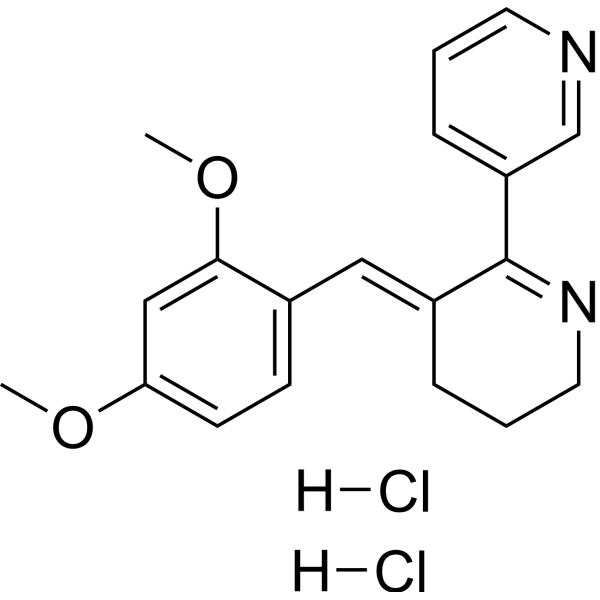


Biologische Aktivität
MedChemExpress (MCE) has not independently confirmed the accuracy of these methods. They are for reference only.


Chemical Information
-
CAS. Nr. 357425-02-6
-
Appearance Liquid (Density: 1.246±0.06 g/cm3)
-
Molecular Weight 227.23
-
Formel C12H12F3N
-
Color Light yellow to brown
-
SMILES
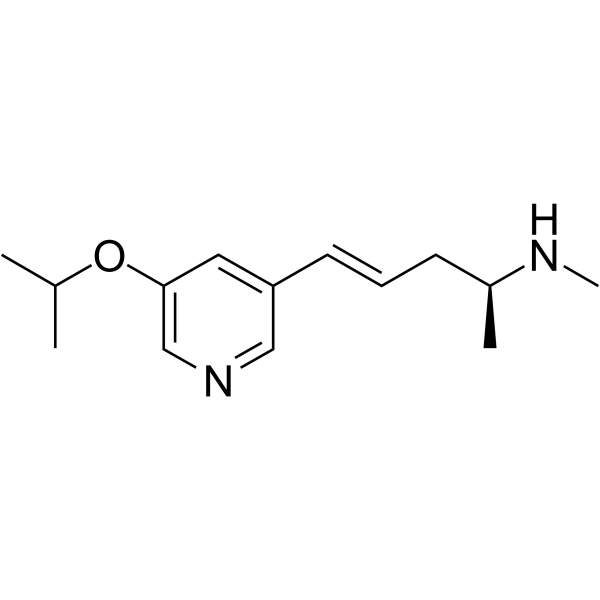
FC(C1=CC=C2[C@@H](C3)CNC[C@@H]3C2=C1)(F)F
-
Versand
Room temperature in continental US; may vary elsewhere.
-
Speicherung
Pure form -20°C 3 years 4°C 2 years In solvent -80°C 6 months -20°C 1 month


Lösungsmittel & Löslichkeit
DMSO : 200 mg/mL (880.17 mM; Need ultrasonic; Hygroscopic DMSO has a significant impact on the solubility of product, please use newly opened DMSO)
Please refer to the solubility information to select the appropriate solvent. Once prepared, please aliquot and store the solution to prevent product inactivation from repeated freeze-thaw cycles.
Storage method and period of stock solution: -80°C, 6 months; -20°C, 1 month. When stored at -80°C, please use it within 6 months. When stored at -20°C, please use it within 1 month.
Please refer to the solubility information to select the appropriate solvent. Once prepared, please aliquot and store the solution to prevent product inactivation from repeated freeze-thaw cycles.
Storage method and period of stock solution: -80°C, 6 months; -20°C, 1 month. When stored at -80°C, please use it within 6 months. When stored at -20°C, please use it within 1 month.
Konzentration (Stammlösung) × Volumen (Stammlösung) = Konzentration (Ziellösung) × Volumen (Ziellösung)
Select the appropriate dissolution method based on your experimental animal and administration route.
- For the following dissolution methods, please ensure to first prepare a clear stock solution using an In Vitro approach and then sequentially add co-solvents:
- To ensure reliable experimental results, the clarified stock solution can be appropriately stored based on storage conditions. As for the working solution for In Vivo experiments, it is recommended to prepare freshly and use it on the same day.
- The percentages shown for the solvents indicate their volumetric ratio in the final prepared solution. If precipitation or phase separation occurs during preparation, heat and/or sonication can be used to aid dissolution.
Add each solvent one by one: 10% DMSO 40% PEG300 5% Tween-80 45% Saline
Solubility: ≥ 5 mg/mL (22.00 mM); Clear solution
This protocol yields a clear solution of ≥ 5 mg/mL (saturation unknown).
Taking 1 mL working solution as an example, add 100 μL DMSO stock solution (50.0 mg/mL) to 400 μL PEG300, and mix evenly; then add 50 μL Tween-80 and mix evenly; then add 450 μL Saline to adjust the volume to 1 mL.
Preparation of Saline: Dissolve 0.9 g sodium chloride in ddH₂O and dilute to 100 mL to obtain a clear Saline solution.
Please enter the basic information of animal experiments:
-
-
-
-
Recommended: Prepare an additional quantity of animals to account for potential losses during experiments.
Please enter your animal formula composition:
-
%DMSO +
Recommended: Keep the proportion of DMSO in working solution below 2% if your animal is weak.
-
%+
-
+%Tween-80 + +
-
%Saline +
The co-solvents required include: DMSO, . All of co-solvents are available by MedChemExpress (MCE). , Tween 80. All of co-solvents are available by MedChemExpress (MCE).
Working solution concentration: 0.22 mg/mL
Method for preparing stock solution: mg drug dissolved in μL DMSO. Stock solution concentration: mg/mL.
1. Take μL DMSO stock solution;
2. Add μL .
μL , mix evenly;
3. Then add μL Tween 80, mix evenly;
4. Then add μL
Please ensure that the stock solution in the first step is dissolved to a clear state, and add co-solvents in sequence. You can use ultrasonic heating (ultrasonic cleaner, recommended frequency 20-40 kHz), vortexing, etc. to assist dissolution.


Reinheit & Dokumentation
-
Data Sheet (273 KB)
-
SDS (252 KB)
- English - EN (252 KB)
- Français - FR (252 KB)
- Deutsch - DE (252 KB)
- Norwegian - NO (252 KB)
- Español - ES (252 KB)
- Swedish - SV (252 KB)
- Italian - IT (252 KB)
- Korean - KR (252 KB)
- Portuguese - PT (252 KB)
-
Handling Instructions (2659 KB)
Verweise
[1]. Campion SN, et al. Toxicity study in juvenile rats with the α4β2 nicotinic acetylcholine receptor partial agonist CP-601,927. Birth Defects Res B Dev Reprod Toxicol. 2011;92(4):323-332. [Content Brief]
[2]. Mineur YS, et al. α4β2 nicotinic acetylcholine receptor partial agonists with low intrinsic efficacy have antidepressant-like properties. Behav Pharmacol. 2011;22(4):291-299. [Content Brief]


Complete Stock Solution Preparation Table
Please refer to the solubility information to select the appropriate solvent. Once prepared, please aliquot and store the solution to prevent product inactivation from repeated freeze-thaw cycles.
Storage method and period of stock solution: -80°C, 6 months; -20°C, 1 month. When stored at -80°C, please use it within 6 months. When stored at -20°C, please use it within 1 month.
| Optional Solvent | Concentration Solvent Mass | 1 mg | 5 mg | 10 mg | 25 mg |
|---|---|---|---|---|---|
| DMSO | 1 mM | 4.4008 mL | 22.0041 mL | 44.0083 mL | 110.0207 mL |
| 5 mM | 0.8802 mL | 4.4008 mL | 8.8017 mL | 22.0041 mL | |
| 10 mM | 0.4401 mL | 2.2004 mL | 4.4008 mL | 11.0021 mL | |
| 15 mM | 0.2934 mL | 1.4669 mL | 2.9339 mL | 7.3347 mL | |
| 20 mM | 0.2200 mL | 1.1002 mL | 2.2004 mL | 5.5010 mL | |
| 25 mM | 0.1760 mL | 0.8802 mL | 1.7603 mL | 4.4008 mL | |
| 30 mM | 0.1467 mL | 0.7335 mL | 1.4669 mL | 3.6674 mL | |
| 40 mM | 0.1100 mL | 0.5501 mL | 1.1002 mL | 2.7505 mL | |
| 50 mM | 0.0880 mL | 0.4401 mL | 0.8802 mL | 2.2004 mL | |
| 60 mM | 0.0733 mL | 0.3667 mL | 0.7335 mL | 1.8337 mL | |
| 80 mM | 0.0550 mL | 0.2751 mL | 0.5501 mL | 1.3753 mL | |
| 100 mM | 0.0440 mL | 0.2200 mL | 0.4401 mL | 1.1002 mL |


CP-601927 Related Classifications
HY-138879 Related Classifications
 Powered by Bioz