



Magnesium fluoride

Based on 1 Customer Validation
Magnesium fluoride is a biochemical reagent. Magnesium fluoride nanoparticles act as an antibacterial and antibiofilm agent with activity against pathogenic bacteria. Magnesium fluoride can be used for the research of bacteria-related infections.
Nur für Forschungszwecke. Wir verkaufen nicht an Patienten.
- Reinheit : 98.62%
- CAS. Nr.: 7783-40-6
- Formel: MgF2
- Molecular Weight:62.30
-
Speicherung:
4°C, sealed storage, away from moisture
* In solvent : -80°C, 6 months; -20°C, 1 month (sealed storage, away from moisture)


To place orders, for customer services and technical support, please contact: MedChemExpress USA
Tel: 609-228-6898 E-mail: [email protected] [email protected]


-
 Biologische Aktivität
-
Chemical Information
-
Lösungsmittel & Löslichkeit
- Protokoll
- Reinheit & Dokumentation
- Verweise
-
 Help & FAQs


-

HY-W051271
Titanium(IV) oxidePhotocatalyst -

HY-W116336B
Zinc oxide, 99.99% metals basisBiochemical Assay Reagents -

HY-Y1267D
Magnesium sulfate, for cell cultureAnti-Inflammatory Agent -

HY-W116336D
Zinc oxide, <100 nm particle sizeNitrate Reductase Activator -

HY-Y1267
Magnesium sulfateAnti-Inflammatory Agent -

HY-Y0283
Potassium iodide ,meet Ch.PBiochemical Reagent -

HY-Y1110H
Magnesium chloride anhydrous, suitable for insect cell cultureCell Culture Medium Component -

HY-Y1110I
Magnesium chloride, for insect cell culture, 97%Mineral Salt -
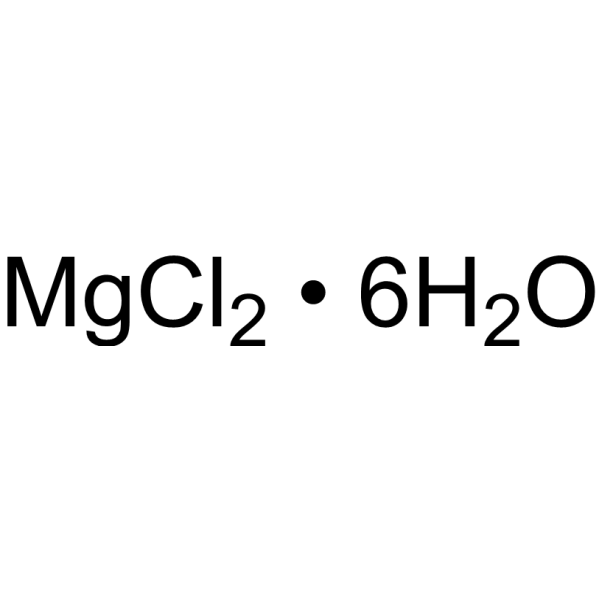
HY-W019981B
Magnesium chloride hexahydrate, for molecular biologySource of Magnesium Ion -
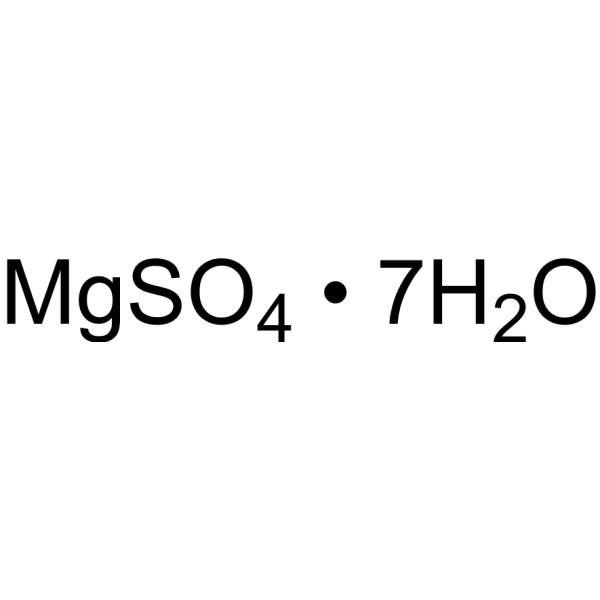
HY-W094475C
Magnesium sulfate heptahydrate, for cell cultureAnti-Inflammatory Agent -
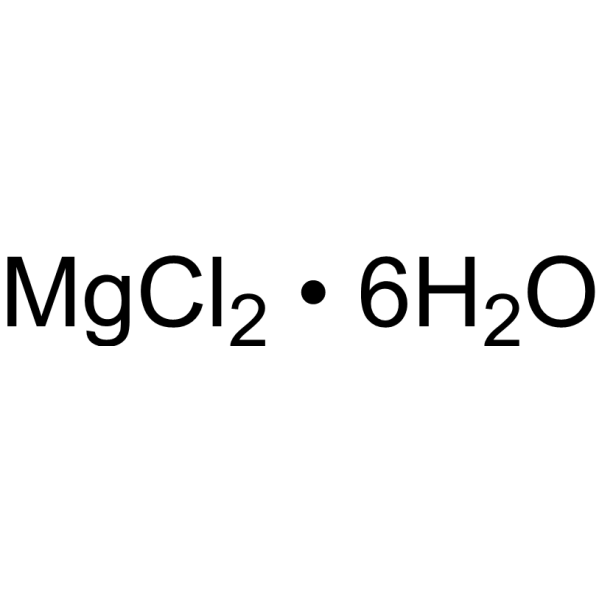
HY-W019981C
Magnesium chloride hexahydrate, for cell cultureMagnesium Ion Source


Biologische Aktivität
Beschreibung
In Vitro
Magnesium fluoride nanoparticles (0.0234-1.5 mg/mL; 24 h) inhibit the growth and biofilm formation of Escherichia coli C600 and Staphylococcus aureus FRF1169 in a dose-dependent manner, and completely inhibit the growth and biofilm formation of Staphylococcus aureus at a concentration of 1.5 mg/mL[1].
Magnesium fluoride nanoparticles (1 mg/mL; 4 h) alter the cellular morphology of Escherichia coli C600 and Staphylococcus aureus FRF1169, resulting in rough cell surfaces, cell wall damage, and nanoparticle adhesion to the cell surface[1].
Magnesium fluoride nanoparticles (1 mg/mL; 4 h) localize on the surface and inside the cell membrane of Escherichia coli C600 and Staphylococcus aureus FRF1169 cells, and increase intracellular Mg2+ and F− levels[1].
Magnesium fluoride nanoparticles (1 mg/mL; overnight) interact with chromosomal DNA of Escherichia coli C600 and Staphylococcus aureus FRF1169, increasing the levels of fluorine and magnesium associated with purified DNA[1].
Magnesium fluoride nanoparticles (1 mg/mL; 8 h) disrupt the membrane potential of E. coli C600 and S. aureus FRF1169, reducing the red/green fluorescence ratio of E. coli from 1.242 to 0.45 and that of S. aureus from 6.31 to 1.925[1].
Magnesium fluoride nanoparticles (1 mg/mL; overnight) induce membrane lipid peroxidation in E. coli C600 and S. aureus, increasing the malondialdehyde level to 106.8 nM in E. coli and 72.1 nM in S. aureus[1].
Magnesium fluoride forms a stable complex with the fluoride riboswitch of Thermotoga thermophilic petroleum bacteria[2].
MedChemExpress (MCE) has not independently confirmed the accuracy of these methods. They are for reference only.


Chemical Information
-
CAS. Nr. 7783-40-6
-
Appearance Solid
-
Molecular Weight 62.30
-
Formel MgF2
-
Color White to off-white
-
SMILES
F[Mg]F
-
Versand
Room temperature in continental US; may vary elsewhere.
-
Speicherung
4°C, sealed storage, away from moisture
* In solvent : -80°C, 6 months; -20°C, 1 month (sealed storage, away from moisture)


Lösungsmittel & Löslichkeit
In Vitro:
DMSO : < 1 mg/mL (insoluble or slightly soluble)


Reinheit & Dokumentation
-
Data Sheet (274 KB)
-
SDS (393 KB)
- English - EN (393 KB)
- Français - FR (393 KB)
- Deutsch - DE (393 KB)
- Norwegian - NO (393 KB)
- Español - ES (393 KB)
- Swedish - SV (393 KB)
- Italian - IT (393 KB)
- Korean - KR (393 KB)
- Portuguese - PT (393 KB)
-
Handling Instructions (2659 KB)
Verweise
[1]. Lellouche J, et al. Antibiofilm activity of nanosized magnesium fluoride. Biomaterials. 2009 Oct;30(30):5969-78. [Content Brief]
[2]. Wedekind JE, et al. Metalloriboswitches: RNA-based inorganic ion sensors that regulate genes. The Journal of biological chemistry. 2017 Jun 09;292(23):9441-9450. [Content Brief]

Calculators
Konzentration (Stammlösung) × Volumen (Stammlösung) = Konzentration (Ziellösung) × Volumen (Ziellösung)


Magnesium fluoride Related Classifications
HY-W019922 Related Classifications
 Powered by Bioz
Keywords
- Magnesium fluoride
- 7783-40-6
- Biochemical Assay Reagents
- Bacterial
- Bacillus cereus
- Thermotoga petrophila
- fluoride riboswitches
- biofilm formation
- Staphylococcus aureus FRF1169
- membrane lipid peroxidation
- bacterial chromosomal DNA
- Pseudomonas syringae
- Escherichia coli C600
- bacterial membrane potential
- Inhibitor
- inhibitor
- inhibit