



Crovalimab

Based on 1 Customer Validation
Crovalimab (SKY59; RO7112689) is a novel humanized antibody against C5 in a pH-dependent manner with KDs of 15.2 nM and 16.8 μM at pH 7.4 and 5.8, respectively. Crovalimab binds human FcRn with great affinity (KD: 17 μM at pH 6.0). Crovalimab can block cleavage of C5 by the C5 convertase and inhibite the activity of a C5 variant (p.Arg885His). Crovalimab inhibits C5b-9 formation significantly in all three complement pathways, the classical pathway (CP), lectin pathway (LP), and alternative pathway (AP). Crovalimab has the potential for paroxysmal nocturnal hemoglobinuria (PNH) and complement-mediated diseases research.
Nos produits utilisent uniquement pour la recherche. Nous ne vendons pas aux patients.
- Pureté : 99.59%
- CAS No.: 1917321-26-6
- Masse moléculaire:145.28 kDa
-
Stockage:Shipping with dry ice
Please store the product under the recommended conditions in the Certificate of Analysis.

To place orders, for customer services and technical support, please contact: MedChemExpress USA
Tel: 609-228-6898 E-mail: [email protected] [email protected]


-
 Activité biologique
-
Chemical Information
- Pureté et documentation
- Références
-
 Help & FAQs


-
HY-P99365
RavulizumabAnti-C5 Antibody -
HY-P9914
EculizumabComplement C5 Antibody -

HY-P99786
PozelimabAnti-C5 Antibody -
HY-147080
Avacincaptad pegol sodiumAnti-C5 RNA Aptamer -

HY-P99050
SutimlimabC1s Inhibitor -

HY-P990545
TanruprubartC1q Inhibitor, C1q Depleter -

HY-P99638
GefurulimabAnti-C5/albumin Dual Antibody -
HY-P990091
RiliprubartActivated C1s Inhibitor -

HY-P99112
SatralizumabIL-6R Inhibitor -

HY-P9956
SiltuximabAnti-IL-6 mAb -

HY-P99009
BatoclimabAnti-FcRn Monoclonal Antibody -

HY-P9945
MepolizumabIL-5 Inhibitor


Activité biologique
Description
Isotype
Human IgG1 kappa
Recommend Isotype Controls
Species Reactivity
Human
IC50 & Target
Complement C5
In Vitro
Crovalimab (SKY59; RO7112689; 0-100 μg/mL) inhibits haemolysis in classical pathway and reactive lysis systems[2].
MedChemExpress (MCE) has not independently confirmed the accuracy of these methods. They are for reference only.
In Vivo
Crovalimab (20 mg/kg; iv; a single dose) stably suppressed complement activity in plasma for 8 weeks[1].
Crovalimab (5 mg/kg by iv at day 0 and 2 mg/kg by sc at day 7, 21, 35, 49, and 63) causes over 20% of serum hemolytic activity in the cRBC lysis assay to correlate with events such as dysphagia and dramatic increases in lactate dehydrogenase (LDH) and alanine aminotransferase (ALT) levels[1].
MedChemExpress (MCE) has not independently confirmed the accuracy of these methods. They are for reference only.
Essai clinique
| NCT Number | Sponsor | Condition | Start Date |
Phase

|
|---|---|---|---|---|
| NCT01329991 | 2011-05 | PHASE1 |
Gene ID
Accession
Conjugated
Unconjugated
Reconsititution
The product can be reconstituted/diluted with sterile PBS or saline.
Format
-
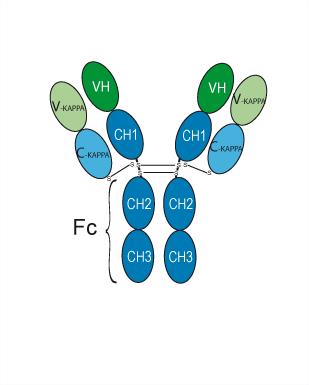
Human IgG1 kappa
Application
ELISA, FACS, Functional assay
Verified Bioactivity
-
 Immobilized Complement C5 Protein, Human (HEK293, His, HY-P700862) can bind Crovalimab. The EC50 for this effect is 5.406 ng/mL.
-
 Flow cytometric analysis of 1X10⁶ HepG2 cells with Crovalimab (HY-P99965, red). Cells were fixed with 4% paraformaldehyde and permeabilised with 90% methanol. Then stained with the primary antibody at 1/50 dilution for an hour at 4℃. Alexa Fluor 488-conjugated AffiniPure Goat Anti-Human IgG H&L (HY-P83776) was used as the secondary antibody at 1/1,000 dilution for 30 minutes at 4℃. Human IgG1 kappa Isotype Control (HY-P99001, blue) was used as the isotype control, cells without incubation with primary antibody were used as the unlabeled control (black).


Chemical Information
-
CAS No. 1917321-26-6
-
Appearance Liquid
-
Masse moléculaire 145.28 kDa
-
Color Colorless to light yellow
-
SMILES
[Crovalimab]
-
Synonyms
SKY59; RO7112689; RG-6107
-
Livraison
Shipping with dry ice.
-
Formulation
Please refer to the lot-specific COA for specific buffer information.
-
Stockage
Please store the product under the recommended conditions in the Certificate of Analysis.


Pureté et documentation
-
Fiche technique (261 KB)
-
SDS (251 KB)
- English - EN (251 KB)
- Français - FR (251 KB)
- Deutsch - DE (251 KB)
- Norwegian - NO (251 KB)
- Español - ES (251 KB)
- Swedish - SV (251 KB)
- Italian - IT (251 KB)
- Korean - KR (251 KB)
- Portuguese - PT (251 KB)
-
Inhibitory Antibodies User Guide (603 KB)
Références
[1]. Taku Fukuzawa, et al. Long lasting neutralization of C5 by SKY59, a novel recycling antibody, is a potential therapy for complement-mediated diseases. Sci Rep. 2017 Apr 24;7(1):1080. [Content Brief]
[2]. Wioleta M Zelek, et al. Characterizing a pH-switch anti-C5 antibody as a tool for human and mouse complement C5 purification and cross-species inhibition of classical and reactive lysis. Immunology. 2018 Nov;155(3):396-403. [Content Brief]

Calculators
Concentration (start) × Volume (start) = Concentration (final) × Volume (final)


Crovalimab Related Classifications
HY-P99965 Related Classifications
 Powered by Bioz