



Evybactin
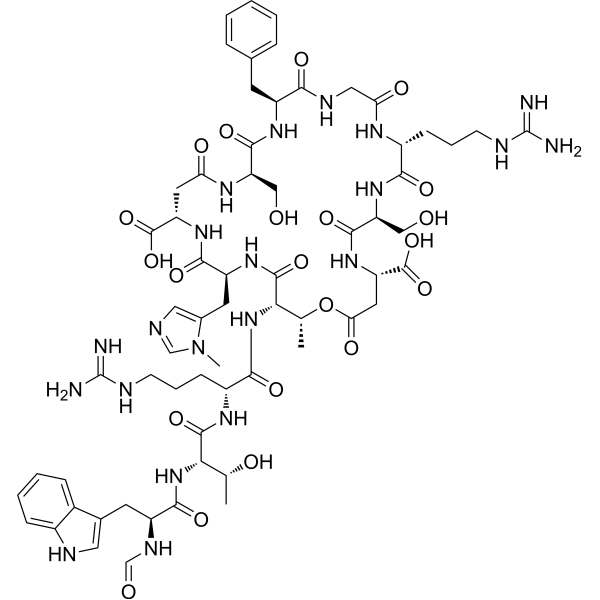
Evybactin is a DNA gyrase inhibitor. Evybactin is a selective inhibitor of Mycobacterium tuberculosis with a MIC value of 0.25 µg/mL. Evybactin is the first antimicrobial compound found to employ this unusual mechanism of selectivity.
Nos produits utilisent uniquement pour la recherche. Nous ne vendons pas aux patients.
- Formule: C64H89N21O21
- Masse moléculaire:1488.52
-
Stockage:
Please store the product under the recommended conditions in the Certificate of Analysis.

To place orders, for customer services and technical support, please contact: MedChemExpress USA
Tel: 609-228-6898 E-mail: [email protected] [email protected]


-
 Activité biologique
-
Chemical Information
- Protocole
- Pureté et documentation
- Références
-
 Help & FAQs


Voir tous les produits spécifiques à Isoform DNA/RNA Synthesis
More

Activité biologique
Description
IC50 & Target
IC50: 1 μM (DNA cleavage)[1]
In Vitro
Evybactin (0-1000 µg/mL; 24 h) inhibits Mycobacterium tuberculosis with a MIC value of 0.25 µg/mL[1]. Evybactin (100 µM; 30 min) induces DNA cleavage with an IC50 value of 1 μM[1].
MedChemExpress (MCE) has not independently confirmed the accuracy of these methods. They are for reference only. Further protocols information, click here.
-
Cell Line:HepG2, FaDu and HEK293 cell lines
-
Concentration:0-1000 µg/mL
-
Incubation Time:24 hours
-
Result:Showed no toxicity against HepG2, FaDu and HEK293 human cells with IC50s >128 µg/mL.
In Vivo
MedChemExpress (MCE) has not independently confirmed the accuracy of these methods. They are for reference only.
-
Animal Model:Mice with E. coli infection[1]
-
Dosage:25 and 100 mg/kg
-
Administration:Intraperitoneal injection; 25 and 100 mg/kg once
-
Result:Showed significant efficacy with a single dose of 25 mg/kg, and protected mice from infection with a single dose of 100 mg/kg, whereas 83% of untreated control animals died in 24 hours.


Chemical Information
-
Masse moléculaire 1488.52
-
Formule C64H89N21O21
-
Livraison
Room temperature in continental US; may vary elsewhere.
-
Stockage
Please store the product under the recommended conditions in the Certificate of Analysis.

Protocole
-
Research Protocol for Infectious Diseases
Infectious-disease experiments test how pathogens interact with host barriers, innate immune receptors, inflammatory signaling, pathogen replication, and tissue injury; pattern-recognition receptors such as TLRs, RIG-I-like receptors, NOD-like receptors, and inflammasomes detect microbial molecules and activate NF-κB, interferon, and cytokine responses. The central hypothesis is that infection severity reflects the balance between pathogen burden and host response: protective inflammation restricts pathogen growth, whereas excessive or mislocalized inflammation contributes to tissue damage and disease phenotype. Unresolved questions include which host pathways are protective versus pathogenic, why some infection models fail to translate to human disease, and which combined readouts best predict clinically relevant infection outcomes.


Pureté et documentation
Références

Calculators
Concentration (start) × Volume (start) = Concentration (final) × Volume (final)


Evybactin Related Classifications
HY-P3473 Related Classifications
 Powered by Bioz