



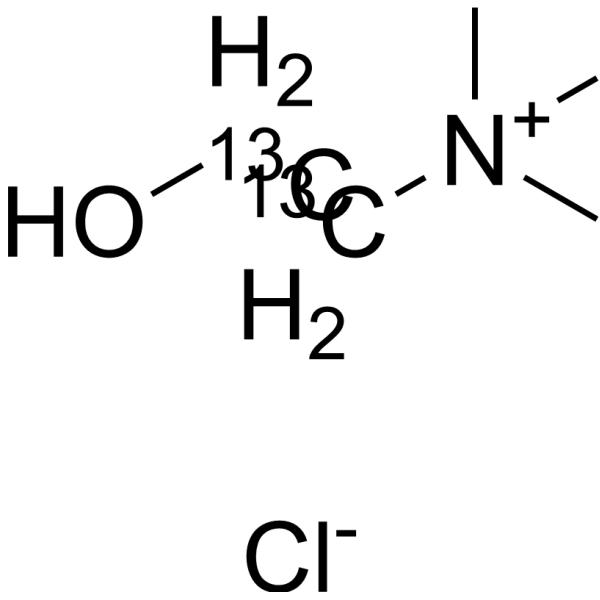
Choline-13C2 chloride

Based on 1 Customer Validation
Choline-13C2 chloride is the 13C-labeled Choline chloride (HY-B1337). Choline chloride is an orally active methylxanthine derivative. Choline chloride exhibits weak antihistaminic and anticholinergic activities and potentiates the effects of histamine and acetylcholine. Choline chloride relaxes bronchial smooth muscle, dilates coronary and peripheral blood vessels, increases urine output and electrolyte excretion, stimulates locomotor activity in the central nervous system, and induces transient hypotension following a pressor phase. Choline chloride modulates sleep architecture by increasing wakefulness time and reducing slow-wave sleep, without altering the frequency or severity of nocturnal hypoxemia, apnea, or hypopnea events. Choline chloride is used in studies of bronchospasm, nocturnal asthma, and chronic asthma.
For research use only. We do not sell to patients.
- Assay : 98.8%
- CAS No.: 202190-49-6
- Formula: C313C2H14ClNO
- Molecular Weight:141.61
-
Storage:
4°C, sealed storage, away from moisture
* In solvent : -80°C, 6 months; -20°C, 1 month (sealed storage, away from moisture)

To place orders, for customer services and technical support, please contact: MedChemExpress USA
Tel: 609-228-6898 E-mail: [email protected] [email protected]


-
 Biological Activity
-
Chemical Information
- Protocols
- Purity & Documentation
- References
-
 Help & FAQs


All Histamine Receptor Isoforms
More

Biological Activity
Description
IC50 & Target
|
Human Endogenous Metabolite |
Application
1. This compound can be used as a tracer
2. This compound can be used as an internal standard for quantitative analysis by NMR, GC-MS, or LC-MS.


Chemical Information
-
CAS No. 202190-49-6
-
Unlabeled CAS 67-48-1
-
Appearance Oil
-
Molecular Weight 141.61
-
Formula C313C2H14ClNO
-
Color Off-white to light yellow
-
SMILES
C[N+](C)(C)[13CH2][13CH2]O.[Cl-]
-
Shipping
Room temperature in continental US; may vary elsewhere.
-
Storage
4°C, sealed storage, away from moisture
* In solvent : -80°C, 6 months; -20°C, 1 month (sealed storage, away from moisture)

Protocols
-
Protocol for Open Field Test (OF)
The Open Field Test is a rodent behavioral assay that measures spontaneous locomotion, exploratory behavior, and anxiety-like behavior when an animal is placed in a novel open arena. The main readouts are total distance traveled, movement time, velocity, center-zone entries, center-zone time, peripheral-zone time, and thigmotaxis. The assay is based on the conflict between exploration of a novel environment and avoidance of exposed open areas; higher center exploration is commonly interpreted as lower anxiety-like behavior, whereas increased wall-following or peripheral occupancy is interpreted as higher anxiety-like behavior.


Purity & Documentation
-
Data Sheet (267 KB)
-
SDS (394 KB)
- English - EN (394 KB)
- Français - FR (394 KB)
- Deutsch - DE (394 KB)
- Norwegian - NO (394 KB)
- Español - ES (394 KB)
- Swedish - SV (394 KB)
- Italian - IT (394 KB)
- Korean - KR (394 KB)
- Portuguese - PT (394 KB)
-
Handling Instructions (2659 KB)
References

Calculators
Concentration (start) × Volume (start) = Concentration (final) × Volume (final)


Choline-13C2 chloride Related Classifications
HY-B1337S5 Related Classifications
 Powered by Bioz