



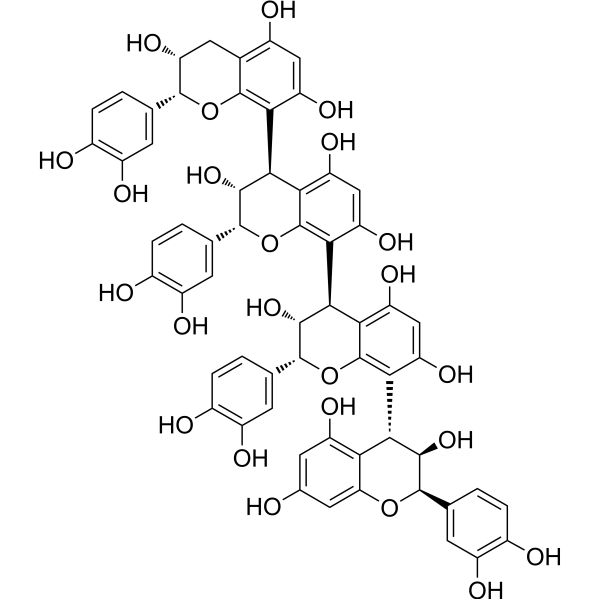
Cinnamtannin A2

Based on 1 Customer Validation
Cinnamtannin A2, a tetrameric procyanidin, can increases GLP-1 and insulin secretion in mice. Cinnamtannin A2 could upregulate the expression of corticotrophin releasing hormone. Cinnamtannin A2 exhibits antioxidant, anti-diabetic and nephroprotective effect.
For research use only. We do not sell to patients.
- Purity : 97.66%
- CAS No.: 86631-38-1
- Formula: C60H50O24
- Molecular Weight:1155.02
-
Storage:
-20°C, sealed storage, away from moisture and light
* In solvent : -80°C, 6 months; -20°C, 1 month (sealed storage, away from moisture and light)

To place orders, for customer services and technical support, please contact: MedChemExpress USA
Tel: 609-228-6898 E-mail: [email protected] [email protected]


-
 Biological Activity
-
Chemical Information
-
Solvent & Solubility
- Protocols
- Purity & Documentation
- References
-
 Help & FAQs




Biological Activity
Description
In Vitro
Cinnamtannin A2 (0.125-2.0 μg/mL) inhibits LDL oxidation induced by copper ions or MeO-AMVN[3].
MedChemExpress (MCE) has not independently confirmed the accuracy of these methods. They are for reference only. Further protocols information, click here.
In Vivo
Cinnamtannin A2 (10 μg/kg; p.o.) increases the secretion of insulin and glucagon-like peptide-1 (GLP-1) in plasma of mice[1].
Cinnamtannin A2 (10 μg/kg; p.o.) significantly promotes phosphorylation of both IRB and IRS-1 in mice[1].
MedChemExpress (MCE) has not independently confirmed the accuracy of these methods. They are for reference only.
-
Animal Model:Male Sprague-Dawley rats (250-300 g) were induced chronic renal failure (CRF) by removing the kidneys[2]
-
Dosage:10 mg/kg
-
Administration:I.p. for 30 days
-
Result:Ameliorated the altered level of creatinine, blood urea nitrogen, Neutrophil gelatinase-associated lipocalin, Kidney Injury Molecule-1 and cytokines in the serum and microalbuminurea.
Reduced the oxidative stress level.
Attenuated the altered expression of proteins involved in Nrf2-Keap1 pathway in the kidney tissue.
Reduced the tubular injury score in the kidney tissue.


Chemical Information
-
CAS No. 86631-38-1
-
Appearance Solid
-
Molecular Weight 1155.02
-
Formula C60H50O24
-
Color White to light yellow
-
SMILES
O[C@@H]([C@@H](C(C=C1)=CC(O)=C1O)O2)[C@@H](C(C(O)=C3)=C(O[C@H](C(C=C4)=CC(O)=C4O)[C@@H]5O)C([C@@H]5C(C(O)=C6)=C(O[C@H](C(C=C7)=CC(O)=C7O)[C@@H]8O)C(C8)=C6O)=C3O)C(C2=C([C@H]([C@H]([C@@H](C(C=C9)=CC(O)=C9O)O%10)O)C(C%10=CC(O)=C%11)=C%11O)C(O)=C%12)=C%12O
-
Structure Classification
-
Initial Source
-
Shipping
Room temperature in continental US; may vary elsewhere.
-
Storage
-20°C, sealed storage, away from moisture and light
* In solvent : -80°C, 6 months; -20°C, 1 month (sealed storage, away from moisture and light)


Solvent & Solubility
In Vitro:
Ethanol : ≥ 50 mg/mL (43.29 mM)
* "≥" means soluble, but saturation unknown.
Please refer to the solubility information to select the appropriate solvent. Once prepared, please aliquot and store the solution to prevent product inactivation from repeated freeze-thaw cycles.
Storage method and period of stock solution: -80°C, 6 months; -20°C, 1 month (sealed storage, away from moisture and light). When stored at -80°C, please use it within 6 months. When stored at -20°C, please use it within 1 month.
Please refer to the solubility information to select the appropriate solvent. Once prepared, please aliquot and store the solution to prevent product inactivation from repeated freeze-thaw cycles.
Storage method and period of stock solution: -80°C, 6 months; -20°C, 1 month (sealed storage, away from moisture and light). When stored at -80°C, please use it within 6 months. When stored at -20°C, please use it within 1 month.
Concentration (start) × Volume (start) = Concentration (final) × Volume (final)
In Vivo:
Select the appropriate dissolution method based on your experimental animal and administration route.
- For the following dissolution methods, please ensure to first prepare a clear stock solution using an In Vitro approach and then sequentially add co-solvents:
- To ensure reliable experimental results, the clarified stock solution can be appropriately stored based on storage conditions. As for the working solution for In Vivo experiments, it is recommended to prepare freshly and use it on the same day.
- The percentages shown for the solvents indicate their volumetric ratio in the final prepared solution. If precipitation or phase separation occurs during preparation, heat and/or sonication can be used to aid dissolution.
Add each solvent one by one: 10% EtOH 40% PEG300 5% Tween-80 45% Saline
Solubility: ≥ 1.25 mg/mL (1.08 mM); Clear solution
This protocol yields a clear solution of ≥ 1.25 mg/mL (saturation unknown).
Taking 1 mL working solution as an example, add 100 μL EtOH stock solution (12.5 mg/mL) to 400 μL PEG300, and mix evenly; then add 50 μL Tween-80 and mix evenly; then add 450 μL Saline to adjust the volume to 1 mL.
Preparation of Saline: Dissolve 0.9 g sodium chloride in ddH₂O and dilute to 100 mL to obtain a clear Saline solution.
Add each solvent one by one: 10% EtOH 90% (20% SBE-β-CD in Saline)
Solubility: ≥ 1.25 mg/mL (1.08 mM); Clear solution
This protocol yields a clear solution of ≥ 1.25 mg/mL (saturation unknown).
Taking 1 mL working solution as an example, add 100 μL EtOH stock solution (12.5 mg/mL) to 900 μL 20% SBE-β-CD in Saline, and mix evenly.
Preparation of 20% SBE-β-CD in Saline (4°C, storage for one week): 2 g SBE-β-CD powder is dissolved in 10 mL Saline, completely dissolve until clear.
In Vivo Dissolution Calculator
Please enter the basic information of animal experiments:
-
-
-
-
Recommended: Prepare an additional quantity of animals to account for potential losses during experiments.
Working solution concentration: 0.22 mg/mL

Protocols
-
RNA extraction experimental
By lysing cells, releasing RNA, and removing impurities such as proteins and DNA, high-purity RNA products are finally obtained. The commonly used traditional method is the guanidine isothiocyanate/phenol/chloroform method (Trizol), which is suitable for a variety of animal materials including animal tissues, microorganisms, cultured cells, etc., and most plant materials.
-
Research Protocol for Endocrine Diseases
Endocrine diseases often arise from disrupted hormone production, hormone signaling, or target-tissue responsiveness; for diabetes-focused endocrine disease models, insulin signaling regulates glucose uptake, hepatic glucose output, lipid metabolism, and β-cell compensation. Type 2 diabetes develops through interacting defects in insulin resistance, β-cell dysfunction, adipose inflammation, hepatic glucose overproduction, altered incretin signaling, and ectopic lipid metabolism. A major unresolved question is whether endocrine dysfunction is driven primarily by target-tissue insulin resistance, intrinsic β-cell failure, immune/inflammatory stress, or combined multi-organ failure that differs by disease stage.
-
Human Islet Cell Culture
The method of preserving islets in vitro, with purified reduced immunogenicity. The steps are islet isolation, islet cell purification, in vitro determination of islet function and islet cell culture.


Purity & Documentation
-
Data Sheet (284 KB)
-
SDS (252 KB)
- English - EN (252 KB)
- Français - FR (252 KB)
- Deutsch - DE (252 KB)
- Norwegian - NO (252 KB)
- Español - ES (252 KB)
- Swedish - SV (252 KB)
- Italian - IT (252 KB)
- Korean - KR (252 KB)
- Portuguese - PT (252 KB)
-
Handling Instructions (2659 KB)
References
[1]. Yamashita Y, et, al. Cinnamtannin A2, a tetrameric procyanidin, increases GLP-1 and insulin secretion in mice. Biosci Biotechnol Biochem. 2013;77(4):888-91. [Content Brief]
[2]. Li N, et, al. Cinnamtannin A2 protects the renal injury by attenuates the altered expression of kidney injury molecule 1 (KIM-1) and neutrophil gelatinase-associated lipocalin (NGAL) expression in 5/6 nephrectomized rat model. AMB Express. 2020 May 8;10(1):87. [Content Brief]
[3]. Osakabe N, et, al. Catechins and their oligomers linked by C4 --> C8 bonds are major cacao polyphenols and protect low-density lipoprotein from oxidation in vitro. Exp Biol Med (Maywood). 2002 Jan;227(1):51-6. [Content Brief]


Complete Stock Solution Preparation Table
Please refer to the solubility information to select the appropriate solvent. Once prepared, please aliquot and store the solution to prevent product inactivation from repeated freeze-thaw cycles.
Storage method and period of stock solution: -80°C, 6 months; -20°C, 1 month (sealed storage, away from moisture and light). When stored at -80°C, please use it within 6 months. When stored at -20°C, please use it within 1 month.
| Optional Solvent | Concentration Solvent Mass | 1 mg | 5 mg | 10 mg | 25 mg |
|---|---|---|---|---|---|
| Ethanol | 1 mM | 0.8658 mL | 4.3289 mL | 8.6579 mL | 21.6446 mL |
| 5 mM | 0.1732 mL | 0.8658 mL | 1.7316 mL | 4.3289 mL | |
| 10 mM | 0.0866 mL | 0.4329 mL | 0.8658 mL | 2.1645 mL | |
| 15 mM | 0.0577 mL | 0.2886 mL | 0.5772 mL | 1.4430 mL | |
| 20 mM | 0.0433 mL | 0.2164 mL | 0.4329 mL | 1.0822 mL | |
| 25 mM | 0.0346 mL | 0.1732 mL | 0.3463 mL | 0.8658 mL | |
| 30 mM | 0.0289 mL | 0.1443 mL | 0.2886 mL | 0.7215 mL | |
| 40 mM | 0.0216 mL | 0.1082 mL | 0.2164 mL | 0.5411 mL |


Cinnamtannin A2 Related Classifications
HY-N9536 Related Classifications
 Powered by Bioz