



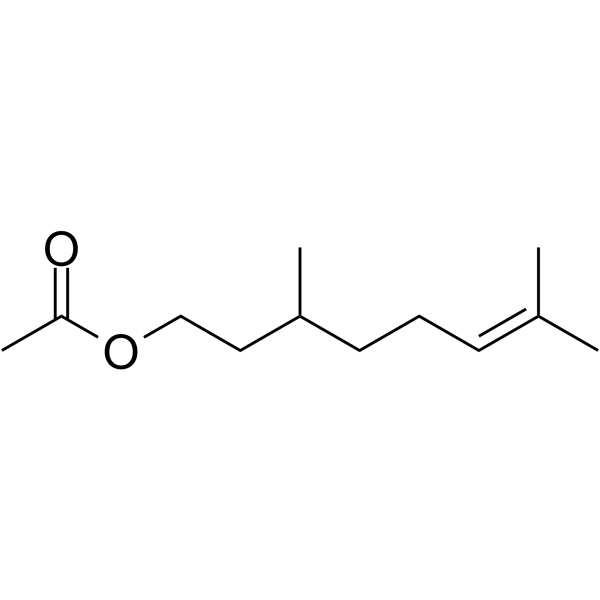
Citronellyl acetate

Based on 1 Customer Validation
Citronellyl acetate, a monoterpene product of the secondary metabolism of plants, is an orally active antinociceptive agent. Citronellyl acetate modulates TRPV1, TRPM8, ASIC, glutamate receptors, PKC, and PKA-mediated nociception. Citronellyl acetate can be used for the research of acute pain.
Nos produits utilisent uniquement pour la recherche. Nous ne vendons pas aux patients.
- Pureté : 98.0%
- CAS No.: 150-84-5
- Formule: C12H22O2
- Masse moléculaire:198.30
-
Stockage:Pure form -20°C, 3 years , 4°C, 2 years ; In solvent -80°C, 6 months , -20°C, 1 month

To place orders, for customer services and technical support, please contact: MedChemExpress USA
Tel: 609-228-6898 E-mail: [email protected] [email protected]


-
 Activité biologique
-
Chemical Information
-
Solvant et solubilité
- Pureté et documentation
- Références
-
 Help & FAQs





Activité biologique
Description
IC50 & Target
[1]|
TRPV1 |
TRPM8 |
Cellular Effect
|
Cell Line

|
Type | Value | Description | References |
|---|---|---|---|---|
| HEK293 | EC50 |
12.2 μM
Compound: 3a
|
Agonist activity at rat TRPA1 expressed in HEK293 cells assessed as increase in intracellular Ca2+ concentration by Fluo-4-AM dye based spectrofluorimetry
Agonist activity at rat TRPA1 expressed in HEK293 cells assessed as increase in intracellular Ca2+ concentration by Fluo-4-AM dye based spectrofluorimetry
|
[PMID: 25455494] |
| HEK293 | IC50 |
>100 μM
Compound: 3a
|
Antagonist activity against human TRPV1 expressed in HEK293 cells assessed as inhibition of capsaicin-induced increase in intracellular Ca2+ concentration by Fluo-4-AM dye based spectrofluorimetry
Antagonist activity against human TRPV1 expressed in HEK293 cells assessed as inhibition of capsaicin-induced increase in intracellular Ca2+ concentration by Fluo-4-AM dye based spectrofluorimetry
|
[PMID: 25455494] |
| HEK293 | IC50 |
>100 μM
Compound: 3a
|
Antagonist activity against rat TRPA1 expressed in HEK293 cells assessed as inhibition of AITC-induced increase in intracellular Ca2+ concentration by Fluo-4-AM dye based spectrofluorimetry
Antagonist activity against rat TRPA1 expressed in HEK293 cells assessed as inhibition of AITC-induced increase in intracellular Ca2+ concentration by Fluo-4-AM dye based spectrofluorimetry
|
[PMID: 25455494] |
| HEK293 | IC50 |
>100 μM
Compound: 3a
|
Antagonist activity against rat TRPM8 expressed in HEK293 cells assessed as inhibition of icilin-induced increase in intracellular Ca2+ concentration by Fluo-4-AM dye based spectrofluorimetry
Antagonist activity against rat TRPM8 expressed in HEK293 cells assessed as inhibition of icilin-induced increase in intracellular Ca2+ concentration by Fluo-4-AM dye based spectrofluorimetry
|
[PMID: 25455494] |
In Vivo
Citronellyl acetate (100-200 mg/kg; p.o.; single dose; 30 or 60 minutes pre-formalin) produces significant antinociception in both the neurogenic and inflammatory phases of the formalin-induced paw-licking model[1].
Citronellyl acetate (100-200 mg/kg; p.o.; single dose; 30 or 60 minutes pre-glutamate) inhibits glutamate-induced nociceptive behavior, indicating involvement of glutamate receptors in its antinociceptive mechanism[1].
Citronellyl acetate (100-200 mg/kg; p.o.; single dose; 30 or 60 minutes pre-capsaicin) inhibits TRPV1-mediated nociception induced by Capsaicin (HY-10448)[1].
Citronellyl acetate (100-200 mg/kg; p.o.; single dose; 30 or 60 minutes pre-menthol) inhibits TRPM8-mediated nociception induced by menthol[1].
Citronellyl acetate (100-200 mg/kg; p.o.; single dose; 30 or 60 minutes pre-acidified saline) inhibits ASIC-mediated nociception induced by acidified saline[1].
Citronellyl acetate (200 mg/kg; p.o.; single dose; 30 or 60 minutes pre-PMA) inhibits PKC-mediated nociception induced by PMA (HY-18739)[1].
Citronellyl acetate (200 mg/kg; p.o.; single dose; 30 or 60 minutes pre-8-Br-cAMP) inhibits PKA-mediated nociception induced by 8-Br-cAMP (HY-12306A)[1].
MedChemExpress (MCE) has not independently confirmed the accuracy of these methods. They are for reference only.
-
Animal Model:Swiss mice with Acetic acid -induced writhing model (male, 4+ weeks old, 26-32 g)[1]
-
Dosage:25, 50, 75, 100, 200 mg/kg
-
Administration:i.g.; single dose; 30-360 minutes pre-acetic acid
-
Result:Determined an ED50 of 74.42 mg/kg for antinociceptive activity.
Reduced the number of writhings at 100 and 200 mg/kg.
Exhibited antinociceptive effects from 30 to 240 minutes post-administration at 200 mg/kg, with maximum effect between 60-120 minutes.
-
Animal Model:Swiss mice with Formalin-induced paw-licking model (male, 4+ weeks old, 26-32 g)[1]
-
Dosage:100 mg/kg; 200 mg/kg
-
Administration:P.o.; single dose; 30 or 60 minutes pre-formalin
-
Result:Reduced early phase paw-licking time to 44.63 ± 4.910 seconds at 100 mg/kg.
Reduced late phase paw-licking time to 11.63 ± 2.976 seconds at 100 mg/kg.
Reduced early phase paw-licking time to 44.38 ± 3.836 seconds at 200 mg/kg.
Reduced late phase paw-licking time to 9.875 ± 2.083 seconds at 200 mg/kg.


Chemical Information
-
CAS No. 150-84-5
-
Appearance Liquid (Density: 0.891 g/cm3)
-
Masse moléculaire 198.30
-
Formule C12H22O2
-
Color Colorless to light yellow
-
SMILES
C/C(C)=C\CCC(C)CCOC(C)=O
-
Structure Classification
-
Initial Source
-
Livraison
Room temperature in continental US; may vary elsewhere.
-
Stockage
Pure form -20°C 3 years 4°C 2 years In solvent -80°C 6 months -20°C 1 month


Solvant et solubilité
In Vitro:
DMSO : 100 mg/mL (504.29 mM; Need ultrasonic; Hygroscopic DMSO has a significant impact on the solubility of product, please use newly opened DMSO)
Please refer to the solubility information to select the appropriate solvent. Once prepared, please aliquot and store the solution to prevent product inactivation from repeated freeze-thaw cycles.
Storage method and period of stock solution: -80°C, 6 months; -20°C, 1 month. When stored at -80°C, please use it within 6 months. When stored at -20°C, please use it within 1 month.
Please refer to the solubility information to select the appropriate solvent. Once prepared, please aliquot and store the solution to prevent product inactivation from repeated freeze-thaw cycles.
Storage method and period of stock solution: -80°C, 6 months; -20°C, 1 month. When stored at -80°C, please use it within 6 months. When stored at -20°C, please use it within 1 month.
Concentration (start) × Volume (start) = Concentration (final) × Volume (final)
In Vivo:
Select the appropriate dissolution method based on your experimental animal and administration route.
- For the following dissolution methods, please ensure to first prepare a clear stock solution using an In Vitro approach and then sequentially add co-solvents:
- To ensure reliable experimental results, the clarified stock solution can be appropriately stored based on storage conditions. As for the working solution for In Vivo experiments, it is recommended to prepare freshly and use it on the same day.
- The percentages shown for the solvents indicate their volumetric ratio in the final prepared solution. If precipitation or phase separation occurs during preparation, heat and/or sonication can be used to aid dissolution.
Add each solvent one by one: 10% DMSO 40% PEG300 5% Tween-80 45% Saline
Solubility: ≥ 2.5 mg/mL (12.61 mM); Clear solution
This protocol yields a clear solution of ≥ 2.5 mg/mL (saturation unknown).
Taking 1 mL working solution as an example, add 100 μL DMSO stock solution (25.0 mg/mL) to 400 μL PEG300, and mix evenly; then add 50 μL Tween-80 and mix evenly; then add 450 μL Saline to adjust the volume to 1 mL.
Preparation of Saline: Dissolve 0.9 g sodium chloride in ddH₂O and dilute to 100 mL to obtain a clear Saline solution.
Add each solvent one by one: 10% DMSO 90% (20% SBE-β-CD in Saline)
Solubility: ≥ 2.5 mg/mL (12.61 mM); Clear solution
This protocol yields a clear solution of ≥ 2.5 mg/mL (saturation unknown).
Taking 1 mL working solution as an example, add 100 μL DMSO stock solution (25.0 mg/mL) to 900 μL 20% SBE-β-CD in Saline, and mix evenly.
Preparation of 20% SBE-β-CD in Saline (4°C, storage for one week): 2 g SBE-β-CD powder is dissolved in 10 mL Saline, completely dissolve until clear.
In Vivo Dissolution Calculator
Please enter the basic information of animal experiments:
-
-
-
-
Recommended: Prepare an additional quantity of animals to account for potential losses during experiments.
Please enter your animal formula composition:
-
%DMSO +
Recommended: Keep the proportion of DMSO in working solution below 2% if your animal is weak.
-
%+
-
+%Tween-80 + +
-
%Saline +
The co-solvents required include: DMSO, . All of co-solvents are available by MedChemExpress (MCE). , Tween 80. All of co-solvents are available by MedChemExpress (MCE).
Working solution concentration: 0.22 mg/mL
Method for preparing stock solution: mg drug dissolved in μL DMSO. Stock solution concentration: mg/mL.
1. Take μL DMSO stock solution;
2. Add μL .
μL , mix evenly;
3. Then add μL Tween 80, mix evenly;
4. Then add μL
Please ensure that the stock solution in the first step is dissolved to a clear state, and add co-solvents in sequence. You can use ultrasonic heating (ultrasonic cleaner, recommended frequency 20-40 kHz), vortexing, etc. to assist dissolution.


Pureté et documentation
-
Fiche technique (269 KB)
-
SDS (761 KB)
- English - EN (761 KB)
- Français - FR (761 KB)
- Deutsch - DE (761 KB)
- Norwegian - NO (761 KB)
- Español - ES (761 KB)
- Swedish - SV (761 KB)
- Italian - IT (761 KB)
- Korean - KR (761 KB)
- Portuguese - PT (761 KB)
-
Instruction de manipulation (2659 KB)
Références


Complete Stock Solution Preparation Table
Please refer to the solubility information to select the appropriate solvent. Once prepared, please aliquot and store the solution to prevent product inactivation from repeated freeze-thaw cycles.
Storage method and period of stock solution: -80°C, 6 months; -20°C, 1 month. When stored at -80°C, please use it within 6 months. When stored at -20°C, please use it within 1 month.
| Optional Solvent | Concentration Solvent Mass | 1 mg | 5 mg | 10 mg | 25 mg |
|---|---|---|---|---|---|
| DMSO | 1 mM | 5.0429 mL | 25.2143 mL | 50.4286 mL | 126.0716 mL |
| 5 mM | 1.0086 mL | 5.0429 mL | 10.0857 mL | 25.2143 mL | |
| 10 mM | 0.5043 mL | 2.5214 mL | 5.0429 mL | 12.6072 mL | |
| 15 mM | 0.3362 mL | 1.6810 mL | 3.3619 mL | 8.4048 mL | |
| 20 mM | 0.2521 mL | 1.2607 mL | 2.5214 mL | 6.3036 mL | |
| 25 mM | 0.2017 mL | 1.0086 mL | 2.0171 mL | 5.0429 mL | |
| 30 mM | 0.1681 mL | 0.8405 mL | 1.6810 mL | 4.2024 mL | |
| 40 mM | 0.1261 mL | 0.6304 mL | 1.2607 mL | 3.1518 mL | |
| 50 mM | 0.1009 mL | 0.5043 mL | 1.0086 mL | 2.5214 mL | |
| 60 mM | 0.0840 mL | 0.4202 mL | 0.8405 mL | 2.1012 mL | |
| 80 mM | 0.0630 mL | 0.3152 mL | 0.6304 mL | 1.5759 mL | |
| 100 mM | 0.0504 mL | 0.2521 mL | 0.5043 mL | 1.2607 mL |


Citronellyl acetate Related Classifications
HY-N7144A Related Classifications
 Powered by Bioz