



Cy3-dCTP

Based on 1 Customer Validation
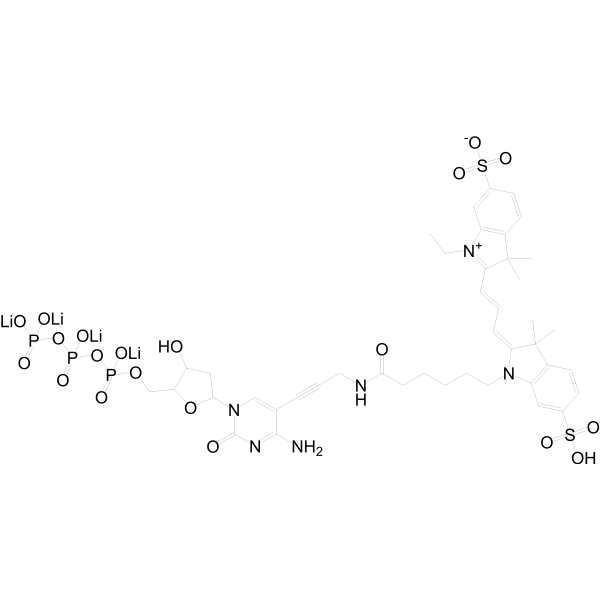
Cy3-dCTP is a directly fluorescently labeled deoxyribonucleotide, in which Cy3 is a cyanine fluorescent dye. Cy3-dCTP is used for direct enzymatic labeling of DNA and cDNA: with the aid of DNA polymerases, this modified nucleotide is incorporated into the extending DNA strand during processes such as reverse transcription, PCR, nick translation or random primer labeling.
For research use only. We do not sell to patients.
- Purity : 98.70%
- Formula: C43H51Li4N6O20P3S2
- Molecular Weight:1156.71
-
Storage:
Solution, -20°C, protect from light, 2 years

To place orders, for customer services and technical support, please contact: MedChemExpress USA
Tel: 609-228-6898 E-mail: [email protected] [email protected]


-
 Biological Activity
-
Chemical Information
- Protocols
- Purity & Documentation
- References
-
 Help & FAQs





Biological Activity
Description
In Vitro
Guide (The following is our recommended protocol. This protocol is only a guide and should be modified according to your specific needs).
While specific steps vary by application, a standard direct labeling protocol (e.g., for microarrays or FISH) generally follows these stages:
1. Reaction Setup
1.1 Mix the DNA or RNA template with primers (e.g., oligo dT or random hexamers).
1.2 Prepare a dNTP mix where a portion of the natural dCTP is replaced by Cy3-dCTP.
1.3 Recommended Ratio: A common ratio is 30–50% Cy3-dCTP to 50–70% unlabeled dCTP to balance labeling efficiency with enzyme processivity.
2. Enzymatic Incorporation
2.2 Add the appropriate enzyme (e.g., Klenow fragment for DNA, Reverse Transcriptase for RNA, or Taq polymerase for PCR).
2.3 Incubate at the enzyme's optimal temperature (e.g., 37°C for Klenow/RT or cycling for PCR).
3. Stopping and Purification:
3.1 Stop the reaction using EDTA (HY-Y0682) or heat inactivation.
3.2 Crucial Step: Remove unincorporated nucleotides using a spin column, ethanol precipitation, or centrifugal filters. This is essential to minimize background fluorescence during downstream applications.
4. Analysis:
4.1 Measure the concentration and labeling efficiency (dye incorporation) using a spectrophotometer like a NanoDrop.
4.2 Read absorbance at 260 nm (DNA) and 550 nm (Cy3).
MedChemExpress (MCE) has not independently confirmed the accuracy of these methods. They are for reference only. Further protocols information, click here.


Chemical Information
-
Appearance Liquid
-
Molecular Weight 1156.71
-
Formula C43H51Li4N6O20P3S2
-
Color Pink to red
-
SMILES
O=S(C1=CC2=C(C=C1)C(C)(C)C(/C=C/C=C3N(CCCCCC(NCC#CC4=CN(C5OC(COP(OP(OP(O[Li])(O[Li])=O)(O[Li])=O)(O[Li])=O)C(O)C5)C(N=C4N)=O)=O)C6=C(C=CC(S(=O)(O)=O)=C6)C/3(C)C)=[N+]2CC)([O-])=O
-
Shipping
Room temperature in continental US; may vary elsewhere.
-
Storage
Solution, -20°C, protect from light, 2 years

Protocols
-
RT-PCR
Reverse transcription technology uses RNA as a template to synthesize DNA. RT-PCR is simple, specific and sensitive, and can be used to detect gene expression levels and expression differences in cells; detect RNA virus content; clone cDNA sequences of specific genes.


Purity & Documentation
-
Data Sheet (273 KB)
-
SDS (251 KB)
- English - EN (251 KB)
- Français - FR (251 KB)
- Deutsch - DE (251 KB)
- Norwegian - NO (251 KB)
- Español - ES (251 KB)
- Swedish - SV (251 KB)
- Italian - IT (251 KB)
- Korean - KR (251 KB)
- Portuguese - PT (251 KB)
-
Handling Instructions (2659 KB)
References
[1]. Yurov YB, et al. High resolution multicolor fluorescence in situ hybridization using cyanine and fluorescein dyes: rapid chromosome identification by directly fluorescently labeled alphoid DNA probes. Hum Genet. 1996;97(3):390-398. [Content Brief]
[2]. Li K, et al. Highly Ordered DNA Framework Interface Enables Efficient Enzymatic Oligonucleotide Synthesis. Adv Sci (Weinh). 2025;12(44):e05868. [Content Brief]

Calculators
Concentration (start) × Volume (start) = Concentration (final) × Volume (final)


Cy3-dCTP Related Classifications
HY-D1725 Related Classifications
 Powered by Bioz
Keywords
- Cy3-dCTP
- Fluorescent Dye
- DNA Stain
- deoxycytidine triphosphate
- fluorescence resonance energy transfer
- fluorescence in situ hybridization
- human chromosomal DNA sequences
- DNA probes
- Zonotrichia albicollis terminal deoxynucleotidyl transferase
- metaphase cells
- trisomy 21
- PDMS interfaces
- interphase cells
- Inhibitor
- inhibitor
- inhibit