



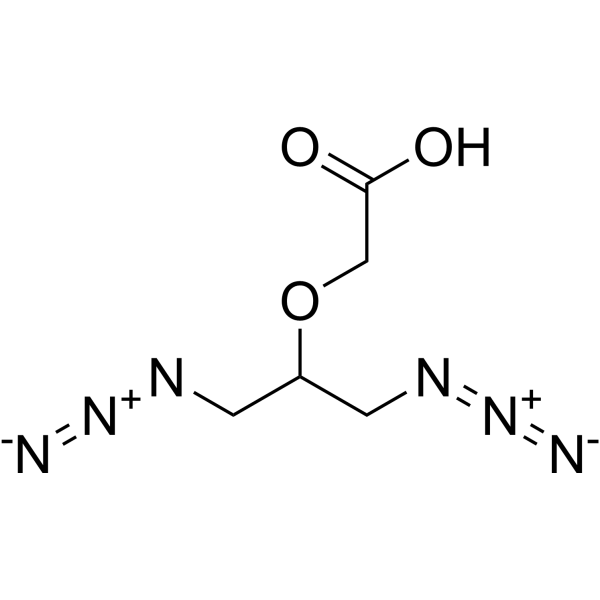
DAPOA
DAPOA is a click chemistry reagent containing an azide group. DAPOA can be used in peptide synthesis as a linker that can be further modified at the azido-groups using Staudinger ligation or click-chemistry. It contains an azide group and can undergo copper-catalyzed azide-alkyne cycloaddition (CuAAc) with molecules containing alkyne groups. It can also undergo ring strain-promoted alkyne-azide cycloaddition (SPAAC) with molecules containing DBCO or BCN groups.
For research use only. We do not sell to patients.
- CAS No.: 2389064-43-9
- Formula: C5H8N6O3
- Molecular Weight:200.16
-
Storage:
Please store the product under the recommended conditions in the Certificate of Analysis.

To place orders, for customer services and technical support, please contact: MedChemExpress USA
Tel: 609-228-6898 E-mail: [email protected] [email protected]


-
 Biological Activity
-
Chemical Information
- Protocols
- Purity & Documentation
- References
-
 Help & FAQs




Biological Activity
Description


Chemical Information
-
CAS No. 2389064-43-9
-
Molecular Weight 200.16
-
Formula C5H8N6O3
-
SMILES
[N-]=[N+]=NCC(CN=[N+]=[N-])OCC(O)=O
-
Shipping
Room temperature in continental US; may vary elsewhere.
-
Storage
Please store the product under the recommended conditions in the Certificate of Analysis.


Purity & Documentation
References

Calculators
Concentration (start) × Volume (start) = Concentration (final) × Volume (final)


DAPOA Related Classifications
HY-151783 Related Classifications
 Powered by Bioz